🪐 Good News for Chitra Paksha / Lahiri Ayanamsa Users: Introducing GNSA — A Galactic Nuclear-System Ayanamsa
An independently derived physical sidereal reference, remarkable modern continuity with Chitra Paksha after J2000 phase binding, and a live six-language Panchang & Jyotish application
For users of Chitra Paksha Ayanamsa / Lahiri Ayanamsa, there is an interesting new result.
A new ayanamsa called GNSA — Galactic Nuclear-System Ayanamsa has been constructed from a physical Galactic nuclear-system reference, rather than by starting from an existing ayanamsa or fitting a new model to Chitra Paksha.
Then something remarkable happens.
When that independently defined astronomical transport is given an explicit Chitra Paksha phase binding at J2000, the resulting Jyotisha realization — GNSA-JP1 — remains sub-arcsecond close to Chitra Paksha over the tested modern period.
That does not mean GNSA independently proves the inherited absolute zodiac zero of Chitra Paksha.
But it does mean something worth examining:
an independently derived physical Galactic transport, after one explicit J2000 phase binding, shows remarkably strong modern continuity with Chitra Paksha.
And this is not only a scientific package.
There is already working software.
Panchang. Rasi. Navamsa. Vimshottari Dasha. Transits. Six languages. One standalone browser application.
🔬 First, the scientific status
GNSA — Galactic Nuclear-System Ayanamsa — has been admitted under the declared SOR v2 project contract: ADMIT_GNSA.
The scientific and software chain is:
independent Galactic reference -> ADMIT_GNSA -> GNSA-JP1 -> SSM-JA-GNSA
GNSA defines the physical sidereal reference and deterministic transport.
GNSA-JP1 provides the explicit Jyotisha phase realization.
SSM-JA-GNSA turns that realization into a usable Panchang and Jyotish application.
Outside-party end-to-end replication remains:
OPEN_NOT_YET_CONFIRMED
So ADMIT_GNSA is a bounded project admission under the declared SOR v2 project contract.
It is not a claim that GNSA is universally or uniquely correct.
That distinction matters.
🪔 Try GNSA-JP1 Panchang & Jyotish Software Now
Launch SSM-JA-GNSA v0.4.1 — Live Panchang & Jyotish Software
Open the same frozen application directly in your preferred language:
All six links open the same frozen SSM-JA-GNSA v0.4.1 application. Only the presentation language changes.
🌟 Why This May Be Especially Interesting to Chitra Paksha / Lahiri Ayanamsa Users
The most important scientific distinction is simple:
GNSA was not created by fitting itself to Chitra Paksha.
GNSA begins with an independently defined physical Galactic nuclear-system direction and deterministic IAU 2006/P03 transport.
Only afterward does GNSA-JP1 introduce the Jyotisha phase.
Its frozen J2000 realization is:
A_JP1(J2000 TT) = 23.8570923254552 deg
with:
gamma_JP1 = 242.99462849792616 deg
and:
A_JP1(t) = wrap360(G_GNSA(t) - gamma_JP1)
The J2000 phase provenance is the standard Chitra Paksha Ayanamsa / Lahiri Ayanamsa phase used in the declared historical research environment.
So the experiment becomes:
What happens if an independently defined Galactic transport is given one Chitra Paksha phase binding at J2000 — and then evolves according to its own transport law?
The result over the tested modern period is:
sub-arcsecond differential continuity.
That is the interesting part.
The result does not say:
GNSA independently proves the absolute Chitra Paksha zodiac zero
It says something narrower:
independent GNSA transport + one J2000 Chitra Paksha phase binding -> tested modern sub-arcsecond continuity
For users of Chitra Paksha Ayanamsa / Lahiri Ayanamsa, that is a result worth examining.
🔭 How Close Is GNSA-JP1 in an Actual Chart?
Consider one worked comparison:
13 August 2026 — 09:00:00 PM — New Delhi
Lagna
GNSA-JP1
8°19'40" Pisces
Chitra Paksha
8°19'42" Pisces
Displayed difference:
approximately 2 arcseconds
This is the displayed Lagna difference in this worked application comparison, not the GNSA-JP1 versus Chitra Paksha ayanamsa differential itself.
In ordinary chart presentation, the displayed difference is extremely small.
Vimshottari Dasha gives us another perspective.
Vimshottari Maha Dasha comparison
+--------------------------+----------------------+----------------------+------------+
| Boundary                 | GNSA-JP1             | Chitra Paksha        | Difference |
+--------------------------+----------------------+----------------------+------------+
| Ketu Maha Dasha start    | 22 Dec 2021 08:17:57 | 22 Dec 2021 07:28:12 | 00:49:45   |
| Ketu Maha Dasha end      | 22 Dec 2028 03:22:04 | 22 Dec 2028 01:28:12 | 01:53:52   |
| Mercury Maha Dasha start | 23 Dec 2124 18:01:16 | 23 Dec 2124 01:28:12 | 16:33:04   |
| Mercury Maha Dasha end   | 24 Dec 2141 02:36:58 | 23 Dec 2141 07:28:12 | 19:08:46   |
+--------------------------+----------------------+----------------------+------------+
One practical way to think about this example is:
very small displayed Lagna difference -> very similar visible chart placement in this example
while, separately:
long-horizon Vimshottari Dasha realization -> boundary times may separate by hours
The example is illustrative rather than a universal bound.
Exact differences depend on the chart input, Moon position, Dasha boundary being examined, and the respective ayanamsa transport.
🌅 Observational Continuity
SSM-JA-GNSA was also checked against published sunrise and sunset reference values across consecutive dates and geographically distributed locations. Sunrise and sunset calculations are ayanamsa-independent in this application architecture, so these values remain unchanged under the GNSA-JP1 realization.
Two concrete examples follow.
📊 A Concrete Nine-Day Sunrise & Sunset Check
One useful continuity witness comes from Chicago, Illinois, USA, across 15 May 2026 -> 23 May 2026.
SSM-JA-GNSA sunrise and sunset values were compared with values published by timeanddate.com and retrieved after the corresponding dates had passed. These comparison values are treated as post-event published reference values, not as independently confirmed physical observations unless the publishing source explicitly states that status.
Sunrise
+-------------+-------------+---------------------+
| Date        | SSM-JA-GNSA | Published Reference |
+-------------+-------------+---------------------+
| 15 May 2026 | 05:30:31 AM | 05:30 AM            |
| 16 May 2026 | 05:29:32 AM | 05:29 AM            |
| 17 May 2026 | 05:28:35 AM | 05:28 AM            |
| 18 May 2026 | 05:27:39 AM | 05:27 AM            |
| 19 May 2026 | 05:26:45 AM | 05:26 AM            |
| 20 May 2026 | 05:25:53 AM | 05:25 AM            |
| 21 May 2026 | 05:25:02 AM | 05:24 AM            |
| 22 May 2026 | 05:24:14 AM | 05:24 AM            |
| 23 May 2026 | 05:23:27 AM | 05:23 AM            |
+-------------+-------------+---------------------+
Sunset
+-------------+-------------+---------------------+
| Date        | SSM-JA-GNSA | Published Reference |
+-------------+-------------+---------------------+
| 15 May 2026 | 08:03:39 PM | 08:04 PM            |
| 16 May 2026 | 08:04:40 PM | 08:05 PM            |
| 17 May 2026 | 08:05:40 PM | 08:06 PM            |
| 18 May 2026 | 08:06:39 PM | 08:07 PM            |
| 19 May 2026 | 08:07:38 PM | 08:08 PM            |
| 20 May 2026 | 08:08:36 PM | 08:08 PM            |
| 21 May 2026 | 08:09:33 PM | 08:09 PM            |
| 22 May 2026 | 08:10:29 PM | 08:10 PM            |
| 23 May 2026 | 08:11:25 PM | 08:11 PM            |
+-------------+-------------+---------------------+
The objective is not bit-identical agreement with another service.
The useful observation is that the standalone deterministic release preserves a smooth, reproducible progression across consecutive astronomical states.
same release + consecutive dates -> coherent deterministic continuity
🌏 Six-City India Observational Witness
A second check looked at geographically distributed Indian locations on 28 May 2026, comparing SSM-JA-GNSA sunrise and sunset values with values published on India Meteorological Department Regional Meteorological Centre (RMC) live portals.
These RMC values are treated as official live-portal published values, not as independently confirmed physical observations unless the relevant RMC or IMD source explicitly states that status.
Sunrise
+-----------+-------------+--------------------+
| Location  | SSM-JA-GNSA | RMC Published      |
+-----------+-------------+--------------------+
| New Delhi | 05:24:49 AM | 05:25:00 AM        |
| Chennai   | 05:41:30 AM | 05:42:00 AM        |
| Kolkata   | 04:52:19 AM | 04:52:00 AM        |
| Mumbai    | 06:01:08 AM | 06:01:00 AM        |
| Nagpur    | 05:32:05 AM | 05:32:00 AM        |
| Guwahati  | 04:31:51 AM | 04:32:00 AM        |
+-----------+-------------+--------------------+
Sunset
+-----------+-------------+--------------------+
| Location  | SSM-JA-GNSA | RMC Published      |
+-----------+-------------+--------------------+
| New Delhi | 07:12:06 PM | 07:12:00 PM        |
| Chennai   | 06:30:48 PM | 06:31:00 PM        |
| Kolkata   | 06:15:18 PM | 06:15:00 PM        |
| Mumbai    | 07:10:50 PM | 07:11:00 PM        |
| Nagpur    | 06:49:44 PM | 06:50:00 PM        |
| Guwahati  | 06:08:50 PM | 06:09:00 PM        |
+-----------+-------------+--------------------+
The objective is not bit-identical agreement or formal astronomical certification. The comparison tests cross-regional observational coherence across geographically distributed witnesses.
🌙 Long-Horizon Vimshottari Dasha
Dasha is particularly interesting because small differences at the beginning of a calculation can propagate across decades.
The realization depends on elements including:
- Moon longitude
- Nakshatra placement
- starting Dasha lord
- birth balance
- Dasha arithmetic
- date normalization
- civil-time interpretation
That makes long-horizon Dasha a useful cumulative stability test.
The core observation remains:
same input + same UTC moment + same release -> same Dasha realization
Testing included DST and non-DST regions, high-latitude and future-date cases, historically complex civil-time regions, and neighbouring-region comparisons.
The goal is stable, replayable realization within GNSA’s declared model — not universal agreement with every astrology program.
🕰️ Astana–Tashkent: When a Small Civil-Time Shift Can Move a Dasha Boundary by Months
A long-horizon stress test compared Astana, Kazakhstan and Tashkent, Uzbekistan using the same local date, local time, and declared UTC+5 assumption.
+-----------------+----------+----------------------+-------------------------------+
| Date            | Time     | Location             | GNSA-JP1 Mahadasha End        |
+-----------------+----------+----------------------+-------------------------------+
| 21 May 2098     | 02:30 PM | Astana, Kazakhstan   | 26 November 2214              |
| 21 May 2098     | 02:30 PM | Tashkent, Uzbekistan | 26 November 2214              |
| 01 January 2050 | 09:30 AM | Astana, Kazakhstan   | 16 April 2157                 |
| 01 January 2050 | 09:30 AM | Tashkent, Uzbekistan | 16 April 2157                 |
+-----------------+----------+----------------------+-------------------------------+
Here, UTC+5 is a declared test assumption, not a prediction of future civil-time law.
In comparative testing, changing the civil-time assumption by just one or two hours shifted some century-scale Dasha boundaries by several months — in some cases approaching nine months.
GNSA-JP1, meanwhile, remained internally consistent across both Astana/Tashkent pairs under the same declared UTC+5 assumption.
This does not establish that one implementation is universally correct. It demonstrates how strongly long-horizon Dasha results can depend on civil-time interpretation.
different civil-time assumption -> potentially large long-horizon divergence
declared UTC offset -> reproducible realization
Timezone complexity does not disappear. It becomes visible, replayable, and testable.
Note: The corresponding Chitra Paksha realization falls on the previous civil date in these examples. The GNSA-JP1 and Chitra Paksha Mahadasha boundary times differ by only a matter of hours here, but at these particular long-horizon boundaries that is enough to cross midnight and change the displayed calendar date by one day.
⚙️ How Do I Use GNSA-JP1?
The simplest answer is:
Use SSM-JA-GNSA v0.4.1.
No additional ayanamsa setting is required. The application already contains the frozen GNSA-JP1 realization.
For other Jyotish or astronomical software, exact GNSA-JP1 requires both the frozen J2000 phase and the GNSA time-dependent transport.
The definition is:
sidereal mode = custom/user-defined ayanamsa
reference epoch = J2000 TT
reference JD = 2451545.0 TT
A_JP1(J2000 TT) = 23.8570923254552 deg
gamma_JP1 = 242.99462849792616 deg
transport = GNSA IAU 2006/P03 mean-ecliptic/equinox-of-date transport
A_JP1(t) = wrap360(G_GNSA(t) - gamma_JP1)
This creates an important practical distinction:
built-in Chitra Paksha / Lahiri Ayanamsa != exact GNSA-JP1
and:
custom J2000 offset alone != complete GNSA-JP1
A program that permits only a fixed J2000 offset may reproduce the GNSA-JP1 phase at J2000.
But unless it also implements the same GNSA transport law, it cannot automatically be assumed to reproduce exact GNSA-JP1 at other epochs.
🪐 What Is GNSA Actually Anchored To?
The physical GNSA reference is based on a fixed barycentric ICRS J2000 ray representing the common Galactic nuclear-system direction.
Its deterministic propagation uses GNSA IAU 2006/P03 mean-ecliptic/equinox-of-date transport.
The scientific chain is:
SOR
-> GNSA
-> physical Galactic nuclear-system reference + deterministic transport
-> GNSA-GC0 physical-zero realization
-> GNSA-JP1 explicit Jyotisha phase realization
-> SSM-JA-GNSA v0.4.1 browser implementation
An important point:
GNSA is not a refinement of Chitra Paksha Ayanamsa.
Its physical reference was derived independently.
Likewise, GNSA does not depend on the retained Revati-Ashvini / Zeta Piscium bounded constraint from the earlier SOR research path.
That separation is important because the modern continuity with Chitra Paksha is examined after the GNSA physical transport has been independently defined.
🖼️ GNSA Structural Observatory Architecture
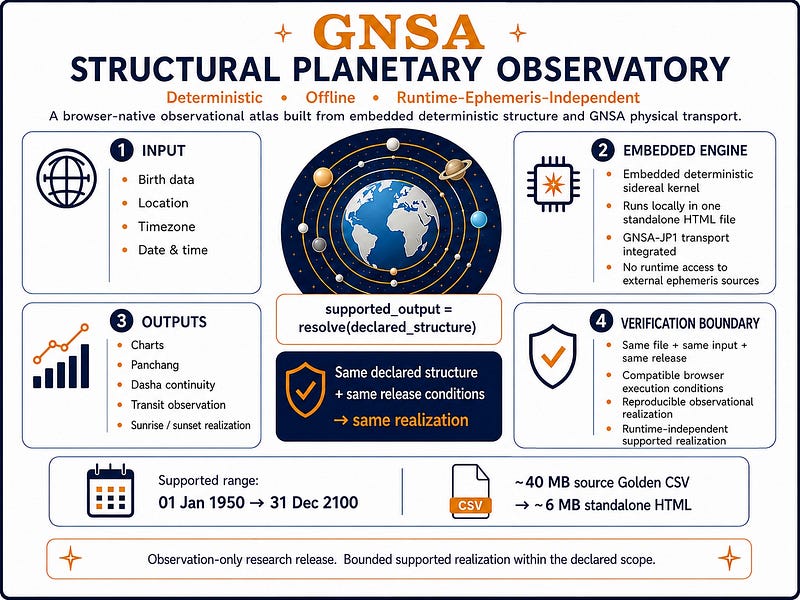
GNSA Structural Planetary Observatory Architecture — the independently defined Galactic nuclear-system reference and deterministic transport lead to the GNSA-JP1 Jyotisha realization, which is resolved inside the standalone SSM-JA-GNSA browser observatory for Panchang, charts, Dasha, transit and reproducible local observation.
The core software principle is:
supported_output = resolve(declared_structure)
and within the frozen release boundary:
same declared structure + same release conditions -> same realization
🪔 What Can SSM-JA-GNSA Actually Do?
SSM-JA-GNSA is a standalone browser-based Panchang and Jyotish observation environment.
The current release includes:
- Panchang
- Rasi chart
- Navamsa chart
- Vimshottari Dasha
- Mahadasha
- Antardasha
- Pratyantardasha
- Sookshma hierarchy
- Transit observation
- Nakshatra
- Moon Nakshatra and Pada
- Yoga
- Karana
- Paksha
- Sunrise and sunset
- Share State replay/import
- JSON export
- Brief and Detailed reports
- Browser print/PDF workflows
- Responsive desktop and mobile presentation
- Browser-side embedded-kernel integrity verification
- A project-assembled atlas containing 3,277 locations
And six presentation languages:
English • Hindi • Kannada • Malayalam • Tamil • Telugu
The supported user input range is:
01 Jan 1950 -> 31 Dec 2100
Dasha timelines can extend beyond the natal-input range because they are resolved forward from the natal Moon structure.
📦 Around 40 MB of Source Data — Around 6 MB as One Application
The GNSA-JP1 application continues the compact deterministic-atlas direction pioneered through SSM-JA.
Approximately:
~40 MB internal source Golden CSV
is distilled into approximately:
~6 MB standalone HTML
The application does not load the guarded source CSV at runtime.
Instead:
source Golden workflow -> compact deterministic kernel -> standalone browser application
The guarded Golden CSV itself is not distributed in the repository.
And it is not required to define GNSA or GNSA-JP1.
The observatory travels as one standalone application.
🌐 Online When You Want It. Fully Local After Download.
SSM-JA-GNSA can be opened directly through GitHub Pages.
But the standalone HTML can also be downloaded and run locally.
For the application itself, there is no runtime dependency on:
- a cloud calculation server
- an external ephemeris API
- an external CSV
- a remote geocoding endpoint
- an account
- a login
The hardened v0.4.1 source contains no runtime path using:
fetch()
XMLHttpRequest
WebSocket
EventSource
sendBeacon
external script URLs
or external stylesheet URLs.
The local execution direction is simple:
one frozen file + user inputs -> local deterministic realization
🔐 Privacy by Architecture
Birth details and chart inputs can be sensitive personal information.
SSM-JA-GNSA does not require a cloud calculation account or remote calculation engine.
Chart, Panchang, Dasha and Transit calculations run locally inside the browser.
Optional saved location presets remain local to the browser.
The design direction is:
local calculation + no runtime calculation service -> user-controlled observation
The software therefore does not need to maintain a central birth-chart database in order to operate.
🧪 What Has Been Verified?
The current primary self-contained application acceptance suite reports:
75/75 PASS
SELF_CONTAINED_APPLICATION_ACCEPTANCE_PASSED
runtime HTTP requests observed = 0
page errors = 0
The suite checks areas including:
- source identity
- frozen GNSA-JP1 constants
- strict offline behavior
- runtime kernel integrity
- exact frozen regression vectors across the supported range
- deterministic replay
- Dasha behavior
- Transit behavior
- Panchang behavior
- six-language behavior
- Share State
- export and print paths
- input boundaries
- retained-receipt consistency
A historical cross-toolchain acceptance receipt is also preserved:
76/76 PASS
including an earlier:
10,000-instant direct cross-toolchain holdout
That historical result remains evidence from its declared research environment. It is not presented as a live rerun by the current primary package.
🧱 No Swiss Ephemeris Runtime Dependency in the Primary Package
Historical GNSA research and selected verification workflows used Swiss Ephemeris / pyswisseph.
But the primary GNSA package does not distribute Swiss Ephemeris or pyswisseph.
And no executable primary-package project Python script imports it.
That separation is deliberate:
historical research toolchain != current primary runtime dependency
Project-generated research receipts can remain part of the scientific evidence record without making the third-party executable library a live dependency of the distributed application.
🔬 What Does ADMIT_GNSA Mean — And What Does It Not Mean?
The current declared status is:
ADMIT_GNSA
under the SOR v2 project contract.
The retained historical SOR v1 verdict remains:
NOT_SCIENTIFICALLY_ESTABLISHED
It has not been rewritten.
Outside-party end-to-end replication remains:
OPEN_NOT_YET_CONFIRMED
So ADMIT_GNSA does not mean:
- universal ayanamsa correctness
- sole correctness
- formal astronomical certification
- outside scientific-community establishment
- predictive validation of sidereal astrology
- proof that every alternative ayanamsa is wrong
It means:
GNSA passed the declared admission contract of the SOR v2 project.
That is the claim.
No more — and no less.
🌟 And What About Chitra Paksha Ayanamsa / Lahiri Ayanamsa?
This boundary deserves repeating because it is central to the result.
GNSA-JP1 does not independently prove the inherited absolute Chitra Paksha Ayanamsa / Lahiri Ayanamsa zodiac zero.
Why?
Because its Jyotisha phase is explicitly bound at J2000 to the Chitra Paksha phase.
What is independently derived is the underlying GNSA physical reference and transport.
So the modern result is:
independent physical GNSA transport
plus:
one explicit J2000 Chitra Paksha phase binding
followed by:
tested modern sub-arcsecond differential continuity
That is a continuity result, not an absolute-zero proof.
For Chitra Paksha users, that distinction does not make the result less interesting.
It makes clear what the result actually shows.
⚠️ What GNSA Does Not Claim
GNSA, GNSA-JP1 and SSM-JA-GNSA do not claim:
- universal or sole ayanamsa correctness
- independent proof of the inherited absolute Chitra Paksha Ayanamsa / Lahiri Ayanamsa phase
- outside-party end-to-end confirmation
- formal astronomical certification
- predictive validation of sidereal astrology
- fortune-telling authority
- medical, legal, financial or professional decision authority
The application is released for calculation, observation, reproducibility, research and educational exploration.
observation before interpretation
calculation before judgment
🌌 Why the Galactic Nuclear System?
Every sidereal realization ultimately needs a declared relationship between a coordinate framework and a reference.
GNSA explores a modern physical route:
Can the Galactic nuclear system itself provide a reproducible physical sidereal reference?
The research direction is therefore not:
find an ayanamsa that happens to match a preferred existing ayanamsa
Instead:
define physical reference -> derive transport -> commit realization -> compare afterward
That order is central to the GNSA scientific story.
Only after the independent physical system exists does GNSA-JP1 ask what happens when the GNSA transport is given an explicit Jyotisha phase.
And that is where the remarkable modern Chitra Paksha continuity emerges.
💡 Two Ideas Come Together in GNSA
There are really two directions being explored at once.
The first is astronomical:
physical Galactic reference -> deterministic sidereal transport
The second is computational:
embedded deterministic structure -> local reproducible Jyotish observation
Together:
physical reference -> deterministic transport -> explicit phase -> offline reproducible realization
The underlying astronomy remains foundational.
But once the standalone application has been constructed, it does not need to consult an external astronomical calculation service every time someone opens a chart.
That changes when the dependency is needed.
It does not pretend that the underlying astronomical foundation never existed.
🚀 Try GNSA-JP1 Yourself
Open the frozen application in your preferred language:
No account.
No installation.
Use it online — or take the same standalone HTML application offline.
🔍 Inspect, Reproduce and Challenge GNSA
The scientific package, GNSA-JP1 authority material, application, verification artifacts and release documentation are public:
GNSA — Galactic Nuclear-System Ayanamsa Repository
The repository includes:
- GNSA scientific authority
- G1/G2 convergence evidence
- GNSA-JP1 phase and transport records
- independent-replication material
- SSM-JA-GNSA software
- application-verification suite
- SHA-256 manifests
- scientific status documentation
- claim boundaries
- reproducibility documentation
Researchers, astronomers, Jyotish practitioners, programmers and reproducibility researchers are invited to:
use it • inspect it • reproduce it • compare it • challenge it
Outside replication remains open.
That is intentional.
A reproducible scientific result becomes more useful when others can independently test it.
🌐 Explore the Wider Shunyaya Ecosystem
GNSA is part of the wider Shunyaya Symbolic Mathematics ecosystem.
Shunyaya Symbolic Mathematics — Master Documentation
The wider ecosystem explores deterministic structure, reproducibility, structural resolution and dependency boundaries across mathematics, computation and observational systems.
For GNSA, the compact expression is:
physical reference -> deterministic transport -> explicit phase -> reproducible observation
✨ Closing Reflection
Users of Chitra Paksha Ayanamsa / Lahiri Ayanamsa have long worked with a familiar sidereal realization in Jyotish.
GNSA asks a very different modern question:
What happens if we independently construct a sidereal reference from the physical Galactic nuclear system — and only afterward give it one explicit Chitra Paksha phase binding at J2000?
Over the tested modern period, the answer is remarkably close.
Sub-arcsecond close.
Not because GNSA was defined as Chitra Paksha.
Not because the transport simply copied Chitra Paksha forward.
But because an independently defined Galactic transport, after one explicit J2000 phase binding, remained remarkably close to Chitra Paksha over the tested modern period.
That does not prove the inherited absolute zodiac zero.
But it does provide a new modern astronomical continuity result that Chitra Paksha Ayanamsa / Lahiri Ayanamsa users may find genuinely worth exploring.
And it is not only a paper result.
You can open the browser and use it.
Panchang. Rasi. Navamsa. Vimshottari Dasha. Transits. Six languages. One standalone file.
🌌 One Galactic Reference. One Explicit Jyotisha Phase. One Reproducible Observatory.
GNSA — Galactic Nuclear-System Ayanamsa
GNSA-JP1 — explicit Jyotisha phase realization
SSM-JA-GNSA v0.4.1 — live six-language Panchang & Jyotish software
independent Galactic reference -> ADMIT_GNSA -> GNSA-JP1 -> SSM-JA-GNSA
Explore it. Compare it. Reproduce it. Challenge it.
Scope: Observation • Education • Research
Outside replication remains open.
OMP


Comments
Post a Comment