🔭 Where Does the Sidereal Zodiac Begin? SOR Starts With Evidence, Not a Selected Ayanamsa
One source-governed Revati-Ashvini / Zeta Piscium bounded origin constraint is now admitted for J2000 — without claiming a universal ayanamsa.
🌌 SOR — Structural Sidereal Origin Resolver
The question sounds simple:
Where does the sidereal zodiac begin?
The natural answer may seem to be:
Choose an ayanamsa.
Enter it into the software.
Calculate the chart.
But that begins after a more fundamental question has already been answered — or assumed:
What evidence supports admitting that origin claim?
An ayanamsa may be familiar.
It may be widely used.
It may produce expected charts.
It may be numerically close to another known value.
But none of those facts, by themselves, establish where the sidereal zodiac begins.
SOR begins with a different principle:
selected ayanamsa != automatically admitted sidereal origin
Instead of selecting a named system first, SOR asks:
- What source statement is being used?
- What coordinate measure does that statement use?
- Which stellar object or system carries the claim?
- How is that carrier realized at a declared epoch?
- Which rules govern the calculation?
- What evidence supports admission?
- Should the result be a point, a region, several alternatives, or no admitted result?
The governing relation is:
origin constraint = admit(source datum, coordinate measure, carrier, frame, epoch, rules, evidence)
The broader idea is simple:
A sidereal origin is not merely selected. It must be structurally supported.
🧭 Why “Choose an Ayanamsa” May Be an Incomplete Starting Point
For a casual reader, an ayanamsa can be understood as the angular offset used to place the sidereal zodiac within a declared astronomical reference.
Different traditions and software systems may use different ayanamsas.
The usual workflow is:
choose ayanamsa -> calculate sidereal positions
SOR moves one step earlier:
examine origin claim -> admit or refuse constraint -> permit later realization
This distinction matters because a named ayanamsa can combine several different assumptions:
- a historical source interpretation;
- a stellar anchor;
- a coordinate convention;
- an epoch;
- a precession model;
- a component-selection rule;
- a software realization policy;
- a rounding policy.
Two values may look similar while being supported by different structures.
Two claims may use the same historical name while relying on different carriers or coordinate measures.
A numerical match alone cannot determine which claim has actually been supported.
SOR therefore separates:
candidate name != source evidence
source value != coordinate measure
carrier identity != astronomical realization
numerical proximity != textual authority
reproducible calculation != automatic scientific admission
one admitted anchor != universal ayanamsa
⭐ What SOR Has Admitted
SOR v4.0.1 C17.3 admits one bounded sidereal-origin constraint.
Recommended software-facing name:
Revati-Ashvini (Zeta Piscium, J2000) — Bounded Origin
The admitted source datum is:
Burgess 1860, Chapter VIII comparative table, Surya-siddhanta branch
The recorded source rule is:
Revati polar longitude = 359 degrees 50 arcminutes
The admitted stellar carrier is:
ZETA_PISCIUM_SYSTEM
The admitted J2000 central region is:
[20.131178133095, 20.137333850983] degrees
The formal catalogue-expanded region is:
[20.131166668488, 20.137436804557] degrees
Within SOR’s declared project-governed admission system:
scientifically_admitted_origin_constraints = 1
scientific_evidence_credit = 1
scientific_state_transition = EXECUTED
project_internal_complete_claim_replication = PASS
cross_implementation_concordance = PASS
This means the project has moved from:
no admitted origin constraint
to:
one admitted single-anchor origin region
It has not moved to:
universal ayanamsa established
or:
global common sidereal origin resolved
The distinction is essential.
🌌 What Does the Result Mean in Simple Terms?
The source records Revati at a polar longitude of:
359 degrees 50 arcminutes
SOR then asks whether that source rule can be consistently connected to the historically identified Zeta Piscium system under a declared astronomical realization at J2000.
The complete structural path is:
source statement -> coordinate measure -> stellar carrier -> J2000 realization -> bounded origin region -> project-governed admission
The result is not presented as one magical degree that every sidereal tradition must adopt.
It is presented as:
One source-governed Revati-Ashvini boundary constraint that has passed the project’s declared admission gates.
That is narrower than a universal ayanamsa claim.
It is also more precise than simply selecting a familiar value from a software menu.
📍 Why Is the Result a Region Instead of One Exact Number?
The historical identification supports the Zeta Piscium system.
Modern catalogues preserve more than one relevant stellar component within that system.
The surviving source precision does not authorize SOR to silently choose one modern component and declare it to be the exact intended point.
SOR therefore applies the rule:
system-level source identification + unresolved component selection -> bounded system region
The central admitted region is approximately:
0.369343 arcminutes wide
Its width primarily reflects the bounded alternatives within the Zeta Piscium system carrier.
SOR does not reduce that structure to an artificial midpoint.
It does not choose the component that produces the most familiar result.
It does not apply a magnitude-weighted proxy and present that proxy as historical authority.
The governing principle is:
insufficient component authority != permission to invent an exact component point
A region can be more honest than a scalar.
It preserves what the evidence supports without pretending that the evidence says more than it does.
📐 The Coordinate Measure Cannot Be Ignored
One of the most important findings in SOR is that the source value is expressed in a polar dhruvaka measure.
That is not automatically identical to barycentric mean-ecliptic longitude.
A number such as 359 degrees 50 arcminutes does not explain its own geometry.
The measure governing that number must also be known.
SOR therefore forbids:
polar source value != barycentric mean-ecliptic longitude
Instead, the stellar state must first be expressed in the measure authorized by the source contract.
The governing relation is:
origin_shift = wrap360(star_polar_longitude - 359.8333333333333 degrees)
This is not a minor formatting detail.
Changing the coordinate measure can change the result.
The same numerical source value interpreted under a different measure becomes a different structural claim.
SOR preserves the separation:
source number != meaning of source number
and:
same number + different measure -> different claim
🧩 What Must Be Declared Before an Origin Can Be Admitted?
SOR treats an origin claim as a collection of independently governed roles.
Source datum
What does the admitted source actually state?
In the current claim:
Revati polar longitude = 359 degrees 50 arcminutes
Coordinate measure
What geometric quantity does that value represent?
In the current claim:
POLAR_DHRUVAKA
Carrier
Which astronomical object carries the historical identification?
In the current claim:
ZETA_PISCIUM_SYSTEM
Frame and epoch
How is the astronomical state realized?
In the current claim:
BARYCENTRIC_MEAN_ECLIPTIC_J2000_REEXPRESSED_AS_POLAR_DHRUVAKA
Realization policy
How are proper motion, stellar components, coordinate conversion, and system alternatives handled?
Evidence
Which source records, catalogue rows, locators, calculation artifacts, and verification receipts support the result?
Admission rules
Which gates must pass before the calculated region receives scientific evidence credit within the project?
The complete relation is:
declared source + declared measure + declared carrier + declared realization + declared rules + admitted evidence -> bounded origin constraint
No single field is allowed to silently authorize all the others.
🛑 A Source Value Does Not Authorize Its Own Interpretation
Suppose a historical table contains a number.
Several questions still remain:
- Is it a longitude, latitude, polar coordinate, arc, offset, or boundary value?
- Which column and textual branch does it belong to?
- Which star or stellar system does it describe?
- Does the source identify a system or one modern component?
- Is a second text independent evidence or merely part of the same source family?
- Does the stated precision support an exact point?
SOR applies a strict separation:
source datum != coordinate interpretation
coordinate interpretation != carrier authorization
carrier authorization != component selection
calculation output != evidence admission
This prevents a modern implementation from silently completing an ancient claim with convenient assumptions.
🔬 Candidate-Neutral Means the Label Does Not Control the Evidence
SOR does not begin with a preferred ayanamsa and search for evidence that makes it look correct.
Its rule is:
candidate label != evidence authority
A claim does not receive credit because:
- it has a respected name;
- it is widely available in software;
- it produces familiar charts;
- it is close to an expected value;
- it agrees with selected life events;
- it resembles the project’s operational profile elsewhere.
The current source, measure, carrier, and realization are evaluated together as one structural claim.
If any governing dependency changes, the new configuration becomes a separate conditional claim:
changed source value -> separate claim
changed coordinate measure -> separate claim
changed carrier -> separate claim
changed frame or epoch -> separate claim
changed component policy -> separate claim
changed realization rule -> separate claim
A conditional calculation does not silently rewrite the admitted result:
conditional evaluation != current finding mutation
This allows alternatives to be explored without confusing them with the presently admitted constraint.
🧬 One Source Family Is Not Multiplied Into Several Independent Votes
Historical sources may repeat, inherit, translate, summarize, or corroborate one another.
Several documents do not necessarily represent several independent origins of evidence.
SOR therefore tracks source genealogy.
Its rule is:
corroborative record != automatically independent source root
For the admitted constraint, the credited source family remains:
SURYA_SIDDHANTA_TEXTUAL_FAMILY
The project does not assign duplicate evidence credit merely because related material appears in more than one preserved record.
This protects the result from artificial evidence inflation.
Ten retellings of one source do not automatically become ten independent witnesses.
✅ Calculation Alone Was Not Enough
A reproducible number did not automatically become an admitted finding.
The first constraint had to pass five project-governed gates:
- Source-boundary authority
- Coordinate-measure adjudication
- Historical-carrier adjudication
- Source-genealogy adjudication
- Project-internal complete-claim replication
All five gates passed for the declared Revati-Ashvini / Zeta Piscium constraint.
The admission relation is therefore:
reproducible calculation + passed structural gates -> project-governed admitted constraint
Not:
calculated number -> automatic scientific authority
This distinction separates computational success from evidentiary admission.
🖼️ SOR Architecture Diagram
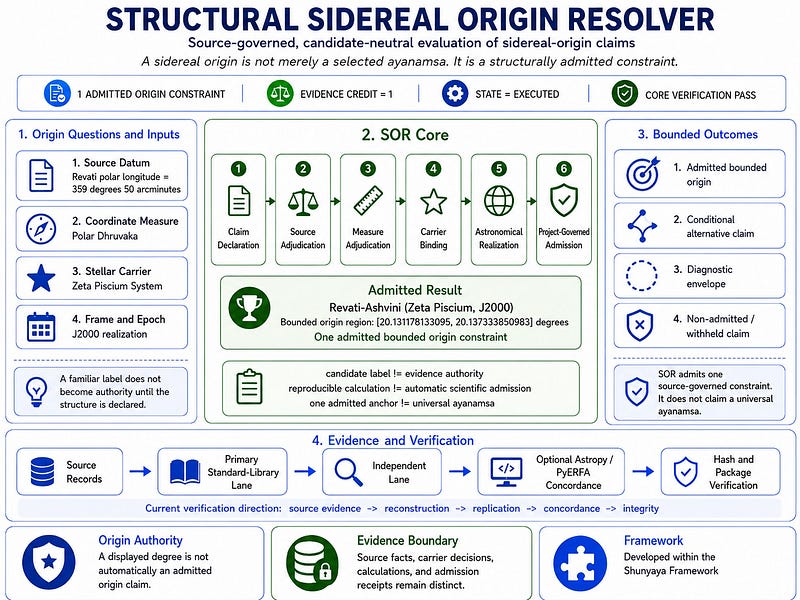
Structural Sidereal Origin Resolver separates the source datum, coordinate measure, stellar carrier, astronomical realization, bounded outcomes, evidence, and verification before admitting a source-governed sidereal-origin constraint.
🌈 Why the Wider Diagnostic Envelope Is Not the Admitted Result
During the investigation, SOR also preserved a historical diagnostic alternative involving an exact-zero source interpretation.
When that alternative is retained together with the strict 359 degrees 50 arcminutes rule and the bounded carrier alternatives, the resulting diagnostic envelope is approximately:
10.369343 arcminutes wide
The admitted strict-source-rule region is only approximately:
0.369343 arcminutes wide
These are different objects.
The wider envelope records unresolved historical alternatives.
It has:
artifact_scientific_evidence_credit = 0
The narrower region uses the admitted strict source rule:
359 degrees 50 arcminutes
It has:
scientific_evidence_credit = 1
SOR does not average the two.
It does not enlarge the admitted result merely because another historical interpretation can be calculated.
It preserves the distinction:
admitted region != diagnostic alternative envelope
Neither object is presented as a conventional statistical confidence interval.
📊 Uncertainty Is Not Treated as One Undifferentiated Number
Several different forms of spread can exist in an origin calculation:
- historical source-rule alternatives;
- stellar-system component alternatives;
- formal catalogue uncertainty;
- implementation differences;
- rounding and display precision.
SOR records these separately.
For the current admitted constraint:
maximum formal catalogue 1 sigma = approximately 0.189102 arcseconds
maximum package-native implementation discrepancy = approximately 0.023881 arcseconds
These quantities are much smaller than the historical exact-zero versus 359 degrees 50 arcminutes source-rule difference.
That difference is structural, not merely numerical noise.
The governing separation is:
historical interpretation spread != catalogue uncertainty != implementation discrepancy
Without this separation, a wide historical disagreement could be misrepresented as astronomical measurement uncertainty.
🔁 Can Another Implementation Reproduce the Complete Claim?
SOR does not rely on one calculation script alone.
The required package contains two separately structured Python standard-library lanes:
REVATI_PRIMARY
and:
REVATI_INDEPENDENT
Each lane reconstructs the complete required claim, including:
- catalogue input;
- epoch propagation;
- ecliptic frame realization;
- polar conversion;
- source-rule application;
- system-region construction.
Their complete-claim concordance passes.
Optional PyERFA and Astropy paths provide additional cross-toolchain comparison when installed.
The required core remains:
Python standard library only
The architectural principle is:
same admitted inputs + same declared contracts + separately structured implementations -> concordant bounded result
This is project-internal multi-implementation replication.
It is not represented as external independent replication or third-party scientific validation.
🧪 Current Verification Status
The published package and repository verification records:
98/98 declared technical files hash-matched
manifest scope = EXACT
required standard-library verification = PASS
frozen package verification = PASS
source-adjudication verification = PASS
numerical verification = PASS
uncertainty verification = PASS
neutral-claim-framework verification = PASS
adversarial falsification verification = PASS
semantic-coherence verification = PASS
optional Astropy and PyERFA concordance = PASS
GitHub Actions verification = PASS at publication
The exact technical hash boundary is:
data/ + json/ + scripts/
Every file within that declared technical scope is covered by the SHA-256 manifest.
Documentation, root files, all content under .github/, the hashes/ folder, and the manifest itself remain outside that technical byte-freeze boundary.
These checks establish reproducibility and integrity within the declared package.
They do not establish universal correctness, professional consensus, third-party peer review, or institutional certification.
⚡ Reproduce the Result
The repository can be cloned with:
git clone https://github.com/OMPSHUNYAYA/SOR.git
Enter the repository with:
cd SOR
Run the complete required standard-library verification with:
python -B scripts/reproduce.py --core
Run the full optional-aware verification with:
python -B scripts/reproduce.py --full
The repository contains the complete verification guide, source locators, catalogue records, coordinate-measure contracts, calculation paths, admission decisions, result artifacts, falsification checks, and integrity manifest.
🔗 How SOR Relates to SSM-JTK and SSM-JA
SOR, SSM-JTK, and SSM-JA address different structural questions.
SOR
SOR asks:
What source-governed bounded sidereal-origin constraints can be admitted?
SOR -> resolves source-governed bounded origin constraints
SSM-JTK
SSM-JTK operates under a declared Chitra Paksha (Lahiri) ayanamsa realization profile.
SSM-JTK -> realizes deterministic sidereal transit-kernel states under its declared profile
SSM-JA
SSM-JA applies the SSM-JTK realization direction within a self-contained browser-native Jyotish atlas.
SSM-JA -> presents deterministic browser-native observation under the declared SSM-JTK realization direction
The Chitra Paksha profile used by SSM-JTK and SSM-JA is an operational realization choice within those systems.
It is not imported into SOR as historical evidence or candidate authority.
The relationship is therefore:
origin-resolution research != operational realization profile != observation interface
The projects can remain connected without merging their claim boundaries.
🔗 Explore SSM-JTK on GitHub
Symbolic Mathematics Jyotish Transit Kernel
🔗 Explore SSM-JA on GitHub
Runtime-Ephemeris-Independent Jyotish Atlas
🌟 Good News for Chitra Paksha / Lahiri Ayanamsa Users: The Later GNSA Result
Since the publication of this SOR result, the Shunyaya research program has continued into a separate line of investigation:
GNSA — Galactic Nuclear-System Ayanamsa
GNSA does not replace the Revati-Ashvini / Zeta Piscium result described in this article.
It asks a different question.
Instead of beginning from a historical stellar-origin claim, GNSA evaluates a separately defined Galactic nuclear-system reference using modern astronomical realization and deterministic transport.
The relationship is:
SOR Revati-Ashvini result != GNSA
earlier admitted bounded constraint != later GNSA project admission
GNSA admission != proof of one universal ayanamsa
The current GNSA research package records:
SOR v2 project-admission status = ADMIT_GNSA
while retaining:
historical SOR v1 verdict = NOT_SCIENTIFICALLY_ESTABLISHED
and:
outside-party end-to-end replication = OPEN_NOT_YET_CONFIRMED
These are intentionally different scientific states.
GNSA establishes its Galactic nuclear-system direction through two declared realization lanes — a compact-radio realization and a stellar-dynamical realization — together with a fixed barycentric ICRS J2000 reference ray and deterministic IAU 2006/P03 transport.
That produces a separately defined astronomical realization.
But an especially interesting result appears when that physical transport is connected to the widely used Chitra Paksha / Lahiri Ayanamsa.
🌟 Why This Is Good News for Chitra Paksha / Lahiri Users
GNSA-JP1 takes the independently defined GNSA transport and performs a single phase binding at J2000 TT to the standard Chitra Paksha / Lahiri realization.
After that one-point phase binding, the differential between the GNSA-JP1 and standard Chitra Paksha / Lahiri realizations remains at sub-arcsecond scale over the tested modern period.
That is a meaningful continuity result.
In simple terms:
independently defined GNSA physical transport
+ Lahiri phase binding at J2000 TT
-> sub-arcsecond modern-period differential
For users who already work with Chitra Paksha / Lahiri Ayanamsa, this is encouraging because the tested comparison shows that the familiar modern Lahiri realization remains operationally very close to the independently defined GNSA transport over the tested period once the two are phase-aligned at J2000.
This supports the modern operational stability and continuity of Chitra Paksha / Lahiri under that comparison.
But the scientific boundary matters.
The result does not mean:
GNSA independently proved the absolute Lahiri zodiac zero
It does not mean:
Lahiri is now established as the uniquely correct universal ayanamsa
And it does not mean:
GNSA-JP1 is simply another name for built-in Lahiri
The correct statement is narrower:
modern sub-arcsecond continuity after J2000 phase binding != independent proof of the absolute Chitra/Lahiri zodiac zero
That distinction is important because the phase relationship and the time-dependent transport are different parts of the problem.
The GNSA transport is physically and computationally defined independently.
The Chitra Paksha / Lahiri phase is then bound at one declared epoch.
The subsequent modern-period agreement tests whether the two realizations continue to track one another closely after that binding.
They do, at sub-arcsecond scale over the tested modern period.
That is why the result can fairly be described as good news for Chitra Paksha / Lahiri Ayanamsa users, while still preserving a strict scientific claim boundary.
The broader architecture is now:
SOR -> source-governed structural origin resolution
GNSA -> separately defined Galactic nuclear-system reference and transport
GNSA-JP1 -> GNSA transport phase-bound to Chitra Paksha / Lahiri at J2000 TT
SSM-JTK -> deterministic sidereal transit-kernel realization
SSM-JA -> browser-native Jyotish observation and Panchang realization
These projects are connected, but their evidence and claim boundaries remain separate.
Readers interested in the full GNSA evidence chain, numerical comparisons, source and rights boundaries, verification artifacts, GNSA-JP1 implementation, and SSM-JA-GNSA realization can explore the dedicated repository:
SOR does claim:
One project-governed, source-governed Revati-Ashvini / Zeta Piscium system J2000 origin constraint has been admitted under the declared coordinate-measure, carrier, calculation, replication, falsification, and evidence boundary.
SOR does not claim:
- one universal or uniquely correct ayanamsa;
- a resolved global common sidereal origin;
- an exact Zeta Piscium component point;
- that one anchor determines every sidereal tradition;
- that chart-event correspondence proves source interpretation;
- that numerical proximity establishes historical identity;
- that internal replication is third-party peer review;
- external independent complete-claim replication;
- institutional scientific certification;
- professional Jyotish authority;
- certified astronomical software status.
The current scientific state is:
SINGLE_ANCHOR_ORIGIN_REGION
Not:
GLOBAL_COMMON_ORIGIN
The result is meaningful precisely because its boundary remains explicit.
🌍 Why Could This Structural Method Matter?
SOR is about sidereal-origin claims, but the deeper pattern is broader.
Many systems begin with a selected constant, reference point, calibration, standard, or authority.
The number is then used repeatedly without preserving the structure that authorized it.
SOR asks a more demanding question:
What must be true before a reference point is allowed to govern later calculations?
The same structural discipline may be useful wherever a result depends on:
- historical source interpretation;
- coordinate or measurement conventions;
- disputed reference points;
- multiple possible physical carriers;
- epoch-sensitive realization;
- inherited evidence;
- competing computational models;
- incomplete or conflicting authority.
The general pattern is:
declared claim structure + evidence + reproducible realization + admission rules -> bounded admitted constraint OR explicit non-result
This does not guarantee that every disputed question will resolve.
It ensures that unresolved structure is not silently replaced by confidence.
🧠 The Larger Structural Idea
A source can contain a number.
A catalogue can contain a coordinate.
Software can produce a precise result.
But these objects do not automatically authorize one another.
SOR separates:
source identity
measure identity
carrier identity
realization identity
result identity
evidence identity
admission identity
This makes it possible to ask:
- Was the correct source branch used?
- Was the coordinate interpreted in the correct measure?
- Was the historical carrier preserved?
- Was component ambiguity handled honestly?
- Were related texts counted only once?
- Did separate implementations reproduce the claim?
- Did the result pass the declared admission gates?
- What remains unverified outside the project?
A displayed degree is only the visible end of the process.
The structural evidence behind it is the larger result.
🌐 Explore SOR
The GitHub repository contains:
- preserved source and catalogue records;
- locator-backed source facts;
- coordinate-measure contracts;
- historical-carrier decisions;
- source-genealogy decisions;
- independently structured calculation paths;
- admitted-region artifacts;
- uncertainty records;
- diagnostic alternative envelopes;
- project-governed admission and state-transition receipts;
- falsification checks;
- conditional claim evaluation;
- SHA-256 integrity records;
- deterministic reproduction workflows.
🔗 Structural Sidereal Origin Resolver on GitHub
The reference implementation and project-authored machine-readable verification artifacts may be used, copied, modified, tested, studied, and redistributed without a license fee, subject to the repository license terms.
Documentation, architecture materials, specifications, diagrams, tutorials, and explanatory content are governed by the separate CC BY-NC 4.0 terms stated in the repository LICENSE.
The included Hipparcos catalogue records remain subject to their separately stated ESA terms and attribution requirements.
🌌 The Larger Question
When someone asks:
Where does the sidereal zodiac begin?
the instinct may be to compare a list of ayanamsas.
SOR asks several questions first:
Which source?
Which source branch?
Which coordinate measure?
Which star or stellar system?
Which modern catalogue realization?
Which frame?
Which epoch?
Which component policy?
Which evidence lineage?
Which admission rules?
Which uncertainty belongs to the source, and which belongs to the catalogue?
Should the result be one point, a bounded region, several conditional alternatives, or no admitted result?
The principle is:
Do not select first and justify later.
declare the claim -> preserve the evidence -> reproduce the realization -> test the gates -> admit only what survives
SOR’s first admitted result is:
Revati-Ashvini (Zeta Piscium, J2000) — Bounded Origin
One source-governed anchor has been admitted within the scientific boundary described in this article.
Subsequent research has also produced the separately published GNSA — Galactic Nuclear-System Ayanamsa, including the GNSA-JP1 modern-continuity result for Chitra Paksha / Lahiri users.
That later work does not retroactively change this article’s Revati-Ashvini result:
earlier SOR finding != later GNSA finding
The universal question remains open.
That is not a weakness.
It is the discipline of preserving the boundary between what has been calculated, what has been admitted, and what has not yet been established.
A sidereal origin is not merely a selected ayanamsa.
It is a structurally admitted constraint.
✍️ Authorship & Disclaimer
Created by the authors of the Shunyaya Framework.
SOR is a bounded research architecture and reference implementation for source-governed, candidate-neutral evaluation of sidereal-origin claims.
It is not a universal ayanamsa authority, certified astronomical system, professional Jyotish authority, institutional scientific certification mechanism, or substitute for independent historical, textual, astronomical, mathematical, and domain-specific review.
The current admitted result is project-governed and computationally self-contained within its declared evidence and verification boundary.
External independent complete-claim replication, third-party peer review, and institutional scientific certification are not claimed.
OMP


Comments
Post a Comment