📩 What If Transport Were Not the Sole Authority Over Message Delivery?
A message is sent.
A network carries it.
A receiver may acknowledge it.
Later, the content may be read or consumed.
But these events are not necessarily the same state.
Structural Integration Leverage (STILE) separates them.
transport_state != structural_delivery_state != consumption_state
Transport may establish movement.
Structure establishes bounded admissibility.
Consumption may establish use.
None of these states is allowed to silently impersonate the others.
🧭 The Structural Shift
STILE asks a narrower question than a messaging protocol:
Is the declared message-delivery structure admissible under a defined profile and versioned rules?
The governing relation is:
structural_delivery_state = resolve(declared_delivery_structure, versioned_rules)
And the core deterministic guarantee is:
same declared structure + same versioned rules -> same structural decision
This does not remove transport.
It does not replace networks.
It creates a separate structural decision layer.
🖼️ STILE v2.1 at a Glance
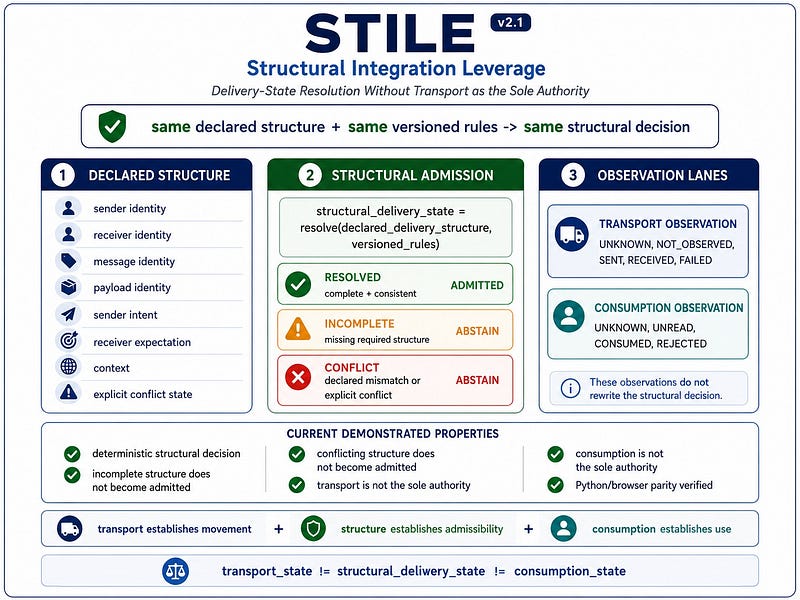
STILE v2.1 separates declared structure, structural admission, transport observation, and consumption observation so that no single operational signal becomes the whole delivery state.
🧱 Three Distinct Lanes
🚚 1. Transport establishes movement
A message may be:
SENT
RECEIVED
FAILED
or simply:
NOT_OBSERVED
These are transport observations.
They tell us something about movement.
They do not automatically determine the structural admission decision.
🛡️ 2. Structure establishes admissibility
STILE evaluates declared message-delivery structure such as:
- sender and receiver identity
- message and expected-message identity
- payload and expected-payload identity
- sender intent and receiver expectation
- context
- explicit conflict state
The resolver then produces one of three outcomes:
complete + consistent -> RESOLVED + ADMITTED
incomplete -> INCOMPLETE + ABSTAIN
conflicting -> CONFLICT + ABSTAIN
The system does not guess.
Missing structure does not become admitted.
Conflicting structure does not become admitted.
👤 3. Consumption establishes use
A message may later be:
UNREAD
CONSUMED
REJECTED
or remain:
UNKNOWN
That is another state entirely.
Receiving something is not necessarily the same as consuming it.
And consuming something is not what creates the earlier structural admission decision.
🔐 Why Separate These States?
Because systems often collapse multiple questions into one:
Did the data move?
Was the declared structure admissible?
Was the content actually used?
STILE keeps those questions separate.
This creates a useful invariant:
transport-only change -> same structural decision
consumption-only change -> same structural decision
The observations may change.
The bounded structural decision does not have to change with them.
🧾 Three Evidence Identities
STILE v2.1 also separates evidence into three SHA-256 identities:
structure_hash
decision_hash
observation_hash
Together, they distinguish:
what was declared
what structural decision followed
what was later observed
That separation makes the model easier to inspect, replay, compare, and independently verify.
⚠️ What STILE Is Not Claiming
STILE does not claim that physical transmission is unnecessary when information must actually move.
It does not prove that bytes reached a remote endpoint.
It does not prove that a person read a message.
It does not make networks, acknowledgements, retries, queues, or messaging systems universally unnecessary.
The claim is deliberately narrower:
Transport observation need not be the sole authority over a bounded structural message-delivery admission decision.
The same applies to later consumption.
✅ A Verifiable Reference Implementation
STILE v2.1 includes both Python and browser reference implementations.
The current verification package reports:
Python conformance -> 25/25 PASS
Browser built-in conformance -> 25/25 PASS
Full browser audit -> 30/30 PASS
Visible demonstration cases -> 8/8 expected
Cross-runtime hash parity -> PASS
The browser reference is self-contained, and the implementation includes frozen SHA-256 identities and automated repository verification.
🌍 Where Could This Matter?
The idea can be explored wherever systems need to distinguish movement from admissibility from later use.
Potential directions include:
- APIs and service integration
- offline-first workflows
- distributed record exchange
- financial coordination
- healthcare data workflows
- IoT state exchange
- disaster-response information systems
These are application directions, not claims that one reference profile already solves every domain.
🔗 Explore STILE v2.1
The complete reference implementation, browser demonstration, verification guide, architecture notes, proof sketch, diagrams, and conformance material are available in the GitHub repository:
STILE — Structural Integration Leverage
For the detailed technical model, implementation, verification results, and licensing terms, explore the repository directly.
⭐ The Core Idea
A transport event and a structural admission decision are not the same thing.
A consumption event and a structural admission decision are not the same thing.
STILE keeps them separate.
transport establishes movement
structure establishes admissibility
consumption establishes use
The deeper question is no longer simply whether a message moved.
It is whether each state is being allowed to speak only for what it actually knows.
OMP


Comments
Post a Comment