🔄 What If Time Passing Did Not Automatically Make a Result Stale?
Re-Evaluating Whether an Established Result Still Holds After Change
A result is often treated as becoming less trustworthy simply because it is older.
A quotation expires.
A supplier recommendation becomes outdated.
An approval may need to be checked again.
A calculation may no longer reflect current conditions.
But elapsed time does not tell us what actually changed.
A result could be 30 days old while every fact that matters to it remains unchanged.
Another result could be only five seconds old when one critical dependency changes and makes it wrong.
Structural Validity Receipt explores a different question:
Does this established result still survive the changes that actually matter to it?
The governing distinction is:
structural age tells how much relevant accepted change occurred
while:
structural validity tells whether the established result survived that change
This allows:
30 days old + zero relevant structural change -> potentially CURRENT
and:
5 seconds old + one invalidating dependency change -> potentially STALE
It also allows something equally important:
relevant change occurred + result still holds -> CURRENT
💡 A Result Can Grow Older Without Becoming Stale
Imagine that a company has evaluated three suppliers.
+------------+-------+----------+
| Supplier   | Price | Eligible |
+------------+-------+----------+
| Supplier A |   120 | Yes      |
| Supplier B |   100 | Yes      |
| Supplier C |   130 | Yes      |
+------------+-------+----------+
The established result is:
Supplier B is the lowest-cost eligible supplier.
Now imagine that 30 days pass.
Has the result become stale?
Chronologically, it is 30 days older.
But that does not tell us whether:
- any supplier price changed;
- any eligibility status changed;
- another supplier became cheaper;
- required information disappeared;
- incompatible evidence appeared.
Time tells us how long ago the result was established.
It does not tell us whether the structure supporting the result still holds.
Structural Validity Receipt therefore separates:
time passing
from:
result-relevant structure changing
and separates both from:
the result becoming invalid
🧠 The Core Idea
Many systems naturally use one of these signals to decide whether a result should be checked again:
- elapsed time;
- a new database version;
- a changed record;
- a later event;
- a global update counter;
- a fresh execution of the entire process.
These signals can be useful.
But they do not all answer the same question.
Structural Validity Receipt, or SVR, separates four different dimensions.
Chronological Age
How much physical time has passed since the result was established?
Global Structural Progression
How much accepted change occurred across the wider bounded system?
SVR represents this through global structural time, or STIME.
Structural Age
How many accepted changes occurred to the declared dependencies that matter to this particular result?
Structural Validity
Does the established result still satisfy its declared validity rule against the current admissible dependency state?
The distinction is:
chronological age != global structural progression
global structural progression != claim-specific structural age
structural age != structural validity
🎯 The Current Reference Question
The current SVR reference implementation uses a deliberately bounded supplier-selection example.
The established result is:
Supplier B is the lowest-cost eligible supplier.
The result depends on exactly six declared fields:
supplier_A.price
supplier_A.eligibility
supplier_B.price
supplier_B.eligibility
supplier_C.price
supplier_C.eligibility
These fields form the declared result-affecting dependency closure for the reference profile.
The current validity rule is:
Supplier B remains CURRENT if Supplier B is eligible and no other eligible supplier has a strictly lower current price.
This is not presented as a universal supplier-selection model.
It is a bounded example that makes the distinction between time, relevant change, structural age, and result survival easy to inspect.
🔄 Relevant Change Does Not Automatically Mean Stale
Suppose Supplier B lowers its price:
Supplier B price: 100 -> 90
This is clearly a relevant change.
It affects one of the declared dependencies behind the established result.
Therefore:
Global STIME +1
and:
Structural Age +1
But Supplier B is still the lowest-cost eligible supplier.
In fact, the established result is now supported even more strongly.
Therefore:
Validity = CURRENT
This is one of SVR’s defining ideas:
A result can experience relevant structural change and still remain current.
The governing relation is:
accepted relevant change -> structural age may increase
but:
structural age increase != automatic invalidation
SVR does not merely watch for change.
It re-evaluates whether the established result survived the change.
🛑 Relevant Change Can Also Make the Result Stale
Now consider a different change:
Supplier B price: 100 -> 150
Supplier A remains eligible at 120.
Again:
Global STIME +1
Structural Age +1
But Supplier B is no longer the lowest-cost eligible supplier.
The established result no longer satisfies its declared validity rule.
Therefore:
Validity = STALE
SVR does not define staleness as:
too much time passed
or:
something somewhere changed
It defines the bounded structural condition as:
the established result no longer survives the current admissible dependency state
🌍 The World Can Change Without This Result Aging
Suppose an employee’s phone number changes.
That may be a real and accepted change within the wider system.
It may advance global structural progression:
Global STIME +1
But the employee’s phone number is not one of the declared dependencies supporting the supplier-selection result.
Therefore:
Structural Age +0
The system changed.
The result did not structurally age.
This preserves an important distinction:
world changed
does not automatically mean:
this result changed
Without that distinction, every global update could force every existing result to appear stale, even when the update had nothing to do with it.
♻️ Repeating the Same Evidence Is Not New Change
Return to the original baseline scenario. Suppose Supplier B’s current price of 100 is received again as an exact duplicate.
Nothing new has been accepted.
Under the current reference model:
duplicate -> no global STIME advance
duplicate -> no structural age advance
duplicate -> no dependency-state mutation
Repeated messages, retries, synchronizations, or replays therefore cannot make a result structurally older merely by repeating evidence that is already present.
⚠️ Missing and Conflicting Evidence Stay Visible
A system should not declare a result CURRENT or STALE when the required structure cannot support either answer.
The current SVR states are:
CURRENT
STALE
INCOMPLETE
CONFLICT
UNSUPPORTED
Consider incompatible evidence for the same current supplier price.
One source says:
Supplier B price = 100
Another supported source says:
Supplier B price = 150
SVR does not silently choose one value.
It returns:
CONFLICT
If a required eligibility field is missing, SVR does not pretend that the supplier is eligible or ineligible.
It returns:
INCOMPLETE
The current precedence is:
unresolved conflict -> CONFLICT
else missing required dependency -> INCOMPLETE
else validity invariant holds -> CURRENT
else -> STALE
The goal is not to force every situation into a convenient answer.
The goal is to preserve what the available structure can — and cannot — support.
🖼️ Structural Validity Receipt Architecture
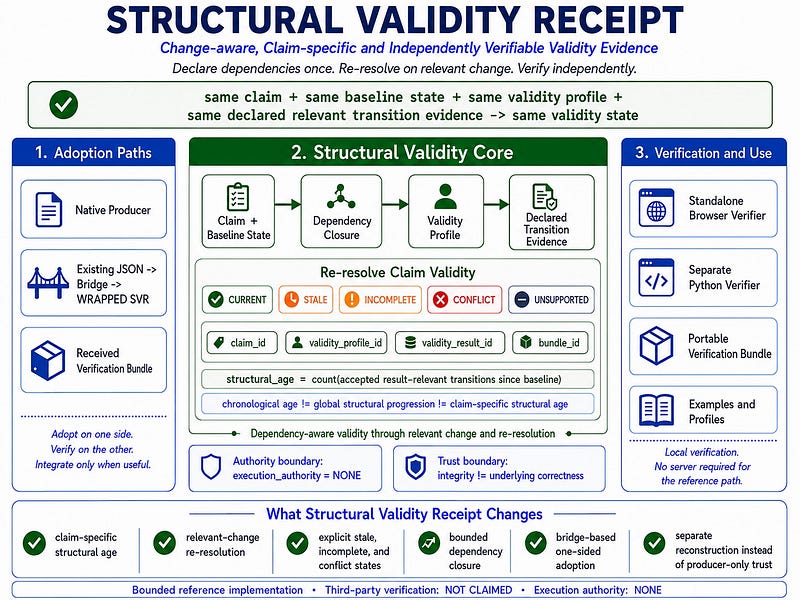
Structural Validity Receipt separates the established result, declared dependency closure, baseline state, accepted transition evidence, claim-specific structural age, deterministic validity re-resolution, receipts, witnesses, bridge-based adoption, and separate verification paths.
🧾 What Does a Validity Receipt Record?
A Structural Validity Receipt records more than a status label.
The current receipt can record identified fields such as:
- the established claim;
- the governing validity profile;
- the baseline dependency state;
- the reconstructed current dependency state;
- global structural progression;
- claim-specific structural age;
- accepted relevant transitions;
- unrelated accepted changes;
- duplicate counts;
- conflict state;
- validity state;
- supporting witness;
- result identity;
- receipt identity.
The receipt therefore answers a bounded question:
Under this identified profile and declared dependency structure, does the established result still hold?
A receipt saying CURRENT does not become trustworthy merely because the producer generated it.
The result must be reconstructable.
🔍 Verification Without Trusting the Producer’s Conclusion
Structural Validity Receipt includes separate verification paths.
The demonstrated flows include:
reference producer -> verification bundle -> independent Python verifier
and:
reference producer -> verification bundle -> standalone browser verifier
The verifier reconstructs:
- the claim;
- the validity profile;
- the baseline state;
- the transition lineage;
- global progression;
- structural age;
- the current dependency state;
- conflict or incomplete conditions;
- the validity result;
- the supporting witness;
- receipt and bundle identities.
The governing principle is:
producer assertion != verification authority
A producer cannot make a stale result current merely by writing CURRENT into a file.
A mismatch between the declared evidence and the claimed result causes verification to fail.
The current project demonstrates separate implementation reconstruction.
It does not claim third-party certification.
🌉 Adoption Does Not Require Replacing Existing Systems
SVR is designed around a practical adoption principle:
Adopt on one side. Verify on the other. Integrate only when useful.
An existing application may continue producing results in its current format.
SVR can be added as a sidecar:
existing result system -> SVR sidecar -> validity bundle -> separate verifier
Existing structured results can also be introduced through a declared bridge.
The current bridge preserves source origin as:
NATIVE
DERIVED
or:
WRAPPED
It also preserves the boundary:
semantic_equivalence = NOT_ASSUMED
A successful conversion does not silently claim that the imported source and the native SVR structure mean exactly the same thing in every respect.
The source origin remains visible.
This allows one-sided adoption without requiring every producer, consumer, database, or workflow to be rebuilt at the same time.
⚖️ CURRENT Does Not Mean Universally True
A particularly important boundary is:
CURRENT != factually true
and:
CURRENT != authenticated
and:
CURRENT != approved
SVR determines whether an established result still satisfies its declared validity invariant against the current admissible dependency state.
It does not automatically prove:
- that the source data is true;
- that the source is authentic;
- that the original result was correct;
- that the dependency closure includes every possible real-world factor;
- that the result is legally effective;
- that an action is safe;
- that an approval should be granted;
- that execution is authorized.
The current reference model declares:
execution_authority = NONE
A CURRENT receipt means only:
The established result still satisfies the declared validity rule against the reconstructed dependency state within the identified bounded profile.
It does not grant authority to act.
🕰️ Chronological Expiry Can Still Matter
SVR does not claim that elapsed time is irrelevant.
A domain may legitimately require:
- legal expiry dates;
- quotation validity windows;
- recertification intervals;
- safety inspection periods;
- maximum document ages;
- mandatory refresh schedules.
These can remain valid and necessary rules.
The distinction is that:
chronological expiry
and:
structural result validity
should be declared as separate questions rather than silently treated as the same thing.
A result may remain structurally valid but be unusable because a legal expiry period ended.
Another result may remain within its chronological period but become structurally stale because a critical dependency changed.
Both conditions can be represented without confusing one for the other.
🌍 Why This Could Matter
Established results are everywhere.
Supplier selections.
Price comparisons.
Eligibility conclusions.
Risk classifications.
Configuration decisions.
Approvals.
Calculated recommendations.
Compliance assessments.
Technical conclusions.
Today, systems often respond to change in one of two ways.
They either continue trusting an old result without knowing whether its supporting conditions changed.
Or they repeatedly reconstruct the entire decision whenever anything changes.
Structural Validity Receipt explores a middle path:
- declare what the result depends on;
- distinguish relevant change from unrelated change;
- count accepted relevant transitions;
- re-evaluate whether the result survived;
- preserve conflict and incompleteness;
- produce a reconstructable receipt;
- keep execution authority separate.
The deeper question is:
Can a result carry an explicit, independently reconstructable account of whether it still holds?
SVR’s answer is deliberately bounded.
Do not treat age as validity.
Do not treat every change as invalidation.
Do not treat unrelated change as result aging.
Do not hide missing or conflicting evidence.
Re-evaluate the result against the structure that actually matters.
🧪 Current Reference Status
The current public release is Structural Validity Receipt v0.3.0.
Published verification includes:
156/156browser reference audit PASS;37/37permanent regression checks PASS;27/27feature coverage checks PASS;22/22Python verifier self-test PASS;100/100Python corpus verification PASS;5/5conforming vectors PASS;12/12hostile vectors rejected as expected;14/14standalone verifier self-test PASS;100/100standalone corpus verification PASS;28/28bridge self-test PASS;61/61independent verification checks for a bridge-generated bundle PASS;- zero unexpected hostile-vector acceptance;
- a passing GitHub Actions verification workflow.
These results demonstrate the current published reference boundaries.
They do not establish universal validity semantics, production suitability, factual truth, universal supplier-selection correctness, or third-party certification.
⚖️ What Structural Validity Receipt Does — and Does Not — Claim
Structural Validity Receipt does not claim that clocks, databases, event logs, version systems, caches, workflows, or existing applications should disappear.
It does not prove that the original result was correct.
It does not prove that the declared dependency closure contains every possible real-world dependency.
It does not establish source authenticity, legal validity, regulatory approval, factual truth, safety certification, or execution authority.
Its question is narrower:
Can the continuing validity of an established result be resolved from its declared dependency structure, baseline state, accepted transition evidence, and identified validity profile?
The governing trust principle is:
do not claim more than the reconstructed bounded structure can support
🌐 Explore Structural Validity Receipt
The repository contains:
- the browser reference implementation;
- the independent Python verifier;
- the standalone browser verifier;
- the bridge;
- the supplier-selection validity profile;
- machine-readable schemas;
- five conforming reference examples;
- the frozen conformance corpus, including conforming and hostile vectors;
- verification evidence;
- architecture documentation;
- conformance requirements;
- audit guidance;
- checksum verification material.
🔗 Structural Validity Receipt — Open Reference Implementation on GitHub
🌌 The Larger Question
For years, systems have often asked:
How old is this result?
Structural Validity Receipt asks a different question:
What changed in the structure that supports this result — and did the result survive?
A result can remain current while time passes.
A result can remain current after relevant change.
A result can become stale almost immediately.
The world can change without this result aging.
Duplicates can repeat without creating new structural history.
Conflict and incompleteness can remain visible instead of being forced into a conclusion.
And validity can be reconstructed without depending solely on the application that produced the result.
The principle is simple:
Track relevant change. Re-evaluate the result. Preserve what still holds. Verify independently.
✍️ Authorship & Disclaimer
Created by the authors of the Shunyaya Framework.
Structural Validity Receipt is a bounded reference architecture and implementation for claim-specific structural age and deterministic validity re-resolution.
It is not intended to replace clocks, databases, version systems, event logs, domain rules, legal expiry policies, professional judgment, authentication, operational authorization, regulatory controls, safety systems, or production assurance.
High-risk or production use requires independent verification, domain-specific validation, complete dependency analysis, appropriate authorization controls, and suitable operational safeguards.
OMP


Comments
Post a Comment