🔍 What If a Financial Receipt Could Answer Different Questions Without Becoming a Different Receipt?
Turning Financial Receipts into Portable Evidence That Resolves by Purpose
A financial receipt is usually treated as a finished document.
You buy something.
A receipt is created.
Later, that same receipt may be used for a return, an expense claim, a warranty request, an audit, or payment reconciliation.
But each of those situations asks a different question.
Is this a valid record of a purchase?
Do the numbers add up?
Does it match a payment?
Is it sufficient evidence for an expense?
What is the current state after a return or refund?
Structural Receipt explores a different model:
Declare once. Resolve by purpose. Preserve through change. Verify independently.
The governing idea is:
receipt structure + identified purpose profile + declared evaluation context -> supported result
The same financial evidence can therefore support different bounded answers without being forced into one universal valid / invalid label.
💡 One Receipt. Different Questions.
Imagine buying a laptop.
The receipt may clearly establish:
Yes, this purchase was declared.
The arithmetic may also be correct.
But payment-matching evidence may be missing.
A warranty question may require different fields.
An accounting classification may produce only a proposal.
So the same receipt could legitimately produce:
PURCHASE_DECLARATION -> RESOLVED
ARITHMETIC_CHECK -> RESOLVED
PAYMENT_MATCH -> INCOMPLETE
ACCOUNTING_CLASSIFICATION -> RESOLVED + PROPOSED
These answers do not contradict one another.
They answer different questions.
Structural Receipt therefore moves away from:
one receipt -> one universal validity flag
toward:
one evidence structure -> multiple purpose-specific resolutions
🧠 The Core Idea
Most financial documents are carried between systems as files, PDFs, database records, images, or application-specific objects.
The receiving system then has to interpret them again.
Structural Receipt asks:
What if the transaction evidence itself carried enough explicit structure to be resolved for a declared purpose?
The current reference model includes purpose profiles for:
- purchase declaration
- arithmetic checking
- payment matching
- expense evidence
- warranty evidence
- return eligibility
- current lineage state
- accounting classification
- audit trace
The rules governing each question are identified too. A receipt is not simply evaluated against an unnamed or silently changing set of application rules. Each declared purpose is governed by an identified purpose profile.
same supported evidence + same purpose profile + same declared context -> same supported result
When a question depends on time, jurisdiction, or currency context, that context is declared explicitly rather than silently taken from the application or the current clock.
Each purpose has its own requirements.
Missing evidence remains missing.
Conflicting evidence remains conflicting.
Unsupported questions remain unsupported.
The current resolution states include:
RESOLVED
INCOMPLETE
CONFLICT
UNSUPPORTED
The goal is not to force every receipt to answer every question.
The goal is to make clear what the available evidence actually supports.
🛑 Resolution Is Not Approval
A particularly important boundary is:
RESOLVED != APPROVED
and:
RESOLVED != AUTHENTICATED
Structural Receipt can reconstruct what a declared evidence structure supports.
That does not automatically prove:
- who issued the receipt
- whether the real-world transaction actually occurred
- whether a warranty claim should be approved
- whether an expense should be reimbursed
- whether an accounting entry should be posted
All current purpose profiles declare:
execution_authority = NONE
The architecture separates:
evidence resolution
from:
authentication, approval, policy, and execution
A receipt may answer a question without receiving authority to perform an action.
🔄 What Happens When the Transaction Changes?
A purchase is not always the end of the story.
An item may be returned.
A partial refund may occur.
A credit may be issued.
A transaction may evolve over time.
Many systems handle this by updating or replacing the current record.
Structural Receipt explores a different approach:
change -> linked lineage event
not:
change -> silent historical replacement
The original purchase remains addressable.
Later supported events can change the current state without pretending that the earlier state never existed.
This creates a clearer distinction between:
what originally happened
and:
what the transaction currently looks like
🖼️ Structural Receipt Architecture Diagram
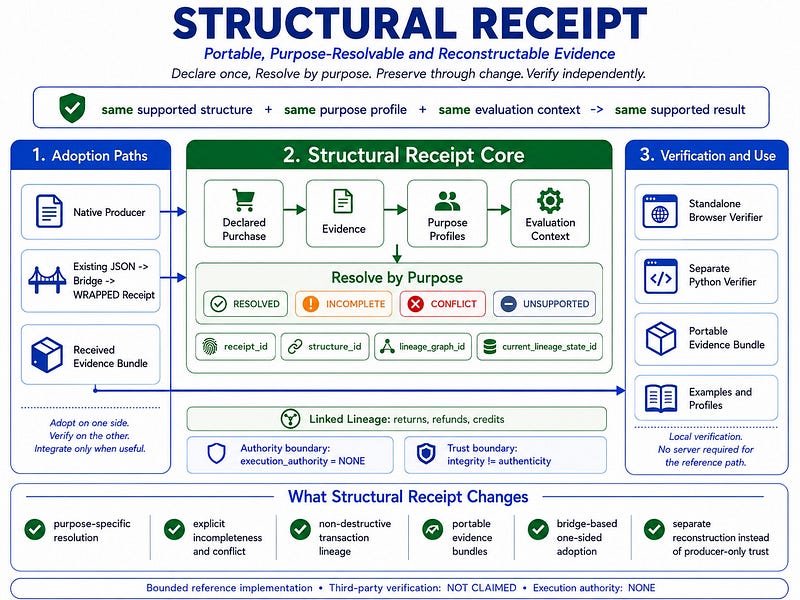
Structural Receipt separates transaction evidence, purpose-specific resolution, declared evaluation context, lineage, bounded authority, and reconstruction across separate verification paths.
🔍 Verification Without Depending on One Application
A receipt should not become trustworthy merely because the application that created it says:
PASS
Structural Receipt therefore includes separate reconstruction paths.
The demonstrated flow includes:
browser producer -> evidence bundle -> standalone browser verifier
and:
browser producer -> evidence bundle -> separate Python verifier
The verifier reconstructs the supported evidence instead of relying only on a producer-generated conclusion.
A materially tampered reference bundle is rejected.
The current claim is:
separate implementation reconstruction = demonstrated
while:
third-party verification = NOT_CLAIMED
That distinction is intentional.
🌉 Adoption Does Not Require Replacing Existing Systems
Structural Receipt is also designed around a practical adoption principle:
Adopt on one side. Verify on the other. Integrate only when useful.
An existing transaction system can continue operating.
Its data can be represented through a declared bridge as:
existing JSON -> declared bridge -> WRAPPED Structural Receipt
The receiving side can then reconstruct and verify the resulting evidence locally.
The model distinguishes:
NATIVE
WRAPPED
DERIVED
A successful conversion does not automatically mean:
successful transformation = complete semantic equivalence
The origin remains explicit.
This makes Structural Receipt potentially usable as a sidecar evidence layer rather than requiring every existing financial platform to be rebuilt.
🌍 Why This Could Matter
Receipts move through many systems.
Retail systems.
Payment systems.
Expense platforms.
Accounting software.
Warranty systems.
Return workflows.
Audit tools.
Today, each system may reinterpret the same document for its own purpose.
Structural Receipt explores whether some of that meaning can travel with the evidence itself.
The deeper question is:
Can a financial receipt become more than a static document without becoming an authority over everything?
Structural Receipt’s answer is deliberately bounded.
Let the receipt carry explicit structure.
Let the declared purpose determine the question.
Let missing evidence remain visible.
Let changes preserve lineage.
Let verification be reconstructable.
And let operational authority remain separate.
🧪 Current Reference Status
The current public release is Structural Receipt v0.5.3.
Published verification includes:
221/221 browser release audit PASS
35/35 standalone verifier audit PASS
308/308 conformance checks on browser and separate Python paths
12/12 tamper corpus PASS
13/13 hostile-input corpus PASS
21/21 bridge self-test PASS
122 permanent browser regression checks
The repository also includes a passing GitHub Actions verification workflow.
These results demonstrate the current published reference boundaries.
They do not establish universal correctness, production readiness, financial truth, or third-party certification.
⚖️ What Structural Receipt Does — and Does Not — Claim
Structural Receipt does not claim that PDFs, databases, accounting systems, payment networks, or conventional receipts should disappear.
It does not establish issuer authenticity by itself.
It does not prove that a real-world transaction occurred.
It does not approve warranties, reimbursements, payments, or accounting entries.
It does not replace legal, regulatory, tax, audit, or financial controls.
Its question is narrower:
Can transaction evidence become portable and purpose-resolvable while preserving explicit uncertainty, change history, bounded authority, and reconstruction across separate verification paths?
The governing trust principle is:
do not claim more than the structurally reconstructed evidence can support
🌐 Explore Structural Receipt
The repository contains the browser reference implementation, standalone verifier, separate Python verifier, purpose profiles, bridge, frozen conformance and tamper corpora, examples, verification guidance, architecture documentation, and supporting evidence.
🔗 Structural Receipt — Open Reference Implementation on GitHub
🌌 The Larger Question
For years, a receipt has mostly answered one basic question:
What did this document record?
Modern financial systems increasingly need to ask:
What is this evidence sufficient to establish right now, for this particular purpose?
Structural Receipt explores the idea that the answer does not have to come from one application, one universal validity flag, or one mutable record.
The same evidence can support different bounded questions.
Changes can preserve history.
Verification can cross application boundaries.
And resolution can remain separate from authority.
The principle is simple:
Declare once. Resolve by purpose. Preserve through change. Verify independently.
✍️ Authorship & Disclaimer
Created by the authors of the Shunyaya Framework.
Structural Receipt is a bounded reference architecture and implementation for purpose-resolvable financial evidence.
It is not intended to replace financial, accounting, payment, tax, legal, audit, regulatory, authentication, or production control systems. High-risk or production use requires independent verification, domain-specific validation, appropriate authorization controls, and suitable operational safeguards.
OMP


Comments
Post a Comment