🔀 What If an Application Could Resolve Its Result Without Letting Presentation Order Decide It?
STOCRS-R explores a deterministic structural model where missing information stays incomplete, conflicts stay visible, and program changes receive explicit new identities.
💡 A Different Question About Applications
Most applications are built around procedures.
Do this first.
Then do that.
Wait for this.
Update that.
Retry if something fails.
Synchronize when necessary.
These mechanisms are essential for running real software.
But there is another question worth asking:
Must the order in which pieces are presented also decide what result is supported?
STOCRS-R explores a narrower alternative.
Within its reference model, STOCRS-R does not let presentation order or repeated claims become result authority. Instead, it resolves from an explicit program, declared inputs, available evidence, and the nodes currently available.
The central idea is:
declared structure + inputs + evidence + available nodes -> supported resolution
The important question is no longer only:
What happened first?
STOCRS-R asks:
What does the declared program actually support?
🧩 The Core Idea
STOCRS-R separates several things that ordinary applications often treat as one large execution story:
- the program itself
- the inputs supplied to it
- the evidence or claims being presented
- the parts of the program currently available
- the final resolution state
Its current bounded relation is:
same program identity + same declared inputs + same evidence + same available-node set + complete presentation of that set -> same supported values
In simpler language:
When the same program, inputs, evidence, and available nodes are completely presented, the supported values are deterministic.
For the complete semantic result:
same semantic resolution inputs + complete presentation of the same available-node set -> same state + same certificate
This does not mean all software becomes independent of execution order.
The claim is narrower:
within the tested STOCRS-R model, node-presentation order does not become result authority.
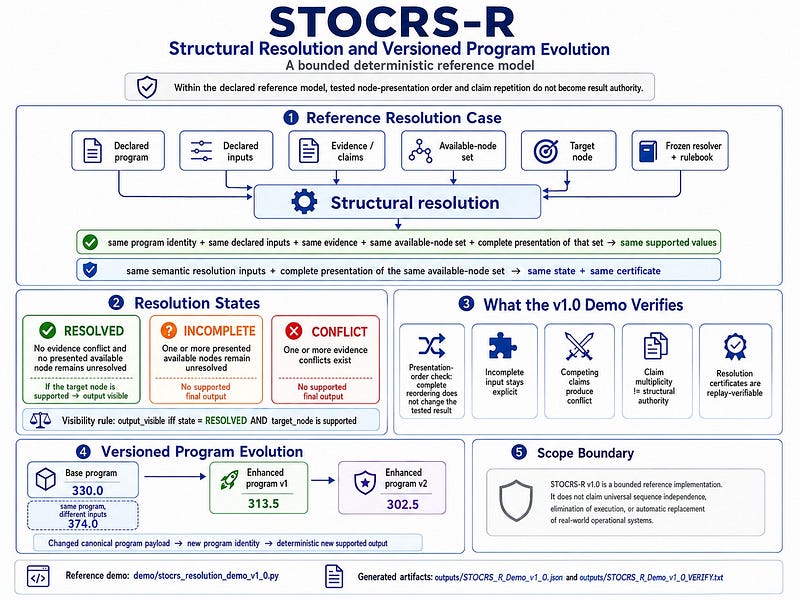
STOCRS-R in one view — declared programs, inputs, evidence, and available nodes are resolved through fixed rules. Complete, non-conflicting cases can resolve, missing information stays incomplete, and conflicts stay conflicts.
🧠 The Same Program Does Not Always Mean the Same Output
This is an important distinction.
STOCRS-R does not say:
same program -> same output
The same program can receive different inputs and produce different results.
In the reference demonstration:same base program + first inputs -> 330.0same base program + different inputs -> 374.0
The program identity stays the same. The input identity changes.
This separation is important because it allows STOCRS-R to distinguish between:
program identity
and:
input identity
The program describes what should be resolved.
The inputs describe what values are being resolved with it.
⚙️ Three Honest Outcomes
STOCRS-R does not force every situation into a successful answer.
The current reference model has three top-level states.
✅ RESOLVED
The available structure resolves without a blocking evidence conflict.
🟠 INCOMPLETE
Something required is missing.
The system does not invent an answer just because one was requested.
🔴 CONFLICT
The evidence conflicts internally or disagrees with the supported structural value.
The conflicting result is not exposed as supported output.
The visibility rule is simple:
output_visible iff state = RESOLVED AND target_node is supported
Sometimes the correct answer is a result.
Sometimes it is conflict.
Sometimes the most honest answer is simply:
not enough information yet.
🛡 Repetition Does Not Become Authority
One of the clearest ideas in STOCRS-R is:
claim multiplicity != structural authority
In everyday language:
Repeating a claim does not automatically make it true.
Imagine that the declared input value is 120.
Then:
[120, 120] -> compatible repeated evidence
But:
[120, 999] -> conflict
And:
[999, 999]
does not allow 999 to replace the declared value merely because it was repeated twice.
Even:
[999, 999, 120]
does not turn the problem into a majority vote.
Different claimed values remain a conflict.
Repetition does not choose a winner.
Evidence may support a result. Repetition alone does not become authority.
🔁 Different Presentation Order, Same Tested Result
The STOCRS-R reference demonstration presents the same base program nodes in different seeded orders.
The tested runs preserve:
- the same supported output
- the same resolution state
- the same certificate
- the same program identity
The resolver does not simply trust whichever node appears first.
Declared dependencies and frozen rules determine what can resolve.
The claim remains deliberately bounded.
STOCRS-R does not say that arbitrary execution order is irrelevant in every real application.
Real systems may still need:
- scheduling
- synchronization
- networking
- persistence
- orchestration
- retries
- coordination
The narrower idea is:
presentation order != result authority
for the tested complete presentations within the reference model.
🚀 What Happens When the Program Itself Changes?
This is where STOCRS-R becomes especially interesting.
Applications evolve.
Rules change.
Policies change.
New parts are added.
STOCRS-R gives the declared program itself an explicit identity.
Conceptually:
program definition -> program identity
The current demonstration contains:
- a base program
- an enhanced program with a coupon value of
15 - another enhanced program with a coupon value of
25
The resolver stays fixed.
The rulebook stays fixed.
The declared program changes — and the demonstrated changed programs receive distinct identities.
This creates a useful distinction:
resolver continuity
versus:
program identity change
The resolver can remain the same while the declared program evolves.
🛒 A Simple Shopping Example
The reference demonstration uses a small shopping-style calculation.
The base program resolves prices, quantities, subtotal, discount, tax, shipping, and final total.
The demonstrated results are:
Base program -> 330.0
Using the same base program with different inputs:
Same program + different inputs -> 374.0
Then the program is enhanced with a loyalty coupon.
With a coupon value of 15:
Enhanced program v1 -> 313.5
When the declared coupon policy changes from 15 to 25:
Enhanced program v2 -> 302.5
The important part is not only that the result changes.
STOCRS-R also records why it changed.
different inputs -> different input identity
changed program -> different program identity
Those are different events, and STOCRS-R keeps them separate.
🔐 A Result Can Carry a Reproducible Certificate
Each reference resolution also receives a SHA-256 certificate derived from its canonical semantic result.
The certificate binds information such as:
- program identity
- input identity
- evidence identity
- available nodes
- resolution state
- supported values
- unresolved nodes
- conflicts
- blocked descendants
The certificate represents more than the final number.
Two cases may share an output while representing different resolution states.
STOCRS-R keeps output value and resolution identity separate.
Conceptually:
output value != complete resolution identity
The current demonstration also produces a separate aggregate certificate for the overall reference run.
🧪 What the Current Reference Implementation Demonstrates
The current STOCRS-R reference demonstration includes 15 automated checks.
They test areas including:
- deterministic supported output
- deterministic resolution state
- deterministic certificates
- reordered node presentation
- separate input identity
- explicit incompleteness
- compatible repeated claims
- conflicting claims
- rejection of unsupported repeated claims
- rejection of majority-style override
- validation of claims against derived values
- program identity changes
- deterministic resolution of demonstrated program enhancements
The repository also includes a passing automated verification workflow.
The important point is that these are declared reference cases.
They are not universal claims about every application or every distributed system.
🌍 Why This Is Interesting
Many applications mix together two questions:
How does the system operate?
What makes a result supported?
STOCRS-R explores what happens when those questions are separated.
Operational systems may still move data, schedule work, synchronize services, or retry failures.
But for suitable deterministic problems, those mechanisms may not need to become result authority.
STOCRS-R explores a model closer to:
declared program + declared inputs + evidence + available structure -> supported resolution
Possible areas worth exploring include:
- rule-driven applications
- offline systems
- intermittent environments
- audit-oriented computation
- conflict-aware data processing
- reproducible decision pipelines
- versioned policy systems
- deterministic application modules
The interesting question is not whether every application should work this way.
It is whether some application decisions can be governed more directly by explicit structure instead of by procedural history.
⚖️ What STOCRS-R Does — and Does Not — Claim
STOCRS-R does not claim that programming languages disappear.
It does not claim that execution environments disappear.
It does not claim that all software can ignore sequence.
It does not claim that synchronization is universally unnecessary.
It is not a distributed consensus protocol.
It is not a production safety certification.
Its current claim is intentionally narrower:
same program identity + same declared inputs + same evidence + same available-node set + complete presentation of that set -> same supported values
And for the complete semantic result:
same semantic resolution inputs + complete presentation of the same available-node set -> same state + same certificate
Within that declared model, STOCRS-R demonstrates deterministic structural resolution, explicit incompleteness, conflict-aware result suppression, reproducible certificates, and versioned program evolution.
🌐 Explore STOCRS-R
STOCRS-R — Open Reference Implementation on GitHub
The repository includes the runnable reference demonstration, generated outputs, verification workflow, proof sketch, architecture notes, enhancement model, challenge scenarios, diagrams, and reproducible verification material.
🌌 The Larger Question
Most software thinking begins with questions such as:
What executes next?
What arrived first?
Which process has the latest state?
STOCRS-R adds another question:
What does the declared structure actually support right now?
Sometimes the answer is:
RESOLVED
Sometimes:
INCOMPLETE
Sometimes:
CONFLICT
And when the declared program itself changes, the question becomes:
Is this still the same program, or has the program acquired a new identity?
That is the space STOCRS-R explores.
✍️ Authorship & Disclaimer
Created by the authors of the Shunyaya Framework.
STOCRS-R is a bounded deterministic structural-resolution research reference implementation. It is not intended for safety-critical or production-critical deployment without independent validation and domain-specific testing.
⭐ The Core Takeaway
STOCRS-R explores a simple but potentially powerful shift:
Do not let presentation order or repeated claims automatically become result authority.
Instead, make the program explicit.
Make the inputs explicit.
Make the evidence explicit.
Make incompleteness visible.
Make conflicts visible.
And when the program changes, give that changed program an explicit new identity.
Within the current reference model:
same program identity + same declared inputs + same evidence + same available-node set + complete presentation of that set -> same supported values
The deeper idea is simple:
A system does not always need to force an answer.
It can resolve what the structure supports.
It can remain incomplete when something is missing.
It can surface conflict when evidence disagrees.
And it can distinguish a changed program from changed inputs.
OMP


Comments
Post a Comment