🔍 What If a 3 x 3 x 3 Cube Had to Prove Its Progress?
🧊 A Browser-Native Cube That Explains, Checks, and Verifies Every Accepted Structural Action
Structure Proposes. Verification Checks. Progress Must Be Visible.
🌐 Live Structural Cube
Open the application directly in a modern browser.
No installation. No account. No external solver.
Most cube solvers tell you what move to make.
Structural Cube asks something more demanding:
Can the cube explain why an action belongs, replay the completed sequence, and verify that genuine progress occurred?
It starts from the legal cube state that exists now. It does not need the history of how the cube was mixed.
Its resolution path is:
state -> rank -> graph -> target -> compiled turns -> replay -> strict descent -> solved state
A completed structural action is accepted only after its compiled sequence has been replayed, its declared effect has been confirmed, and its structural rank has fallen.
The explanation, the action, and the evidence therefore come from the same process.
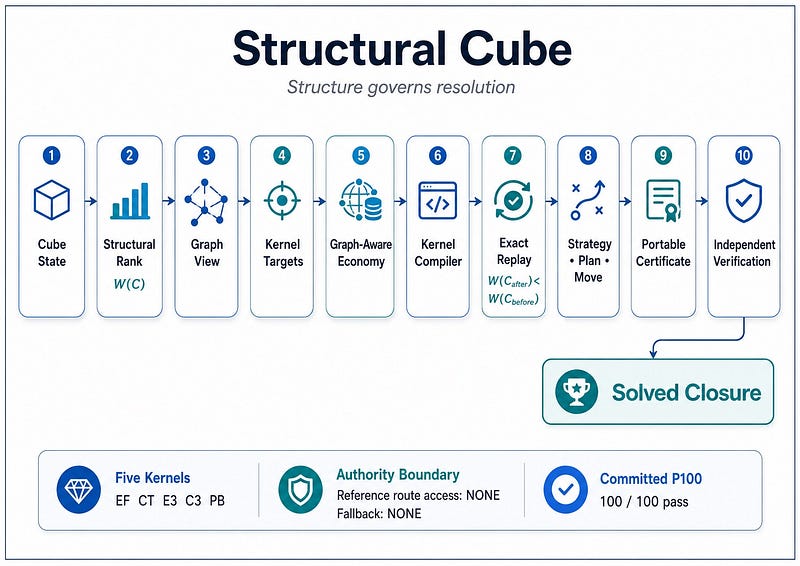
Structural Cube v1.0.2 — the resolution and evidence path from the current cube state through structural rank, graph-guided target selection, exact replay, portable certification, and independent verification to solved closure.
🧭 What Structural Cube Is
Structural Cube is a self-contained browser application for mixing, exploring, learning, and resolving a standard 3 x 3 x 3 cube.
A user can:
- mix the cube randomly or manually;
- resolve it automatically;
- request guided hints;
- solve without hints;
- inspect the structural evidence behind each completed action.
The application combines a native cube model, legality checks, an observed obligation graph, a solved-state rank, exact structural kernels, replay verification, learner guidance, portable certificates, and independent Python verification.
It runs as one HTML file.
No external solver, server, API, cloud database, or runtime puzzle dataset is required during ordinary use.
🔍 What Counts as a Structural Action?
In Structural Cube, one structural action may contain several ordinary face turns.
The entire sequence is treated as one exact contract.
Individual turns may temporarily rearrange other pieces, but the completed action must:
- produce its declared structural effect;
- reach the recorded target state;
- end at a lower structural rank.
The governing condition is:
W_after < W_before
Strict descent is checked at the completed structural-action boundary, not after every individual face turn.
🧠 The Structural Difference
Established cube methods remain highly effective. They may use layers, cases, memorized algorithms, commutators, search tables, or optimized routes.
Structural Cube asks a different question:
Which unresolved structure is active now, which exact action can reduce it, and how can that reduction be checked before continuing?
Its discipline is:
state -> structure -> action contract -> verification -> route -> lesson
not:
state -> hidden route first -> explanation afterward
The resolver begins with the present legal state. A seeded scramble may help reproduce a test, but the original mixing route does not govern the next action.
This creates a simple shift:
history of the problem != sole authority over its resolution
A route may solve the cube. Structural Cube also asks whether the route can explain and verify its progress.
📐 A Rank That Must Fall
Structural Cube assigns a non-negative structural rank W to the current legal state.
The current release uses:
W(C) = 24*rho + 4*(D_e + D_c) + tau_e + tau_c + F + T
Its central conditions are simple:
0 <= W(C) <= 126
W(C) = 0 iff C = SOLVED
W_after < W_before
The first relation keeps the rank finite.
The second gives the solved cube a unique zero.
The third requires every completed primary action to make measurable progress.
This produces the finite-descent principle:
finite non-negative rank + strict descent -> finite accepted-action count
The complete cubie representation, legality equations, and rank definitions remain available in the public repository for technical review.
The published claim remains limited to the committed P100 corpus and declared release profile.
🧩 From Unresolved Structure to Exact Action
Structural Cube uses five pure kernel families:
EF(i,j)- corrects a paired edge-orientation residueCT(i,j)- corrects a paired corner-twist residueE3(i,j,k)- applies an exact three-edge permutation cycleC3(i,j,k)- applies an exact three-corner permutation cyclePB(i,j;k,l)- bridges shared edge-corner permutation parity
The current state is also converted into an observed obligation graph containing misplaced pieces, orientation residues, permutation cycles, parity conditions, targets, and structural couplings.
At every completed action boundary, the resolver:
- identifies exact strict-descent targets;
- scores them under the current graph;
- retains the strongest admitted candidates;
- compares deterministic continuations;
- chooses the lowest declared compiled cost;
- replays the complete action;
- checks its effect and descent;
- rebuilds the graph from the new state.
The active economy profile is:
TOP_4_GRAPH_POOL_DEPTH_4
The compiler may search for an isolated pure-kernel realization, but it may not consult a hidden full-state solution:
reference_route_access = NONE
current_state_reference_distance_access = NONE
The graph is therefore part of selection, not a visual explanation attached afterward.
⚡ Every Tested Route Became Shorter
Structural validity alone does not guarantee an economical route.
Structural Cube therefore compares admitted strict-descent continuations before selecting the next action.
Across the committed P100 corpus:
- earlier-selector mean:
193.99moves; - graph-aware economy mean:
174.58moves; - seeds improved:
100; - seeds equal:
0; - seeds regressed:
0; - total face turns reduced:
1,941.
This does not establish globally shortest solutions.
It establishes something narrower and reproducible:
Every tested route became shorter under the declared comparison, while exact replay, strict descent, certificate continuity, and solved closure remained intact.
🎓 Strategy, Plan, and Move
The guidance panel separates three questions:
🧭 Strategy
What larger goal is being pursued?
🗺️ Plan
Why does the next action belong to that goal?
🔄 Move
Which turn should be performed now?
The learning chain is:
verified purpose -> Strategy -> Plan -> Move
The learner-facing explanation comes from the same checked state evidence used by the resolver.
When the evidence supports a precise explanation, the application gives one.
When it does not, the guidance remains general rather than inventing certainty.
Technical formulas and certificates remain available in a separate view.
🖥️ One Browser-Native Application
Structural Cube v1.0.2 is distributed as one self-contained HTML application of about 6 MB.
It includes the cube interface, legal transformations, graph resolver, kernel catalogue, learner guidance, technical inspection, and browser-side verification.
Users can:
- mix the cube reproducibly;
- turn it manually;
- resolve automatically;
- request hints;
- solve independently;
- pause and resume;
- proceed one move at a time;
- continue after making a different legal move.
The browser becomes the cube environment.
The current state becomes the source of structural observation.
✅ Published v1.0.2 Verification
Structural Cube v1.0.2 was evaluated against a committed corpus of 100 reproducible starting states:
seed_set = 1..100
scramble_length = 22
generator = xorshift32
The central result is:
100 states solved, 100 portable certificates produced, and 100 certificates independently verified.
The published results are:
+------------------------------------------------------------+------------------+
| Property                                                   | Result           |
+------------------------------------------------------------+------------------+
| Version                                                    | 1.0.2            |
| Committed starting states                                  | 100              |
| States solved                                              | 100/100          |
| Strict W descent                                           | PASS             |
| Final W = 0                                                | 100/100          |
| Reference-route access                                     | NONE             |
| Current-state reference-distance access                    | NONE             |
| Fallback activation                                        | NONE             |
| Seeds improved against the earlier selector                | 100              |
| Seeds equal                                                | 0                |
| Seeds regressed                                            | 0                |
| Earlier selector mean                                      | 193.99           |
| Graph-aware economy mean                                   | 174.58           |
| Median moves                                               | 172              |
| p95 moves                                                  | 207              |
| Maximum moves                                              | 223              |
| Total moves reduced across P100                            | 1,941            |
| Portable certificates                                      | 100              |
| Browser certificate verification                           | 100/100 PASS     |
| Independent Python verification                            | 100/100 PASS     |
| Tamper rejection                                           | PASS             |
| Realization catalogue entries                              | 2,292            |
| Wall-clock authority                                       | NONE             |
+------------------------------------------------------------+------------------+
Runtime is operational information only.
wall_clock_authority = NONE
One producer run completed in approximately 52 seconds on the tested machine. Runtime varies by device and environment, but correctness does not depend on completing before a time limit.
🔍 How the Evidence Travels
Structural Cube does not treat a visibly solved cube as sufficient evidence.
For each committed route, the application produces a portable certificate describing:
- the starting state;
- the selected structural target;
- the compiled face turns;
- the expected pure effect;
- the observed transition;
- the rank before and after;
- strict descent;
- action-chain continuity;
- final solved closure.
The certificate profile is:
SCCERT-1-D02-EXP-A
The evidence path is:
browser application -> certificates -> portable bundle -> independent verifier -> release manifest
The independent verifier is written using the Python standard library. It does not call the browser resolver.
It reconstructs the cube transitions, legality, rank values, graph decisions, kernel effects, certificate chains, evidence roots, and final solved states.
The committed result is:
status = PASS
certificate_count = 100
passed_certificate_count = 100
failed_certificate_count = 0
The committed tamper-rejection test also passes.
Full commands, SHA-256 identities, certificate roots, manifests, reports, and reconstruction details are published in the GitHub repository.
This keeps the article readable while leaving the complete verification path publicly inspectable.
🔥 Challenge the Evidence
Structural Cube is published as a falsifiable reference implementation.
A reviewer should be able to challenge questions such as:
- Does the same canonical state produce a different route under the same release?
- Does an accepted action fail to produce its declared effect?
- Is an action accepted when
W_after >= W_before? - Can a broken certificate chain pass?
- Can modified evidence preserve a valid root?
- Can a non-solved final state be accepted?
The primary falsification relation is:
invalid structural transition -> valid certificate
A reproducible failure would require correction of the implementation, strengthening of the verifier, or narrowing of the claim.
🌍 Why This Matters Beyond the Cube
A cube is a small but unforgiving structural laboratory.
Its legal transformations are exact.
Its disorder is visible.
Its solved condition is unambiguous.
Its actions can be replayed.
That makes it useful for exploring a broader question:
Can progress be carried by verified transitions rather than hidden inside an opaque procedure?
Structural Cube connects:
purpose -> action contract -> execution -> evidence -> verified progress
The wider claim is not that real-world systems behave like cubes.
The deeper possibility is that, in some deterministic systems, accepted transitions can carry their own progress evidence.
🌱 Within the Shunyaya Framework
Shunyaya is an original framework for structural mathematics and deterministic systems that explores how systems can make their internal structure, progression, evidence, and limits visible while preserving their established outputs.
For Structural Cube:
the classical cube state remains the cube state
The legal transformations remain ordinary cube transformations.
What becomes visible is the surrounding structure:
- unresolved obligations;
- target-selection authority;
- exact action contracts;
- observed transitions;
- rank changes;
- route identity;
- certificate identity;
- learning purpose.
The cube is not redefined.
Its resolution becomes more explicit and independently inspectable.
⚠️ Scope and Claim Boundary
Structural Cube v1.0.2 establishes its published results for the committed P100 corpus and declared release profile.
It does not claim:
- globally shortest solutions;
- universal coverage of every legal cube state;
- superiority over established cube methods;
- competition-speed leadership;
- measured learning-outcome superiority;
- independent institutional certification.
The current version class is:
EXPERIMENTAL
The declared evidence boundary is:
COMMITTED_P100
The boundary states what has been demonstrated, not what is merely hoped.
🌌 The Deeper Idea
A legal turn is not automatically a useful structural action.
A route is not automatically an explanation.
An explanation is not automatically evidence.
Structural Cube therefore requires:
legal action + declared target + exact effect + replay + strict descent + certificate continuity
The process begins with the present state, identifies what remains unresolved, selects an exact target, compiles a legal realization, replays the action, checks the result, and rebuilds from the new state.
state -> structure -> action -> evidence -> descent -> solved state
A cube can move in many legal ways.
The deeper question is whether every accepted movement belongs to a visible and verifiable path of closure.
The cube moves locally. The structure closes globally.
🚀 Try It. Inspect It. Challenge It.
Open the live application directly in a modern browser.
No installation.
No account.
No external solver.
Explore the application, certificates, verifier, specifications, architecture, and claim boundaries:
Cube learners, educators, engineers, verification researchers, graph researchers, and systems thinkers are encouraged to test, replay, inspect, compare, mutate, and challenge the release.
The declared relation is:
same canonical state + same release rules -> same selected structural route and evidence
The strength of deterministic infrastructure comes from reproducibility and falsifiability, not assertion.
❓ Frequently Asked Questions
1. Is this a normal layer-by-layer solver?
No.
Structural Cube does not use one fixed layer order as its resolution authority. It reads the current state, identifies structural targets, compares admitted actions, and accepts a completed action only after replay and strict-descent verification.
2. Does it need to know how the cube was mixed?
No.
The original scramble may help reproduce a test, but the resolver operates from the legal state that exists now.
3. Does it use a hidden reference solution?
The active release declares:
reference_route_access = NONE
current_state_reference_distance_access = NONE
The compiler may realize an isolated kernel effect, but it may not consult a hidden full-state solution.
4. Does every individual face turn reduce the rank?
No.
One structural action may contain several face turns. Strict descent is checked after the complete action:
W_after < W_before
5. Does strict descent prove the shortest solution?
No.
Strict descent proves progress under the declared rank. The economy layer shortened every committed P100 route against the stated earlier selector, but the project does not claim globally optimal solutions.
6. What has been independently verified?
The independent Python verifier reconstructed and checked all 100 committed certificates, including legal states, ranks, graph decisions, kernel effects, action transitions, evidence chains, roots, and solved closure.
The committed result is:
100/100 PASS
This result applies to the committed P100 corpus, not every possible legal cube state.
🧭 Explore the Broader Shunyaya Ecosystem
Structural Cube is one of four current flagship systems within the broader Shunyaya ecosystem.
The four flagships explore:
SSM-JA -> deterministic observation
SVARE -> exact structural resolution
SSG -> closed-return stability
Structural Cube -> visible structural action and verified descent
OMP


Comments
Post a Comment