💡 Can Products Become More Capable Without Becoming More Exposed?
🔍 What if capability growth no longer forced exposure growth?
A smart bulb contains ten capabilities.
You turn on the light locally — a physical switch, nothing more.
Should telemetry automatically become visible?
Should the firmware update channel participate?
Should the cloud API surface appear?
Many connected systems implicitly behave as though the answer is already yes.
Capability exists.
Therefore visibility appears.
CAPS explores whether that assumption was ever necessary.
Modern devices continuously accumulate cloud connectivity, remote access, telemetry, diagnostics, update channels, automation, voice integration, and growing API surfaces.
As capability grows, an assumption quietly follows:
more capability
↓
more visibility
↓
more exposure
Much of modern engineering therefore focuses on protecting increasingly visible capability surfaces rather than questioning whether visibility itself should automatically appear.
🛡️ CAPS — Capability Admissibility Protection System
CAPS explores a different question:
Must capability existence automatically imply capability visibility?
Or can capability remain while visibility itself becomes structurally governed?
🚫 What CAPS Is Not
Before going further:
CAPS does not attempt to replace authentication, encryption, access control, identity systems, or existing security infrastructure.
It explores something narrower:
a capability visibility layer that sits alongside these systems.
The question is not:
"How do we protect what becomes visible?"
The question becomes:
"Should this capability become visible at all under the present structural conditions?"
🔄 Rethinking Capability Growth
Most capability-heavy systems have evolved around a familiar progression:
capability
↓
visibility
↓
protection
Protect everything that surfaces.
This approach is not necessarily wrong.
But it quietly assumes something important:
capability existence automatically creates visibility.
CAPS explores a different architectural direction:
capability
↓
protection structure
↓
visibility
Under this direction, capability existence alone does not determine visibility.
The surrounding structure determines whether visibility becomes admissible:
• protection completeness
• protection consistency
• request provenance
• request structure
💡 SmartBulb Demonstration
The SmartBulb demonstration makes this concrete.
Ten capabilities coexist simultaneously inside the same device.
Under:
scenario = local_on
profile = balanced
request = normal
the resolve() function evaluates each capability independently.
The result:
Light Engine → VISIBLE
Local Switch → VISIBLE
WiFi → DORMANT
Telemetry → FORBIDDEN
The capability surface did not change.
The admitted visibility surface did.
You can run the demonstration yourself in under 30 seconds:
python demo/CAPS-SmartBulb/caps_smartbulb_v0_11.py --scenario local_on --profile balanced --request normal --explain
🎯 The Narrow Question CAPS Explores
The claim explored by CAPS is intentionally narrow.
CAPS explores whether capability visibility itself can become structurally governed.
Capabilities may remain:
• implemented
• functional
• connected
• remotely accessible
• automation capable
• update capable
and still not necessarily participate in visibility.
The core invariant explored by CAPS becomes:
capability_visible iff protection_admissible
where:
visibility = resolve(capability, scenario, protection_profile, request_structure)
Capabilities may continue existing.
Visibility must be admitted.
This is not capability reduction.
This is capability separation.
CAPS Architecture — Separating Capability from Visibility
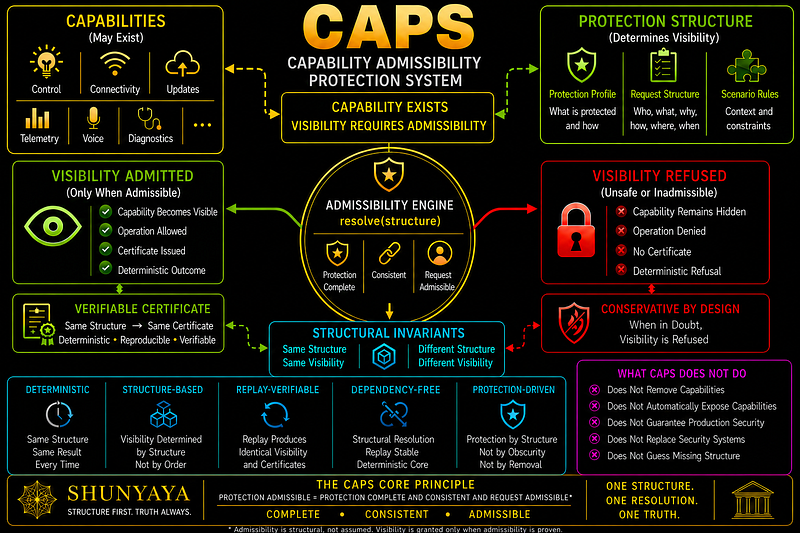
CAPS Architecture — Capability Persistence with Admitted Visibility
Visibility is admitted only when protection structures, request structures, scenarios, and consistency conditions become complete, consistent, and admissible.
⚡ The 30-Second Proof
The easiest way to evaluate CAPS is not through theory.
It is through execution.
Clone the repository:
git clone https://github.com/OMPSHUNYAYA/CAPS.git
cd CAPS
Run the SmartBulb quickstart:
python demo/CAPS-SmartBulb/caps_smartbulb_v0_11.py --quickstart
python demo/CAPS-SmartBulb/caps_smartbulb_v0_11.py --verify
Expected:
Verification Result: PASS
identical certificate across replay
🧪 Try an Unsafe Request
Now try an unsafe request:
python demo/CAPS-SmartBulb/caps_smartbulb_v0_11.py --scenario local_on --profile balanced --request telemetry_leak --explain
What happens inside resolve():
telemetry_leak
↓
scope_valid=False
↓
request_admissible=False
↓
global admissibility gate closes
↓
visibility refused
Telemetry capability persists.
Visibility does not.
The output becomes:
NO FORCED VISIBILITY
🚪 DoorLock, 🌐 Router, and 🖨 Printer Follow The Same Direction
The DoorLock, Router, and Printer demonstrations extend the same structural direction across different capability surfaces:
python demo/CAPS-DoorLock/caps_doorlock_v0_3.py --quickstart
python demo/CAPS-Router/caps_router_v0_2.py --quickstart
python demo/CAPS-Printer/caps_printer_v1_8.py --quickstart
Printer systems introduce something additional:
capability
↓
visibility
↓
governance
↓
output, evidence, custody, decision
The capability surface remains.
Structural posture governs what becomes visible.
Every demonstration supports:
--verify
--matrix
--explain
--challenge
🔬 The Objective Is Simple
Inspect it.
Modify it.
Replay it.
Challenge the invariants.
These are not static architecture diagrams.
These are live, inspectable, replayable structural demonstrations.
🧩 Small Demonstrations, Larger Questions
This direction is intentionally explored through small product demonstrations.
Current reference demonstrations include:
💡 SmartBulb — connected capability surfaces
🚪 DoorLock — physical-access capability surfaces
🌐 Router — infrastructure capability surfaces
🖨 Printer — document-output and governance capability surfaces
Additional demonstrations are expected to progressively expand across broader capability-rich domains.
The demonstrations remain intentionally small.
Not because the problem is small.
Because small demonstrations isolate invariants.
🔁 One Invariant Across Multiple Products
Across demonstrations, the expected behavior remains consistent:
• capability persistence remains stable
• visibility becomes structurally admitted
• replay remains deterministic
• identical structure preserves identical certificates
The product changes.
The capability surface changes.
The question remains unchanged.
🔬 The Challenge — Inspect the Invariants
CAPS intentionally invites falsification.
Clone the repository and attempt to demonstrate any of the following inside the reference implementations:
• identical structure produces different visibility
• unsafe requests produce admitted visibility
• incomplete conditions produce unsafe exposure
• identical structure produces different certificates
⚠️ If Any Of These Can Be Demonstrated
the visibility model fails within that demonstrated space.
That result is worth knowing.
That result is worth publishing.
✅ If None Can Be Demonstrated
capability existence alone may not fundamentally determine visibility within the modeled structure.
The structural question then becomes testable across increasingly larger capability surfaces.
The objective is not agreement.
The objective is reproducible inspection.
🧪 Reproduce The Checks Yourself
Clone the repository:
git clone https://github.com/OMPSHUNYAYA/CAPS.git
cd CAPS
Run verification:
python demo/CAPS-SmartBulb/caps_smartbulb_v0_11.py --verify
python demo/CAPS-DoorLock/caps_doorlock_v0_3.py --verify
python demo/CAPS-Router/caps_router_v0_2.py --verify
python demo/CAPS-Printer/caps_printer_v1_8.py --verify
🔁 Observe The Invariant
same structure
↓
same visibility
↓
same certificate
🎯 What The Challenge Really Tests
The challenge is intentionally simple:
Can visibility become structurally governed?
Or does capability existence alone inevitably force exposure?
CAPS does not ask readers to agree.
CAPS asks readers to inspect.
🌐 Four Domains, One Invariant
CAPS currently spans four product demonstrations.
Each contains a different capability surface.
Each is governed by the same structural logic.
💡 SmartBulb
Ten capabilities coexist simultaneously, including:
• local switching
• WiFi
• telemetry
• voice assistant
• OTA update
• cloud API
Under a simple local-on scenario, only the capabilities required for local operation become visible.
The remaining capabilities continue to exist.
They simply do not automatically participate in visibility.
🚪 DoorLock
Twelve capabilities coexist simultaneously, including:
• deadbolt mechanism
• credential store
• remote unlock API
• guest access manager
• access logs
• firmware update
• admin console
Under a local lock scenario, only the capabilities required for bounded physical access become visible.
Remote unlock surfaces, logging surfaces, and administrative surfaces remain structurally dormant, isolated, blocked, or forbidden depending on the protection structure.
The capabilities persist.
Visibility does not automatically follow.
🌐 Router
Twenty capabilities coexist simultaneously, including:
• packet forwarding
• stateful firewall
• remote admin API
• telemetry export
• cloud management
• VPN systems
• traffic analytics
Under a normal browsing scenario, only the capabilities necessary for routing and bounded network operation participate in visibility.
Remote administration, telemetry export, and higher exposure surfaces remain governed by structural admissibility.
🖨 Printer
Twenty-two capabilities coexist simultaneously, including:
print engines
remote print APIs
document queues
secure release
audit systems
credential systems
firmware channels
cache systems
vendor service surfaces
evidence retention
custody controls
Under a remote-print governance scenario, capability existence remains preserved while output, movement, evidence, release posture, and governance surfaces become structurally admitted.
Examples observed include:
remote print capability exists while output remains held
document cache remains visible while physical output disappears
evidence persists while movement visibility becomes deferred
vendor-service surfaces remain isolated
The capability surface exists.
The admitted visibility surface changes.
🔁 One Structural Invariant
The product changes.
The capability surface changes.
The structural invariant remains:
same structure -> same visibility -> same certificate
⚙️ The Formal Core
CAPS is an executable realization within the broader Shunyaya structural mathematics framework.
The central invariant becomes:
capability_visible iff protection_admissible
where admissibility requires three simultaneous conditions:
protection_admissible = protection_complete AND protection_consistent AND request_admissible
🧩 In Simple Terms
Visibility is admitted only when:
• protection structure is complete
• protection structure is internally consistent
• request structure is admissible for the selected scenario and profile
🚫 What Happens When Conditions Fail?
If any condition fails:
the global admissibility gate closes.
Capabilities that may otherwise have resolved to VISIBLE or ISOLATED collapse into BLOCKED instead.
The visibility resolver becomes:
visibility = resolve(capability, scenario, protection_profile, request_structure)
🔄 Structural Collapse Invariant
The structural collapse invariant becomes:
phi((m,a,s)) = m
where:
m = capability existence
a = admissibility result
s = structural context
The consequence is simple:
capability existence remains unchanged regardless of the admissibility result.
Capability is not removed.
Visibility is refused.
These are different things.
🔁 The Core Invariants Repeated Throughout CAPS
This produces the central invariants repeatedly observed throughout CAPS:
same structure -> same visibility
same structure -> same certificate
🧪 Why Determinism Exists
This is also why the demonstrations remain deterministic and replayable.
resolve() behaves as a pure structural resolver:
• no hidden state
• no timestamps
• no randomness
• no replay drift
🎯 The Consequence
The same structure always produces:
same visibility
↓
same certificate
↓
same outcome
🌍 Where This Direction Matters
The demonstrations are intentionally small.
The implications are not.
📡 Consumer and Industrial IoT
Devices may ship with rich capability surfaces while keeping telemetry, diagnostics, update channels, and higher-exposure capabilities structurally dormant until visibility becomes admissible.
Capability growth no longer automatically forces exposure growth.
🏭 Critical Infrastructure and OT
Routers, gateways, and industrial controllers may benefit from a structural least-visibility property.
Visibility becomes a safety and reliability concern, not only a security concern.
A router may contain remote administration capability while normal browsing scenarios admit only the visibility required for routing.
🛡️ Zero Trust and Enterprise
Visibility itself becomes an admissibility decision.
Identity remains necessary.
Identity alone is not sufficient.
Request structure, scenario, protection profile, and provenance must also become admissible.
🔒 Privacy and Regulation
Privacy-by-design shifts from policy language toward structurally enforceable behavior.
Telemetry, diagnostics, and data export surfaces participate only when purpose, scope, provenance, and structural conditions become complete and consistent.
🤖 Agentic and Autonomous Systems
Perhaps the most forward-looking application.
A capable AI system may possess rich functionality without automatically exposing those capabilities to users, networks, tools, or other agents.
🔁 The Same Structural Question Remains
Across every domain, the question remains surprisingly similar:
Capabilities may exist.
Should visibility automatically follow?
🔭 From Small Demonstrations To Larger Capability Surfaces
Whether capability visibility ultimately proves useful across broader product ecosystems remains intentionally open.
That is precisely why CAPS is explored through demonstrations rather than theoretical claims.
Small demonstrations first.
Repeated inspection next.
Broader capability surfaces afterward.
🔍 The Easiest Way To Evaluate CAPS
The easiest way to evaluate CAPS is not through this article.
It is through inspection.
Explore the demonstrations, documentation, challenge materials, and reference implementations here:
📚 Open Reference Implementations
The reference implementation demonstrations are released under the Open Standard Reference License — free to:
• use
• study
• implement
• extend
• deploy
See repository licensing details for additional information.
🧪 The Philosophy Remains Simple
Inspect the demonstrations.
Inspect the invariants.
Replay the structures.
Observe the outcomes.
Then decide whether capability visibility itself can become structurally governed.
🚀 This Is The Master Post. The Series Continues.
This post introduces the CAPS master direction.
The next posts will go deeper into the individual demonstrations:
💡 CAPS-SmartBulb — connected-device capability surfaces
🚪 CAPS-DoorLock — physical-access visibility boundaries
🌐 CAPS-Router — infrastructure capability surfaces
🖨 CAPS-Printer — output governance and document visibility surfaces
📈 What Comes Next?
Future posts will progressively expand across additional capability-rich domains including:
🏭 industrial gateways
🏥 medical systems
🚦 autonomous infrastructure
🤖 agentic runtimes
and broader capability-heavy systems where visibility itself may become a structural question.
🔁 One Direction, Many Demonstrations
The demonstrations may change.
The products may change.
The capability surfaces may change.
The structural question remains the same:
Can capability persist while visibility itself becomes governed?
🌍 Join the Structural Revolution
CAPS is one demonstration inside a much larger structural direction.
Across 75+ structural systems spanning correctness, time independence, network independence, observability, communication, infrastructure, identity, traversal, and capability-heavy domains, the broader Shunyaya ecosystem has repeatedly explored a single converging question:
Were the dependencies we assumed fundamental ever truly fundamental?
🧩 The Dependency Elimination Framework
The broader Dependency Elimination Framework explores this through the same structural principle:
outcome_visible iff structure_complete AND structure_consistent
Across domains, the question remains surprisingly similar.
Whether the domain involves:
• time
• decision systems
• money
• AI
• cybersecurity
• identity
• consensus
• networking
• cloud infrastructure
• capability-heavy products
the structural exercise remains the same:
Remove what was never fundamental.
Preserve structure.
Observe what remains.
⚙️ From Dependencies To Structural Questions
The broader structural stack explores this repeatedly by progressively removing assumed dependencies while preserving correctness.
Ordering, execution, clocks, connectivity, visibility, and other assumptions become structural questions rather than permanent requirements.
CAPS applies this same question specifically to capability visibility.
Capability may persist while visibility itself becomes governed by admissibility.
🔍 The Easiest Way To Evaluate This Direction
The easiest way to evaluate this direction is not through assertion.
It is through inspection.
Explore the broader structural ecosystem here:
🚀 One Framework. Many Domains. Increasingly Larger Questions.
This is not capability reduction.
This is capability separation.
same structure -> same visibility -> same certificate
Structure first. Truth always.
OMP


Comments
Post a Comment