🛡️ The Safest SMS May Be the SMS That Refuses to Deliver - Proof in ~1.62 KB
Admissibility Before Message Delivery
(Safety remains conditional on the correctness, completeness, and governance quality of the admissibility rules themselves — not on refusal alone.)
Within the SMAIRE framework, refusal under inadmissible messaging structure is treated as a form of bounded messaging intelligence — not failure.
The kernel below is a deterministic Python function.
SMAIRE does not claim perfect telecom security, universal protection, elimination of spam, or elimination of all malicious messaging across all environments.
This post is part of the broader Shunyaya ecosystem (Shunyaya — The Flow of Zero), which treats Zero as a dynamic baseline and introduces conservative structural layers that add governance, admissibility, and observability while always collapsing cleanly back to classical results.
SMAIRE applies the same principle to messaging infrastructure:
structure -> admissibility -> delivery
The narrower architectural claim is this:
placing an admissibility gate before message delivery can structurally constrain delivery realization, routing realization, message authorization, and machine-scale communication before delivery begins.
We spent years teaching systems how to deliver messages.
Almost nobody taught systems when not to deliver.
Modern messaging systems increasingly:
- authenticate senders
- route messages
- synchronize infrastructure
- exchange delivery events
- coordinate devices
- trigger notifications
- authorize participation
- support machine-scale communication
But a deeper question remained structurally unresolved:
Should message delivery occur at all?
Traditional messaging architectures typically assume:
send -> route -> deliver
But what if — within a structurally governed framework — messaging intelligence also includes the ability to refuse delivery under structurally inadmissible conditions?
SMAIRE proposes this as an architectural principle rather than a universal definition of messaging intelligence:
structure -> admissibility -> delivery
Not all message delivery is admissible.
That may become one of the defining architectural principles of the autonomous communication era.
This is SMAIRE:
Structural SMS Admissibility & Integrity Resolution Engine
Admissibility Before Message Delivery
Before the Architecture: A Concrete Scenario
A hospital command center receives dozens of structurally complete machine-generated messages during a mass-casualty incident.
All required fields are present.
No conflicts exist.
No forbidden conditions are active.
The policy layer still returns ABSTAIN on most messages because the infrastructure is operating in a temporary "quiet mode" designed to prevent staff overload during emergency stabilization.
Only the highest-priority life-critical messages become SMS_ADMISSIBLE.
Nurses receive a calm, focused alert stream instead of notification saturation.
The structure remained valid.
The delivery was intentionally and intelligently withheld.
That is the SMAIRE posture.
Not maximum delivery. Structurally bounded delivery.
Why Message Delivery Admissibility Matters
This becomes increasingly important as messaging systems begin to:
- coordinate autonomous agents
- support machine-to-machine communication
- route AI-generated messaging
- manage large-scale notification infrastructure
- authorize message delivery
- operate critical infrastructure alerts
- support autonomous systems at scale
The future risk of messaging infrastructure may not simply be spam, phishing, fraud, or unauthorized communication alone.
It may be structurally inadmissible message delivery at machine scale.
SMAIRE explores whether message delivery may itself require structural admissibility before it proceeds.
The Shift
Traditional messaging systems are typically optimized for:
- message delivery
- routing speed
- authentication
- delivery success
- throughput
- sender participation
- notification orchestration
The implicit assumption is usually:
more delivery = better communication
SMAIRE explores a different structural direction:
more admissibility awareness = more bounded message delivery
That changes messaging architecture fundamentally.
SMAIRE does not primarily compete on:
- delivery speed
- routing performance
- larger monitoring pipelines
- stronger post-delivery protection
Instead, it introduces a structurally prior question:
Should message delivery materialize at all under the present structure?
That question sits upstream of nearly every metric traditional messaging systems optimize for.
Under SMAIRE:
structure -> admissibility -> delivery
Not every structurally possible message becomes structurally admissible.
A Structural Distinction from Existing Messaging Architectures
Some contemporary enterprise messaging architectures already perform:
- pre-delivery filtering
- policy evaluation
- sender validation
- risk scoring
- behavior analysis
- delivery authorization
SMAIRE does not claim such systems are absent.
The distinction introduced by SMAIRE is narrower and more structural:
message delivery admissibility is treated as a first-class structural delivery boundary rather than as a secondary policy layer operating within a fundamentally delivery-first architecture.
Under SMAIRE, the question is not merely whether a sender passes a policy check.
The deeper question becomes:
Should message delivery become structurally admissible at all before delivery begins?
That distinction remains architecturally meaningful even within environments that already perform pre-delivery evaluation.
Traditional messaging systems often attempt delivery first and evaluate consequences later:
send -> route -> deliver -> monitor
SMAIRE reverses the order:
structure -> admissibility -> delivery
Under SMAIRE, message delivery itself becomes conditional.
Not every structurally possible message becomes structurally admissible.
That distinction matters.
A message may be:
- send-capable
- authentication-capable
- routing-compatible
- delivery-ready
and still remain structurally inadmissible.
SMAIRE therefore introduces a different question before message delivery begins:
Should this message exist under the present structure at all?
This creates a fundamentally different posture toward messaging infrastructure.
Not delivery without limits.
Not refusal without reasoning.
But structurally bounded message delivery.
Under SMAIRE:
- incomplete structure may refuse delivery
- conflicting structure may refuse delivery
- forbidden structure may refuse delivery
- unstable structure may refuse delivery
The refusal is not failure.
Within SMAIRE, the refusal may become part of bounded messaging intelligence itself.
Traditional vs. SMAIRE Messaging Posture
+-----------------------+----------------------------------------------+------------------------------------------------+
| Aspect                | Traditional Messaging Systems                | SMAIRE Structural Posture                      |
+-----------------------+----------------------------------------------+------------------------------------------------+
| Decision Order        | send -> route -> deliver -> notify           | structure -> admissibility -> delivery         |
| Core Question         | Can the message deliver?                     | Should delivery occur at all?                  |
| Protection Timing     | Mostly post-delivery                         | Pre-delivery structural gate                   |
| Refusal Semantics     | Filtering, blocking, spam reaction           | Structural REFUSE / ABSTAIN states             |
| Stability Source      | Routing + delivery infrastructure            | Admissibility structure                        |
| Failure Mode          | Delivery begins before evaluation stabilizes | Delivery never begins if inadmissible          |
| Intelligence Signal   | Successful delivery                          | Bounded refusal as intelligent outcome         |
| Infrastructure Load   | Unbounded delivery posture                   | Bounded by admissibility and delivery relevance|
| Architectural Posture | Delivery-first messaging                     | Admissibility-first delivery                   |
+-----------------------+----------------------------------------------+------------------------------------------------+
This table makes the architectural inversion immediately visible.
SMAIRE Pipeline — Structure -> Admissibility -> Delivery
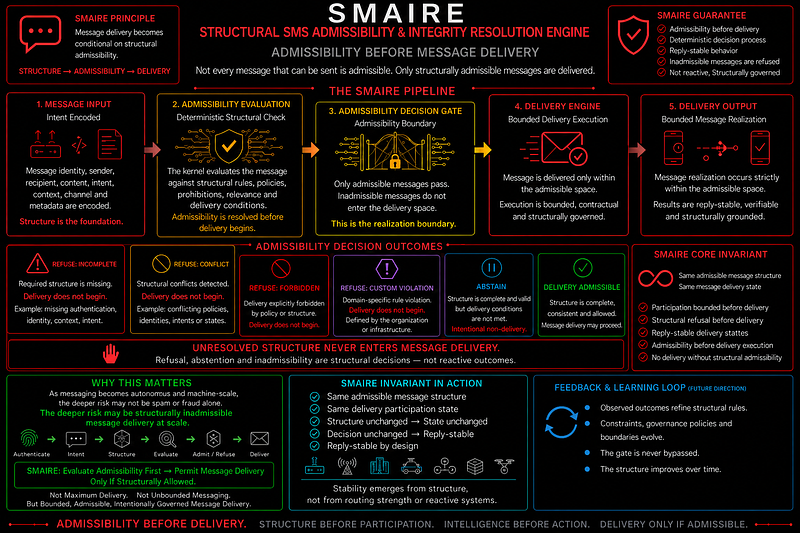
SMAIRE introduces a structural admissibility layer before message delivery begins.
Only admissible messaging structures enter the delivery space.
If structural admissibility resolves to:
REFUSE: INCOMPLETEREFUSE: CONFLICTREFUSE: FORBIDDENREFUSE: CUSTOM_VIOLATION
or ABSTAIN
message delivery does not proceed.
The minimal kernel below demonstrates the core admissibility logic.
A Note on ABSTAIN vs REFUSE: INCOMPLETE
REFUSE: INCOMPLETE occurs when required structural fields such as sender identity, delivery authorization, delivery intent, or messaging context are missing.
The message delivery structure is therefore incomplete.
ABSTAIN is different.
Under SMAIRE, ABSTAIN may be explicitly declared when message delivery conditions are not met even though the structure itself remains internally valid and consistent.
Examples may include:
- policy-withheld delivery
- deferred delivery requests
- quarantined sender states
- conditionally non-deliverable messages
- intentionally paused message delivery
The messaging system therefore signals intentional non-delivery rather than structural failure.
This distinction matters in real-world messaging systems where a sender or delivery request may remain structurally sound while intentionally inactive, isolated, delayed, or temporarily withheld from message delivery.
Real-world example
An autonomous infrastructure coordination system may receive a structurally complete message delivery request from a machine participant:
- all required delivery fields are present
- no conflicts exist
- no forbidden delivery conditions are active
However, the policy layer may still return ABSTAIN because the infrastructure is currently operating in a temporary "quiet mode" for regulatory, coordination, emergency, or stability-management reasons.
The structure remains valid.
The delivery is intentionally withheld.
The Delivery Boundary
Modern messaging protection systems often focus on:
- authentication
- encryption
- spam filtering
- fraud detection
- sender reputation
- anomaly monitoring
- post-delivery isolation
But SMAIRE explores a more structural question:
What if inadmissible message delivery should never begin in the first place?
That changes the position of messaging protection itself within the architecture.
Traditional messaging systems frequently operate like this:
send -> authenticate -> deliver -> monitor
This is not inherently unsafe.
However, it is structurally ordered around delivery first and evaluation second.
Protection evaluation therefore often occurs after message delivery has already begun.
SMAIRE explores a different posture:
evaluate admissibility -> permit delivery only if structurally allowed
This creates a fundamentally different message delivery boundary.
Under SMAIRE:
- refusal is not a fallback
- refusal is not merely spam filtering
- refusal is not post-delivery isolation
- refusal is not probabilistic anomaly reaction
Refusal becomes structurally governed.
That distinction is critical.
A message may be:
- send-capable
- authentication-capable
- routing-compatible
- commercially deliverable
and still remain structurally inadmissible.
SMAIRE therefore treats admissibility as a prerequisite to message delivery itself.
Not every deliverable message should participate in the communication space.
The Simple Message Delivery Admissibility Kernel v1 (~1.62 KB)
SMAIRE can be expressed through a very small structural kernel.
The goal is not to simulate a complete telecom security stack.
The goal is to determine whether message delivery becomes structurally admissible before delivery begins.
def SMAIRE(S, custom_checks=None):

    if S.get("forbidden"):
        return "REFUSE: FORBIDDEN"

    if S.get("conflict"):
        return "REFUSE: CONFLICT"

    if S.get("abstain"):
        return "ABSTAIN"

    required = [
        "sender_identity",
        "delivery_authorization",
        "delivery_intent",
        "message_context"
    ]

    if any(not S.get(k) for k in required):
        return "REFUSE: INCOMPLETE"

    if custom_checks:
        for check in custom_checks:
            if check(S):
                return "REFUSE: CUSTOM_VIOLATION"

    return "SMS_ADMISSIBLE"


result = SMAIRE({
    "sender_identity": True,
    "delivery_authorization": True,
    "delivery_intent": True,
    "message_context": True,
    "conflict": False,
    "forbidden": False
})

print(result)
# SMS_ADMISSIBLE

# Failure-state examples — same invariant, different structures:

print(SMAIRE({"forbidden": True}))
# REFUSE: FORBIDDEN

print(SMAIRE({"conflict": True, "abstain": True}))
# REFUSE: CONFLICT  <- conflict takes precedence over abstain

print(SMAIRE({
    "sender_identity": True,
    "conflict": False,
    "forbidden": False,
    # delivery_authorization, delivery_intent,
    # and message_context are missing
}))
# REFUSE: INCOMPLETE

print(SMAIRE({
    "abstain": True,
    "sender_identity": True,
    "delivery_authorization": True,
    "delivery_intent": True,
    "message_context": True,
    "conflict": False,
    "forbidden": False
}))
# ABSTAIN  <- structure valid, delivery intentionally withheld

# The invariant holds across admissible and inadmissible states alike.
Structural Priority Ordering Within the Kernel
The SMAIRE kernel evaluates structural delivery states in a deliberate priority order.
FORBIDDEN is evaluated first — explicit prohibition represents the strongest structural constraint.
CONFLICT is evaluated second — structural contradictions must resolve before delivery policy states are considered.
ABSTAIN is evaluated third — intentional non-delivery remains distinct from structural failure.
INCOMPLETE is evaluated afterward among the refusal states — missing delivery fields represent weaker structural violations than explicit contradictions or prohibitions.
This ordering is intentional.
A structure that is both conflicting and policy-withheld resolves to:
REFUSE: CONFLICT
not:
ABSTAIN
Harder structural violations therefore take precedence over softer delivery states.
Traditional messaging systems often operate like this:
send -> authentication -> delivery
SMAIRE introduces a structural admissibility layer before message delivery:
structure -> admissibility -> delivery
Run:
smaire_kernel.py
Under identical messaging structure, repeated execution produces the same deterministic delivery state sequence:
C:\Users\ASUS\Desktop\SMAIRE>python smaire_kernel.py
SMS_ADMISSIBLE
REFUSE: FORBIDDEN
REFUSE: CONFLICT
REFUSE: INCOMPLETE
ABSTAIN

C:\Users\ASUS\Desktop\SMAIRE>python smaire_kernel.py
SMS_ADMISSIBLE
REFUSE: FORBIDDEN
REFUSE: CONFLICT
REFUSE: INCOMPLETE
ABSTAIN

C:\Users\ASUS\Desktop\SMAIRE>python smaire_kernel.py
SMS_ADMISSIBLE
REFUSE: FORBIDDEN
REFUSE: CONFLICT
REFUSE: INCOMPLETE
ABSTAIN
This demonstrates the SMAIRE invariant:
same messaging structure -> same message delivery state
The kernel is intentionally minimal.
The goal is not to replace SMS infrastructure, telecom routing, authentication systems, messaging platforms, or security infrastructure.
The goal is structural admissibility before message delivery begins.
SMAIRE v2 — Extensible Messaging Rules & Domain Libraries
The minimal SMAIRE kernel already supports lightweight custom structural rules.
For real-world deployment after independent validation, safety review, and domain-specific messaging testing, these rules may be used to define organization-specific delivery admissibility boundaries.
Example custom rules:
def unstable_delivery_check(S):

    return (
        S.get("delivery_stability") == "unstable"
        and
        not S.get("quarantine_allowed")
    )

def conflicting_intent_check(S):
    return (
        S.get("delivery_intent") == "high_priority"
        and
        S.get("sender_type") == "automated_agent"
        and
        S.get("trust_score", 100) < 15
    )

def policy_withheld_check(S):
    return S.get("policy_status") == "quarantined"
If any rule fires, SMAIRE returns:
REFUSE: CUSTOM_VIOLATION
This preserves the SMAIRE invariant:
same messaging structure -> same message delivery state
while allowing messaging platforms, enterprises, autonomous systems, notification infrastructure, and machine-scale communication environments to introduce domain-specific delivery admissibility policies before delivery begins.
Future SMAIRE kernel directions may explore:
- cryptographic structure binding
- hierarchical admissibility (
sender -> domain -> infrastructure) - structural completeness scoring
- replay-stable message delivery observability (replay-stable: the same admissibility structure always resolves to the same delivery state across repeated executions; distinct from replay-attack resistance, which is a separate security property)
- domain-specific admissibility libraries
Potential future research directions may include:
- smaire-enterprise — curated admissibility policy libraries for enterprise messaging environments
- smaire-agentic — admissibility rules for LLM, AI-agent, and autonomous messaging ecosystems
- smaire-critical — bounded delivery frameworks for healthcare, energy, transportation, and public-safety infrastructure
- smaire-iot — lightweight admissibility kernels for constrained and machine-scale devices
These libraries may eventually provide reusable structural admissibility policies for different message delivery environments without requiring organizations to define every rule from scratch.
What Just Happened?
No telecom protocol was replaced.
No messaging infrastructure was rebuilt.
No authentication standard was removed.
No delivery stack was rewritten.
Only the structure was evaluated before delivery materialized.
That is the shift.
Even in ~1.62 KB:
- structural message delivery admissibility gates can exist before delivery begins
- inadmissible message delivery can refuse structurally
- replay-stable delivery states can emerge from structure alone
- unresolved messaging structure does not need to be forced into message delivery
Under SMAIRE:
- message delivery may proceed
- message delivery may pause
- message delivery may abstain
- message delivery may refuse entirely
The refusal is therefore not reactive.
The refusal becomes structural.
Cross-System Synergies — AIR + SURE + STARR + SWAIRE + SMAIRE
SMAIRE is designed to compose cleanly with other Shunyaya structural systems.
- AIR (Admissibility Before Autonomy) may first determine whether an autonomous agent should form a messaging or participation intent at all. Only structurally admissible intents proceed toward realization.
- SURE (Structural Universal Resolution Engine) may generate structurally bounded messaging and participation structures before runtime participation begins.
- STARR (Structural Admissibility Resolution) may publish admissible participation and delivery representations that SWAIRE and SMAIRE can evaluate and enforce across distributed infrastructure environments.
- SWAIRE (Structural Wireless Admissibility & Integrity Resolution Engine) may evaluate whether wireless participation itself becomes structurally admissible before connectivity begins.
SMAIRE (Structural SMS Admissibility & Integrity Resolution Engine) may then evaluate whether message delivery itself becomes structurally admissible before delivery begins.
Together, they form a layered structural participation and delivery pipeline:
intent (AIR) -> structure (SURE) -> representation (STARR) -> participation (SWAIRE) -> delivery (SMAIRE)
To make this more concrete:
AIR evaluates whether an autonomous agent should form a participation or delivery intent at all.
Only structurally admissible intents proceed.
SURE generates a structurally bounded and internally consistent participation and delivery structure from that intent.
Only structurally valid structures move forward.
STARR defines and publishes admissible participation and delivery representations — for example, declaring that certain participation classes carry:
forbidden: true
These representations become structurally evaluable participation and delivery inputs.
SWAIRE receives the resulting structure and evaluates it against the wireless participation admissibility gate.
For example, a structure carrying:
forbidden: true
causes SWAIRE to return:
REFUSE: FORBIDDEN
before any connectivity attempt begins.
If participation becomes admissible, SMAIRE may then evaluate whether message delivery itself remains structurally admissible before delivery proceeds.
For example, delivery structures containing:
conflict: true
or
policy_status: quarantined
may cause SMAIRE to return:
REFUSE: CONFLICT
or
ABSTAIN
before delivery begins.
Bounded participation and delivery therefore emerge from layered structural admissibility gates rather than from any single monolithic system.
Each layer gates the next.
No layer bypasses structural evaluation.
Admissibility-Aware Messaging Systems
Most messaging systems are evaluated by:
- delivery speed
- routing reach
- notification capability
- participation scale
- throughput efficiency
- delivery success
SMAIRE introduces a different evaluation layer:
message delivery admissibility
The question is no longer only:
Can the message deliver?
The deeper question becomes:
Should message delivery occur at all under the present structure?
SMAIRE introduces deterministic message delivery states before delivery begins:
SMS_ADMISSIBLEABSTAINREFUSE: INCOMPLETEREFUSE: CONFLICTREFUSE: FORBIDDENREFUSE: CUSTOM_VIOLATION
These states are resolved structurally before delivery proceeds.
That distinction matters.
Traditional messaging systems often operate like this:
send -> route -> deliver -> monitor
SMAIRE instead evaluates:
structure -> admissibility -> delivery
Under SMAIRE:
- incomplete structure may block delivery
- conflicting structure may block delivery
- forbidden structure may block delivery
- unstable structure may block delivery
The system therefore does not ask only:
Can delivery occur?
It asks:
Is message delivery structurally admissible at all?
That shift appears small.
Architecturally, it is not.
Under SMAIRE, the most intelligent messaging outcome may sometimes be:
- refusal
- abstention
- bounded delivery
- delayed delivery
- quarantined delivery
This creates a fundamentally different posture toward messaging infrastructure.
Not:
- systems that always deliver
- systems that always authorize
- systems that always permit communication
But messaging systems that remain structurally bounded before delivery begins.
SMAIRE therefore explores a different category of messaging infrastructure:
admissibility-aware messaging systems — optimized not for maximum delivery, but for structurally admissible communication.
The SMAIRE Invariant
SMAIRE explores a simple but precise structural invariant:
same messaging structure -> same message delivery state
This holds across all inputs — admissible and inadmissible alike.
A FORBIDDEN structure always returns REFUSE: FORBIDDEN.
An INCOMPLETE structure always returns REFUSE: INCOMPLETE.
A fully admissible structure always returns SMS_ADMISSIBLE.
The invariant is not limited to admissible cases.
It covers the entire message delivery state space.
If the admissibility structure remains unchanged:
- the message delivery posture remains unchanged
- the admissibility state remains unchanged
- the delivery boundary remains unchanged
This creates replay-stable message delivery behavior without requiring:
- authentication redesign
- telecom infrastructure replacement
- messaging protocol rebuilding
- probabilistic anomaly escalation
- reactive delivery control
The structural claim is narrow but important:
message delivery stability may emerge from admissibility structure itself.
Not from:
- stronger routing infrastructure alone
- larger monitoring pipelines
- post-delivery isolation layers
- increasingly reactive messaging escalation systems
Under SMAIRE, message delivery stability becomes structurally bounded before delivery begins.
That shift may become increasingly important as messaging infrastructure moves toward autonomous, machine-scale communication ecosystems.
Architectural Direction — Adaptive Message Delivery Admissibility
Future SMAIRE architecture may explore adaptive message delivery admissibility layers in which observed delivery outcomes refine structural rules, delivery constraints, quarantine policies, and admissibility boundaries over time.
The admissibility gate itself is never bypassed.
However, the structure evaluated by the gate may mature through:
- replay analysis
- delivery history
- bounded messaging feedback
- infrastructure policy refinement
- observed delivery stability
- structural anomaly learning
This remains an architectural direction for future SMAIRE versions and is not demonstrated by the current minimal kernel.
What SMAIRE Is Not
SMAIRE does not claim:
- universal messaging security
- perfect protection
- elimination of all malicious communication
- elimination of messaging protocols
- elimination of authentication systems
- elimination of telecom infrastructure
The claim is narrower.
SMAIRE explores whether message delivery may first require:
structural admissibility
before delivery proceeds.
The system therefore does not attempt to guarantee:
- universal safety
- perfect authorization
- absolute trust
- correctness of all messaging outcomes
Instead, SMAIRE introduces a structural posture:
inadmissible message delivery may refuse to materialize
That distinction matters.
SMAIRE is therefore not:
- a replacement for messaging infrastructure
- a replacement for authentication protocols
- a replacement for telecom security infrastructure
It is an admissibility layer.
A structural message delivery boundary before delivery begins.
One important structural note:
the safety properties of SMAIRE remain conditional on the correctness, completeness, and governance quality of the admissibility rules supplied to the kernel.
A misconfigured rule set — for example, one that incorrectly marks a critical alert as ABSTAIN — may still produce a structurally governed yet operationally incorrect outcome.
This is why independent validation, domain-specific testing, infrastructure review, and human oversight remain essential complements to any admissibility-first architecture.
Immediate Implications & Path to Impact
If structurally bounded message delivery becomes viable at scale — through independent validation, messaging testing, infrastructure review, and domain-specific adaptation — the architectural posture introduced by SMAIRE may extend far beyond traditional SMS environments.
Potential high-leverage domains include:
- enterprise messaging infrastructure
- large-scale notification systems
- autonomous agent communication
- machine-to-machine coordination
- distributed communication environments
- critical infrastructure alert systems
- future autonomous communication ecosystems
Potential future SMAIRE infrastructure directions may explore:
- lightweight messaging reference integrations
- replay-stable delivery observability
- structural delivery simulation environments including future reproducible large-scale communication simulations for evaluating admissibility behavior and delivery stability
- formal admissibility state modeling
- domain-specific messaging admissibility libraries
- distributed delivery governance
Potential future research directions may include:
smaire-enterprisesmaire-agenticsmaire-criticalsmaire-iot
Sustainability & Infrastructure Efficiency
By refusing structurally inadmissible message delivery before delivery begins, SMAIRE may eventually help reduce:
- unnecessary machine-scale communication
- avoidable delivery infrastructure overhead
- energy consumption from inadmissible message delivery
- unnecessary escalation surfaces
This introduces a broader possibility:
intelligent delivery refusal may eventually become both:
- a communication security posture
- an infrastructure efficiency posture
The architectural shift remains simple:
message delivery becomes conditional on admissibility
That changes the posture of messaging infrastructure itself.
Not:
- maximum delivery
- maximum participation
- maximum authorization
But:
bounded message delivery under structural admissibility
As communication ecosystems become increasingly autonomous, distributed, and machine-scale, this distinction may become increasingly important.
The future of messaging infrastructure may not depend only on systems that can deliver.
It may increasingly depend on systems that know when not to.
Current Limitations
SMAIRE v1 is intentionally a structural message delivery admissibility demonstration — not a complete telecom protection or communication security system.
Current limitations include:
The kernel operates on explicitly declared messaging structure only. Hidden sender behavior, undiscovered attack vectors, spoofed communication environments, or emergent delivery patterns may still require upstream analysis systems.
SMAIRE does not yet include:
- cryptographic attestation
- distributed trust infrastructure
- replay-resistant delivery verification
- hardware-backed identity guarantees
- distributed consensus validation
- full distributed audit infrastructure
SMAIRE does not replace:
- messaging encryption
- authentication protocols
- fraud detection systems
- telecom infrastructure
- delivery governance
- communication supervision
- human oversight
Structural admissibility alone does not guarantee:
- universal security
- perfect trust
- legal compliance
- elimination of all malicious communication
- correctness of all messaging outcomes
SMAIRE instead introduces a narrower architectural claim:
inadmissible message delivery may be structurally refused before delivery begins.
SMAIRE — Structural SMS Admissibility & Integrity Resolution Engine
SMAIRE explores a simple but potentially foundational idea:
admissibility before delivery
Not every deliverable message becomes admissible.
Not every message delivery request should materialize.
As communication ecosystems increasingly move from human-managed messaging toward autonomous machine-scale communication, that distinction may become structurally important.
The architectural shift introduced by SMAIRE is small:
structure -> admissibility -> delivery
Its implications may not be.
The kernel is tiny.
The architectural posture is not.
Part of the Shunyaya structural ecosystem exploring deterministic admissibility, bounded delivery, and structurally governed communication infrastructure.
Open Structural Message Delivery Admissibility Demonstration
This tiny kernel is an open structural message delivery admissibility demonstration — free to use, study, implement, and extend.
Core invariant:
same messaging structure -> same message delivery state
SMAIRE explores:
- structural admissibility before delivery
- bounded message delivery
- replay-stable delivery behavior
This is not a complete telecom operating system, universal messaging security framework, or production-scale communication governance platform.
The broader SMAIRE architecture and admissibility ecosystem belong to the wider Shunyaya structural framework.
Authorship & Disclaimer
Created by the authors of the Shunyaya Framework.
Deterministic structural message delivery demonstration only.
Not intended for production deployment in enterprise, autonomous, industrial, medical, transportation, defense, critical infrastructure, financial, governmental, or safety-critical communication environments without independent validation, infrastructure review, and security testing.
Related Structural Systems

AIR -> SURE -> STARR -> SWAIRE -> SMAIRE: bounded participation and delivery emerge from layered structural gates — not from any single system.
SMAIRE is part of a broader family of structural systems exploring admissibility, bounded participation, deterministic resolution, and structure-first coordination across domains.
Medium
• SWAIRE — admissibility before connectivity
• AIR — admissibility before autonomous realization
• SURE — bounded AI admissibility and structural generation
• STARR — structural admissibility resolution before realization begins
• SRI — intelligence admissibility before AI execution
• SLANG — deterministic resolution without workflow dependency
• STRUMER — structural media resolution without editing workflows
• STILE — deterministic message delivery through structural alignment
GitHub
• STINT-Money — structural settlement without continuous connectivity
Join the structural revolution.
Explore the broader Shunyaya structural ecosystem across 75+ deterministic systems and executable proofs.
A Final Question
If two messaging systems receive:
- the same admissibility structure
- the same delivery boundaries
- the same structural constraints
yet resolve toward incompatible message delivery states without any structural difference,
where does the delivery divergence originate?
Under SMAIRE, this suggests the messaging structure was not actually complete.
A condition remained implicit.
A delivery boundary remained unresolved.
A structural constraint remained underspecified.
A structurally complete message delivery admissibility space does not permit arbitrary delivery divergence.
That is the structural claim.
And if message delivery remains stable under the same admissibility structure,
what does that imply about messaging infrastructure itself?
It suggests that bounded message delivery may fundamentally be a structural property —
not merely a delivery property.
Try It
Run the kernel locally:
python smaire_kernel.py
Then modify the structure and observe how the delivery boundary changes:
- Add
"abstain": True - Add a custom rule returning
REFUSE: CUSTOM_VIOLATION - Remove
"delivery_authorization" - Add conflicting structural delivery conditions
Observe what changes.
The important shift is not stronger delivery infrastructure.
The important shift is this:
message delivery becomes structurally bounded before delivery begins
structure -> admissibility -> delivery
Potential future SMAIRE ecosystem directions may explore:
- interactive structural delivery simulators
- visual delivery admissibility state exploration
- replay-stable delivery analysis tooling
- formal admissibility state modeling
- signed structural delivery layers
- distributed communication observability
That may become one of the most important architectural principles of future communication infrastructure.
OMP


Comments
Post a Comment