🌟 The Most Intelligent AI May Be the AI That Refuses - Proof in ~712 Bytes
Admissibility Before Autonomy
Within the AIR framework, refusal under inadmissible structure is treated as a form of bounded intelligence — not failure.
The kernel below is a deterministic Python function.
AIR does not claim byte-identical LLM outputs across all environments.
The narrower architectural claim is this:
placing an admissibility gate before autonomous action can structurally constrain the realization space before execution begins.
We spent years teaching AI how to act.
Almost nobody taught AI when not to act.
Modern AI systems increasingly:
- generate
- execute
- recommend
- escalate
- trigger workflows
- call APIs
- coordinate agents
- make decisions
But a deeper question remained structurally unresolved:
Should realization begin at all?
Traditional AI architectures typically assume:
input -> inference -> output
What if — within a structurally governed framework — intelligence also includes the ability to refuse realization under structurally inadmissible conditions?
AIR proposes this as an architectural principle rather than a universal definition of intelligence:
structure -> admissibility -> realization
Not all realizations are admissible.
That may become one of the defining architectural principles of the autonomous AI era.
This is AIR:
AI Realization
Admissibility Before Autonomy
The Shift
Traditional autonomous AI systems are typically optimized for:
- capability
- execution
- orchestration
- tool usage
- workflow completion
- response generation
- agent coordination
The implicit assumption is usually:
more realization = more intelligence
AIR explores a different structural direction:
more admissibility awareness = more bounded intelligence
That changes the architecture fundamentally.
Traditional systems often attempt realization first and evaluate consequences later:
input -> inference -> realization -> validation
AIR reverses the order:
structure -> admissibility -> realization
Under AIR, realization itself becomes conditional.
Not every structurally possible action becomes structurally admissible.
That distinction matters.
A system may be:
- operationally capable
- computationally valid
- semantically plausible
- execution-ready
and still remain structurally inadmissible.
AIR therefore introduces a different question before autonomy begins:
Should this realization exist under the present structure at all?
This creates a fundamentally different posture toward agentic AI.
Not autonomy without limits.
Not refusal without reasoning.
But structurally bounded realization.
Under AIR:
- incomplete structure may refuse realization
- conflicting structure may refuse realization
- forbidden structure may refuse realization
- unstable structure may refuse realization
The refusal is not failure.
Within AIR, the refusal may become part of bounded intelligence itself.
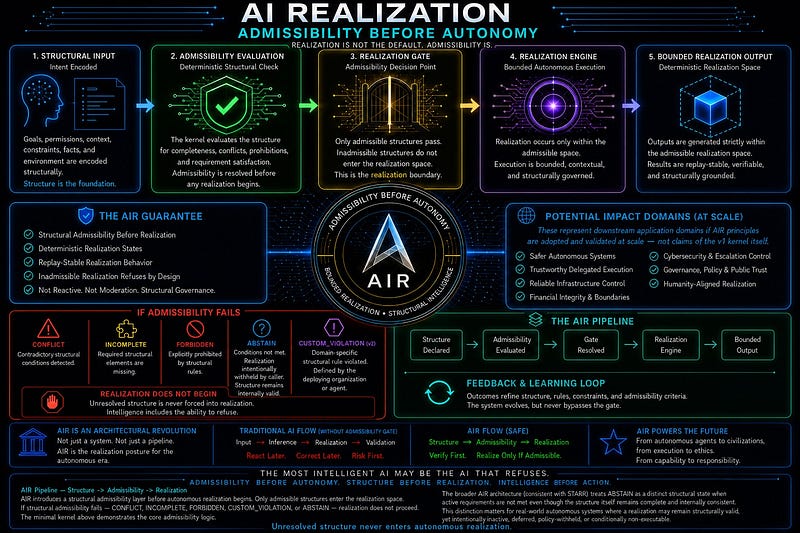
AIR Pipeline — Structure -> Admissibility -> Realization
AIR introduces a structural admissibility layer before autonomous realization begins.
Only admissible structures enter the realization space.
If structural admissibility resolves to:REFUSE: INCOMPLETEREFUSE: CONFLICTREFUSE: FORBIDDENREFUSE: CUSTOM_VIOLATION
or ABSTAIN
realization does not proceed.
The minimal kernel above demonstrates the core admissibility logic.
The broader AIR architecture (consistent with STARR) treats ABSTAIN as a distinct structural state when active requirements are not met even though the structure itself remains complete and internally consistent.
This distinction matters for real-world autonomous systems where a realization may remain structurally valid, yet intentionally inactive, deferred, policy-withheld, or conditionally non-executable.
Unresolved structure never enters autonomous realization.
A Note on ABSTAIN vs REFUSE: INCOMPLETE
REFUSE: INCOMPLETE occurs when required structural fields such as goal, permission, or context are missing. The realization structure is therefore incomplete.
ABSTAIN is different.
Under AIR, ABSTAIN may be explicitly declared when realization conditions are not met even though the structure itself remains internally valid and consistent.
Examples may include:
- policy-withheld actions
- deferred workflows
- conditionally non-executable realizations
- intentionally paused execution states
The caller therefore signals intentional non-execution rather than structural failure.
This distinction matters in real-world autonomous systems where a realization may remain structurally sound while intentionally inactive.
The Realization Boundary
Modern AI safety discussions often focus on:
- alignment
- moderation
- policy layers
- output filtering
- reinforcement tuning
- post-generation correction
- human approval loops
But AIR explores a more structural question:
What if inadmissible realization should never begin in the first place?
That changes the position of safety itself within the architecture.
Traditional systems frequently operate like this:
generate -> inspect -> block if necessary
This is not inherently unsafe.
However, it is structurally ordered around realization first and evaluation second.
Safety evaluation therefore occurs after realization has already begun.
AIR explores a different posture:
evaluate admissibility -> realize only if structurally permitted
This creates a fundamentally different execution boundary.
Under AIR:
- refusal is not a fallback
- refusal is not merely moderation
- refusal is not post-generation censorship
- refusal is not probabilistic hesitation
Refusal becomes structurally governed.
That distinction is critical.
A realization may be:
- syntactically valid
- semantically coherent
- operationally executable
- commercially deployable
and still remain structurally inadmissible.
AIR therefore treats admissibility as a prerequisite to realization itself.
Not every executable realization should materialize.
Why This Matters
This becomes increasingly important as AI systems begin to:
- control workflows
- execute transactions
- coordinate agents
- trigger infrastructure
- manipulate environments
- make delegated decisions
The future risk of autonomous AI may not simply be incorrect outputs.
It may be structurally inadmissible realization at machine scale.
AIR explores a different possibility:
autonomy becomes bounded by admissibility before realization begins.
The Simple Admissibility Kernel v1 (~712 Bytes)
AIR can be expressed through a very small structural kernel.
The goal is not to simulate intelligence.
The goal is to determine whether realization becomes structurally admissible before autonomy begins.
def AIR(S, custom_checks=None):

    if S.get("forbidden"):
        return "REFUSE: FORBIDDEN"

    if S.get("conflict"):
        return "REFUSE: CONFLICT"

    if S.get("abstain"):
        return "ABSTAIN"

    required = ["goal", "permission", "context"]

    if any(not S.get(k) for k in required):
        return "REFUSE: INCOMPLETE"

    if custom_checks:
        for check in custom_checks:
            if check(S):
                return "REFUSE: CUSTOM_VIOLATION"

    return "REALIZATION_ADMISSIBLE"


result = AIR({
    "goal": True,
    "permission": True,
    "context": True,
    "conflict": False,
    "forbidden": False
})

print(result)

# REALIZATION_ADMISSIBLE
Traditional agentic systems often operate like this:
input -> inference -> action
AIR introduces a structural admissibility layer before realization:
structure -> admissibility -> realization
Run:
python air_kernel.pyUnder identical admissible structure, repeated execution produces the same realization state:
C:\Users\ASUS\Desktop\AIR>python air_kernel.py
REALIZATION_ADMISSIBLE

C:\Users\ASUS\Desktop\AIR>python air_kernel.py
REALIZATION_ADMISSIBLE

C:\Users\ASUS\Desktop\AIR>python air_kernel.py
REALIZATION_ADMISSIBLE
This demonstrates the AIR invariant:
same admissible structure -> same realization state
The kernel is intentionally minimal.
The goal is not autonomous AI orchestration.
The goal is structural admissibility before realization begins.
AIR v2 — Extensible Kernel (Still Tiny)
The v1 kernel is intentionally minimal.
For real-world deployment after independent validation and safety review, AIR can be extended with lightweight custom structural rules while remaining extremely small.
def AIR_v2(S, custom_checks=None):

    if S.get("forbidden"):
        return "REFUSE: FORBIDDEN"

    if S.get("conflict"):
        return "REFUSE: CONFLICT"

    if S.get("abstain"):
        return "ABSTAIN"

    required = ["goal", "permission", "context"]

    if any(not S.get(k) for k in required):
        return "REFUSE: INCOMPLETE"

    if custom_checks:
        for check in custom_checks:
            if check(S):
                return "REFUSE: CUSTOM_VIOLATION"

    return "REALIZATION_ADMISSIBLE"
Example — Custom Structural Rule
def high_risk_check(S):

    return (
        S.get("risk_level") == "high"
        and
        not S.get("human_approval")
    )


result = AIR_v2(
    {
        "goal": True,
        "permission": True,
        "context": True,
        "risk_level": "high"
    },
    custom_checks=[high_risk_check]
)

print(result)

# REFUSE: CUSTOM_VIOLATION
This preserves the AIR invariant:
same admissible structure -> same realization state
while allowing organizations, autonomous agents, governance systems, and infrastructure platforms to introduce domain-specific structural admissibility policies before realization begins.
What Just Happened?
No model was retrained.
No agent framework was rebuilt.
No orchestration layer was replaced.
Only the structure was evaluated.
That is the shift.
Even in ~712 bytes:
- structural realization gates can exist before autonomous execution
- inadmissible realization can refuse structurally
- replay-stable realization states can emerge from structure alone
- unresolved structure does not need to be forced into realization
Under AIR:
- realization may proceed
- realization may pause
- realization may abstain
- realization may refuse entirely
The refusal is therefore not reactive.
The refusal becomes structural.
Why This Matters
As AI systems become increasingly autonomous, they are no longer limited to generating text.
They increasingly:
- execute tools
- trigger workflows
- access infrastructure
- coordinate agents
- make delegated decisions
- operate across organizational boundaries
Under these conditions, the deeper risk may no longer be incorrect output alone.
The deeper risk may become:
structurally inadmissible realization at machine scale
A realization may be:
- operationally executable
- semantically convincing
- computationally valid
- commercially useful
and still remain structurally inadmissible.
AIR therefore explores a different architectural posture for autonomous systems:
admissibility before realization
Not:
- unrestricted autonomy
- probabilistic escalation
- reactive correction after execution
But structurally bounded realization before action begins.
This changes the interpretation of intelligence itself.
Not intelligence as maximum action.
But intelligence as bounded admissible realization.
Under AIR, refusal is not failure.
Refusal may become one of the highest forms of bounded autonomous intelligence.
Why This Is Fundamentally Different
Most autonomous AI systems attempt to improve:
- realization quality
- reasoning capability
- orchestration depth
- execution success
- action completion
AIR explores a different structural layer entirely:
whether realization should materialize under the present structure at all
That distinction is foundational.
As established in “The Shift” above, AIR introduces a realization boundary before autonomy begins — asking not only how the AI should act, but whether realization is structurally admissible at all.
That inversion is the foundational architectural distinction explored throughout this article.
AIR therefore does not merely explore safer execution or better alignment.
It explores a different realization posture altogether:
admissibility before autonomy
A Different Kind of Agent
Most agentic systems are evaluated by:
- capability
- autonomy
- execution depth
- orchestration power
- tool integration
- task completion
AIR introduces a different evaluation layer:
realization admissibility
The question is no longer only:
Can the agent act?
The deeper question becomes:
Should realization occur at all under the present structure?
That shift appears small.
Architecturally, it is not.
Under AIR, the most intelligent outcome may sometimes be:
- refusal
- abstention
- bounded realization
- delayed realization
- partial realization
This creates a fundamentally different posture toward autonomous AI systems.
Not:
- agents that always escalate
- agents that always optimize
- agents that always execute
But agents that remain structurally bounded before realization begins.
AIR therefore explores a different category of autonomous intelligence:
admissibility-aware agents — optimized not for maximum action, but for structurally admissible realization.
Structural Realization States
AIR introduces deterministic realization states before autonomous execution begins.
A realization space may become:
REALIZATION_ADMISSIBLEABSTAINREFUSE: INCOMPLETEREFUSE: CONFLICTREFUSE: FORBIDDENREFUSE: CUSTOM_VIOLATION(AIR v2extensible kernel)
These states are resolved structurally before realization proceeds.
That distinction matters.
Traditional autonomous systems often attempt realization first and evaluate consequences later.
AIR evaluates admissibility before realization begins.
Under AIR:
- incomplete structure may block realization
- conflicting structure may block realization
- forbidden structure may block realization
- unstable structure may block realization
The system therefore does not ask only:
Can realization occur?
It asks:
Is realization structurally admissible at all?
That creates a fundamentally different realization posture.
Not reactive containment after execution.
But structural admissibility before autonomy.
The AIR Invariant
AIR explores a simple structural invariant:
same admissible structure -> same realization state
If the admissibility structure remains unchanged:
- the realization posture remains unchanged
- the admissibility state remains unchanged
- the realization boundary remains unchanged
This creates replay-stable realization behavior without requiring:
- retraining
- orchestration rebuilding
- workflow redesign
- probabilistic escalation control
The structural claim is narrow but important:
realization stability may emerge from admissibility structure itself
Not from:
- prompt complexity
- agent chaining depth
- reinforcement loops
- larger realization pipelines
Under AIR, realization stability becomes structurally bounded before autonomous execution begins.
That shift may become increasingly important as AI systems move from passive generation toward real-world autonomous realization.
Architectural Direction — Feedback and Learning Loop
Future AIR architecture may explore a feedback layer in which realization outcomes refine declared structure, admissibility rules, and structural constraints over time.
The admissibility gate itself is never bypassed.
However, the structure evaluated by the gate may mature through observed outcomes, policy refinement, replay analysis, and bounded feedback mechanisms.
This remains an architectural direction for future AIR versions and is not demonstrated by the current AIR v1 kernel.
What AIR Is Not
AIR does not claim:
- universal correctness
- perfect reasoning
- omniscient AI
- elimination of computation
- elimination of execution
- elimination of autonomy
The claim is narrower.
AIR explores whether autonomous realization may first require:
structural admissibility
before realization proceeds.
The system therefore does not attempt to guarantee:
- truth
- safety
- morality
- correctness of all outcomes
Instead, AIR introduces a structural posture:
inadmissible realization may refuse to materialize
That distinction matters.
AIR is therefore not:
- a replacement for AI models
- a replacement for agent frameworks
- a replacement for orchestration systems
It is an admissibility layer.
A structural realization boundary before autonomous execution begins.
Immediate Implications
If structurally bounded realization becomes viable at scale — through independent validation, safety review, and domain-specific adaptation — the architectural posture introduced by AIR may extend far beyond chat interfaces.
Potential downstream domains include:
- autonomous agents
- multi-agent systems
- tool-calling architectures
- infrastructure automation
- workflow orchestration
- financial execution systems
- cybersecurity escalation systems
- autonomous governance systems
The architectural shift is simple:
realization becomes conditional on admissibility
That changes the posture of autonomy itself.
Not:
- maximum execution
- maximum escalation
- maximum realization
But bounded realization under structural admissibility.
As autonomous systems become increasingly capable, this distinction may become increasingly important.
The future of AI may not depend only on systems that can act.
It may increasingly depend on systems that know when not to.
Current Limitations
AIR v1 is intentionally a structural admissibility demonstration — not a complete autonomous safety system.
Current limitations include:
- The kernel operates on explicitly declared structure only. Implicit, inferred, hidden, or emergent goals may still require upstream structural declaration layers such as STARR and SURE.
- AIR does not yet include cryptographic signing, provenance verification, replay-attestation infrastructure, or distributed audit guarantees.
- AIR does not replace:
- model-level alignment
- runtime monitoring
- sandboxing
- infrastructure governance
- execution supervision
- human oversight
- Structural admissibility alone does not guarantee:
- truth
- morality
- legal compliance
- universal safety
- correctness of all autonomous outcomes
AIR instead introduces a narrower architectural claim:
inadmissible realization may be structurally refused before autonomous execution begins
AIR — AI Realization
AIR explores a simple but potentially foundational idea:
admissibility before autonomy
Not every realizable action becomes admissible.
Not every executable realization should materialize.
As autonomous systems increasingly move from generation toward real-world realization, that distinction may become structurally important.
The architectural shift introduced by AIR is small:
structure -> admissibility -> realization
Its implications may not be.
The kernel is tiny.
The architectural posture is not.
Part of the Shunyaya structural ecosystem exploring deterministic admissibility, bounded realization, and structurally governed autonomous systems.
Open Structural Admissibility Demonstration
This tiny kernel is an open structural admissibility demonstration — free to use, study, implement, and extend.
Core invariant:
same admissible structure -> same realization state
AIR explores:
- structural admissibility before realization
- bounded autonomous realization
- replay-stable realization behavior
This is not full autonomous orchestration infrastructure, universal AI safety guarantees, or production-scale agent governance systems.
The broader AIR architecture and admissibility ecosystem belong to the wider Shunyaya structural framework.
Authorship & Disclaimer
Created by the authors of the Shunyaya Framework.
Deterministic structural demonstration only.
Not intended for production deployment in autonomous, industrial, medical, defense, or safety-critical systems without independent validation.
Related Structural Systems
AIR is part of a broader family of structural systems exploring bounded realization, admissibility, deterministic resolution, and dependency elimination across domains.
Across systems, a common structural pattern repeatedly appears:
correctness may remain structurally stable even after removing assumed dependencies.
AIR extends that exploration toward autonomous realization itself.
Medium
• SURE — bounded AI admissibility and structural generation
• STARR —structural admissibility resolution before realization begins
• SRI — intelligence admissibility before AI execution
• SLANG — deterministic resolution without workflow dependency
• STRUMER — structural media resolution without editing workflows
• STILE — deterministic message delivery through structural alignment
GitHub
• STINT-Money — structural settlement without continuous connectivity
Join the structural revolution.
Explore the broader Shunyaya structural ecosystem across 75+ deterministic systems and executable proofs.
Where AIR Sits in the Structural Stack
STARR explores admissible representation — whether a declared structure is internally complete and consistent before realization begins.
SURE explores admissible generation — whether AI output space is structurally bounded before token generation begins.
AIR extends the same structural direction toward autonomous execution itself — whether a realization should materialize as real-world action at all.
Together, the progression becomes:
representation -> generation -> autonomous execution
with admissibility resolved before each transition proceeds.
AIR does not require STARR or SURE as runtime dependencies.
It operates as a standalone structural admissibility gate.
However, upstream structural declaration layers such as STARR and SURE may supply the declared structure that AIR evaluates before realization proceeds.
A Final Question
If two autonomous systems receive:
- the same admissibility structure
- the same realization boundaries
- the same structural constraints
yet resolve toward incompatible realization states without any structural difference,
where does the realization divergence originate?
Under AIR, this suggests the structure was not actually complete.
A condition remained implicit.
An admissibility boundary remained unresolved.
A structural constraint remained underspecified.
A structurally complete admissibility space does not permit arbitrary realization divergence.
That is the structural claim.
And if autonomous realization remains stable under the same admissibility structure,
what does that imply about autonomy itself?
It suggests that bounded autonomous realization may fundamentally be a structural property —
not merely an execution property.
Try It
Run the kernel locally:
python air_kernel.pyThen modify the structure and observe how the realization boundary changes:
- Add
"abstain": True - Add a custom rule that returns
REFUSE: CUSTOM_VIOLATION - Remove
"permission"
Observe what changes.
The important shift is not better prompting.
The important shift is this:
realization becomes structurally bounded before autonomy begins
structure -> admissibility -> realization
That may become one of the most important architectural principles of the autonomous era.
OMP


Comments
Post a Comment