🧠 The 606-Byte Proof That Intelligence Exists Before AI
AI expands capability. Structure determines correctness.
🧩 Structural Resolution Intelligence (SRI)
A tiny kernel that determines intelligence
without models, training, inference, or prediction.
This is not a new AI model.
This is not machine learning.
This is not a smarter LLM.
This is not a better inference system.
No model was trained.
No inference was performed.
No prediction was generated.
Only intelligence admissibility was resolved from structure.
This is a minimal, complete system for structural intelligence.
For years, we’ve been told that intelligence requires:
• massive models
• endless training
• probabilistic inference
• billions in compute
What if that was never true?
What if intelligence does not come from AI?
What if it was always present —
hidden in structure,
waiting not to be built,
but to be revealed?
🔍 The Claim
Intelligence does not require artificial intelligence.
It requires only this:
intelligence_visible iff structure_mature
🧭 A Note on the Word “Intelligence”
In this post, “intelligence” refers to structural admissibility — the property of a system having sufficient, complete, and consistent structure to permit an intelligent act.
SRI does not use intelligence in the sense of cognition, consciousness, AGI, human reasoning, or machine learning capability. It uses intelligence in the Shunyaya structural sense:
intelligence_visible iff structure_mature
Intelligence becomes admissible when structure is complete and consistent. It is withheld when structure is incomplete, conflicting, abstained, or forbidden.
This distinction matters.
The claim is not that SRI reproduces cognition or replaces human intelligence. The claim is that the admissibility condition required before intelligent action can safely exist is structurally determined — not AI-determined.
🧱 Note on the Word “Structure”
Throughout this article, “structure” refers to the complete, declared, and consistent set of conditions governing whether intelligence becomes structurally admissible.
Structure here does not mean formatting, layout, prompt phrasing, or input arrangement alone.
It refers to the full declared invariant set governing admissibility, completeness, consistency, conflict, abstention, and permission.
Here is the proof — in ~606 bytes.
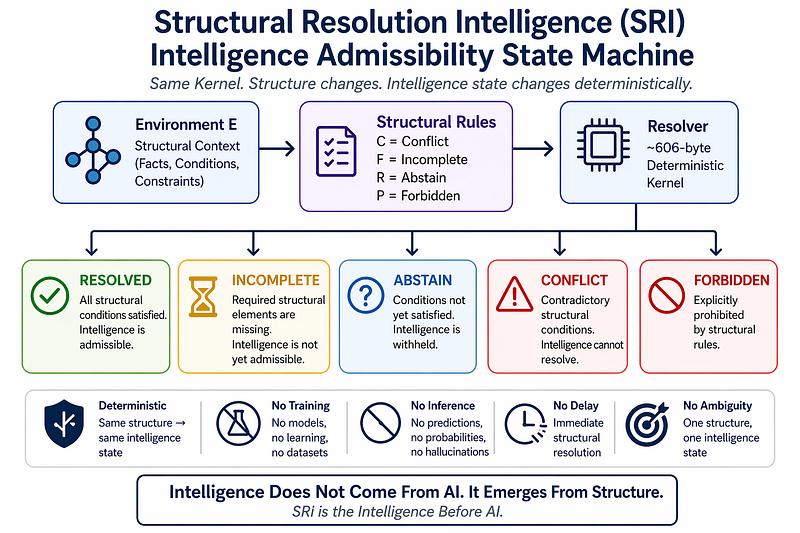
⚖️ Artificial Intelligence vs Structural Resolution Intelligence (SRI)
Artificial Intelligence            | Structural Resolution Intelligence (SRI)
----------------------------------|------------------------------------------
Learns from data                  | Operates on structure
Uses models and training          | Uses states {RESOLVED, INCOMPLETE, ABSTAIN, CONFLICT, FORBIDDEN}
Produces predictions              | Resolves intelligence states
Performs inference                | Evaluates structural admissibility
Requires training and compute     | Requires no learning
Outputs answers                   | Determines if answers are allowed
AI Focus: What is the answer?
SRI Focus: Is intelligence admissible before any answer is attempted?
These are not competing systems at the same layer.
AI and SRI operate at different layers:
• AI operates at the capability layer — producing outputs
• SRI operates at the admissibility layer — determining whether outputs are structurally permitted to exist
🔄 The Shift
Artificial Intelligence answers:
What can be predicted?
SRI answers:
Is intelligence structurally valid enough to exist?
🚨 The Critical Difference
Artificial Intelligence -> produces outputs
SRI -> determines whether intelligence is admissible
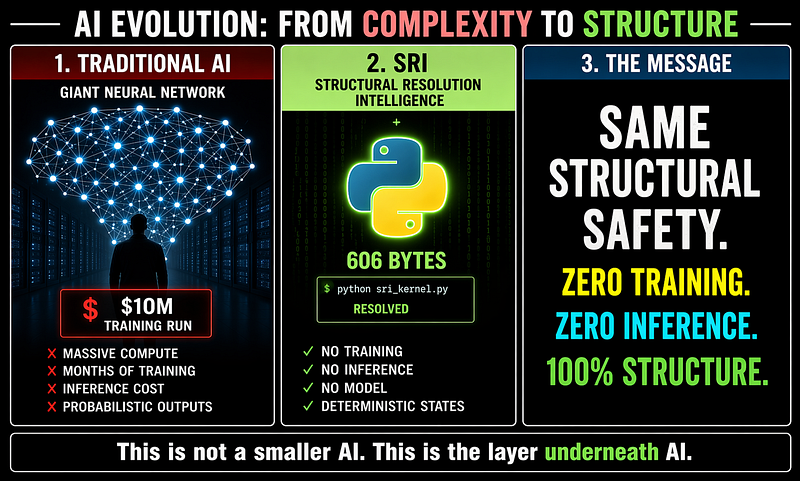
From compute-heavy to structure-determined intelligence — same structural safety, different foundation.
✈️ A Real-World Example
A user asks an AI agent:
“Book a flight from New York to San Francisco tomorrow morning.”
Traditional AI systems often attempt tool calls immediately:request -> LLM inference -> tool call
If structure is incomplete, they may:
• hallucinate missing parameters
• choose incorrect tools
• proceed despite ambiguity
SRI introduces a prior layer:
request -> resolve(structure) -> [RESOLVED?] -> AI execution
Possible structural outcomes:
• INCOMPLETE -> missing required information
• ABSTAIN -> ambiguity remains
• CONFLICT -> incompatible constraints detected
• FORBIDDEN -> policy or safety violation
• RESOLVED -> admissible for execution
SRI decides whether intelligence is structurally allowed before AI attempts generation.
AI decides how.
SRI decides whether.
🌍 A World Built on Artificial Intelligence
For decades, intelligence systems have been built on assumptions:
• training data
• neural networks
• inference pipelines
• probabilistic models
• optimization loops
Each treated not just as useful —
but as required.
Every system follows the same pattern:
train -> infer -> output
❓ But What If This Is Not Fundamental?
What if intelligence does not depend on AI?
What if something deeper preserves it?
🌊 The Deeper Shift
Across domains, a pattern emerges:
correctness does not depend on the mechanism we assumed it did
It can be preserved by something more fundamental:
structure
🧩 Structural Clarification
correctness = structureThis system operates at a prior layer:
admissibility determines whether correctness is allowed to exist.
Once structure is admissible,
correctness follows deterministically from structure.
🧬 Dependency Elimination Framework
The following Dependency Elimination Framework summarizes structural dependency-elimination demonstrations across 75+ systems within the Shunyaya ecosystem (see the indexed GitHub repositories for runnable reference implementations).
All listed dependencies resolve to structure for correctness.
Domain            | Dependency Removed for Correctness                   | What Preserves Correctness
------------------|------------------------------------------------------|------------------------------
Time              | clocks                                               | structure
Decision          | order                                                | structure
Meaning           | sequence                                             | structure
Money             | transactions / continuous connectivity               | structure
Truth             | agreement                                            | structure
Computation       | execution / arithmetic dependency                    | structure
AI                | inference                                            | structure
Cybersecurity     | process / pipelines                                  | structure
Identity          | authority / registry / certificate / replay identity | structure
Authentication    | login / reset workflows                              | structure
Consensus         | voting / quorum                                      | structure
Governance        | recount / tally workflows                            | structure
Network           | connectivity                                         | structure
Cloud             | cloud infrastructure                                 | structure
Media (Video)     | editing / timelines / manual workflows               | structure
Media (Diagram)   | manual drawing / layout                              | structure
Media (Audio)     | waveform editing / sequencing                        | structure
Observability     | forced visibility / premature publication            | structure
Spatial Systems   | blind spatial assumption / rendering trust           | structure
Audit             | verification / replay reconstruction                 | structure
Transition        | traversal / search                                   | structure
Integration       | communication / coordination                         | structure
Communication     | acknowledgements / retries / messaging pipelines     | structure
Each row demonstrates removal of an assumed dependency as the fundamental source of correctness, while structure preserves deterministic outcomes.
Operational substrates may still exist, but correctness becomes structurally governed, reproducible, and replay-verifiable.
If correctness remains structurally stable after removing an assumed dependency for correctness, that dependency may not have been fundamental to correctness.
🔓 Clarification
This does not remove AI as a capability.
It removes AI as a dependency for intelligence to exist.
💥 The Strongest Removal
Intelligence -> remove artificial intelligence dependency -> structure remains -> intelligence revealed
📌 The Critical Line
Artificial Intelligence -> remove inference dependency -> structure remains -> admissibility preserved -> intelligence follows
🚫 What SRI Does Not Do
SRI does not define intelligence.
SRI does not generate intelligence.
SRI does not replace intelligence.
It determines only this:
whether intelligence is structurally admissible.
🌅 Before AI — There Is Intelligence
There exists a prior layer:
Intelligence itself
Not trained.
Not inferred.
Not predicted.
Only revealed — when structure is sufficient.
To be precise: what is revealed is not cognition or general reasoning.
What is revealed is admissibility — the structural condition that must be satisfied before any intelligent act is permitted.
SRI is not AI.
It is the admissibility layer before AI.
It is the I before AI.
🧪 Now Let’s Prove It
Below is a complete working kernel.
No model.
No training.
No inference.
Only structure.
⚙️ The Code (~606 Bytes)
This is the entire intelligence gate — in ~606 bytes.
No model. No inference. No training loop.
Smaller than most AI system prompts.
S = {
    "E": {"input": True, "ready": True},
    "C": [lambda s: s["E"].get("conflict") is True],
    "F": [lambda s: s["E"].get("context") is None],
    "R": [lambda s: s["E"].get("input") is True and s["E"].get("ready") is True],
    "P": []
}

def resolve(S):
    for c in S["C"]:
        if c(S):
            return "CONFLICT"
    for f in S["F"]:
        if f(S):
            return "INCOMPLETE"
    for p in S["P"]:
        if p(S):
            return "FORBIDDEN"
    for r in S["R"]:
        if not r(S):
            return "ABSTAIN"
    return "RESOLVED"

print(resolve(S))
💾 Save the File
Save the script as:
sri_kernel.py▶️ Run
python sri_kernel.py📤 Output
INCOMPLETENo model was trained.
No inference was performed.
No answer was predicted.
Only intelligence admissibility was resolved from structure.
The resolver did not generate intelligence.
It exposed whether intelligence was structurally permitted.
🧠 What This Output Represents
This is not a failed prediction.
This is an intelligence state:
• input is present
• readiness is present
• required context is missing
So the system returns:
INCOMPLETEMeaning:
The intelligence is not structurally ready.
This is what modern AI systems are missing:
the ability to know when not to act.
No AI is needed to detect this — the structure itself is insufficient.
🔧 Change One Line
Update:
"context": "available"So the full updated structure becomes:
S = {
    "E": {"input": True, "ready": True, "context": "available"},
    "C": [lambda s: s["E"].get("conflict") is True],
    "F": [lambda s: s["E"].get("context") is None],
    "R": [lambda s: s["E"].get("input") is True and s["E"].get("ready") is True],
    "P": []
}

def resolve(S):
    for c in S["C"]:
        if c(S):
            return "CONFLICT"
    for f in S["F"]:
        if f(S):
            return "INCOMPLETE"
    for p in S["P"]:
        if p(S):
            return "FORBIDDEN"
    for r in S["R"]:
        if not r(S):
            return "ABSTAIN"
    return "RESOLVED"

print(resolve(S))
Run Again
python sri_kernel.pyOutput
RESOLVEDSame resolver.
Only structure changed.
Different intelligence state.
Intelligence followed structure — not computation.
⛔ Force a Condition Failure
Update:
"R": [lambda s: s["E"].get("decision") is True]Your full structure should now be:
S = {
    "E": {"input": True, "ready": True, "context": "available"},
    "C": [],
    "F": [],
    "R": [lambda s: s["E"].get("decision") is True],
    "P": []
}

def resolve(S):
    for c in S["C"]:
        if c(S):
            return "CONFLICT"
    for f in S["F"]:
        if f(S):
            return "INCOMPLETE"
    for p in S["P"]:
        if p(S):
            return "FORBIDDEN"
    for r in S["R"]:
        if not r(S):
            return "ABSTAIN"
    return "RESOLVED"

print(resolve(S))
Run Again
python sri_kernel.pyOutput
ABSTAINThe system refuses to fabricate intelligence.
What This Output Represents
This is not a failed AI model.
This is a structural abstention state:
• no conflict exists
• no incompleteness is declared
• but the required intelligence condition is still not satisfied
So the system returns:
ABSTAINMeaning:
The system refuses to force an intelligent conclusion.
No guessing.
No fallback.
No forced intelligence.
The system knows when to stay silent.
🛑 Introduce Conflict
Now add a conflict rule and mark conflict present.
Update the full structure to:
S = {
    "E": {"input": True, "ready": True, "context": "available", "conflict": True},
    "C": [lambda s: s["E"].get("conflict") is True],
    "F": [],
    "R": [lambda s: s["E"].get("input") is True and s["E"].get("ready") is True],
    "P": []
}

def resolve(S):
    for c in S["C"]:
        if c(S):
            return "CONFLICT"
    for f in S["F"]:
        if f(S):
            return "INCOMPLETE"
    for p in S["P"]:
        if p(S):
            return "FORBIDDEN"
    for r in S["R"]:
        if not r(S):
            return "ABSTAIN"
    return "RESOLVED"

print(resolve(S))
Run Again
python sri_kernel.pyOutput
CONFLICTThe system detects incompatible structure.
What This Output Represents
This is not a model disagreement.
This is a structural conflict state:
• the structure contains an explicit contradiction
• intelligence is not safely admissible
So the system returns:
CONFLICTMeaning:
The intelligence structure is incompatible.
Contradiction is not resolved.
It is exposed — and blocked.
No forced coherence. No silent failure.
🚷 Add a Forbidden Rule
Now explicitly block the structure.
Update the full script to:
S = {
    "E": {"input": True},
    "C": [],
    "F": [],
    "R": [lambda s: s["E"].get("input") is True],
    "P": [lambda s: s["E"].get("input") is True]
}

def resolve(S):
    for c in S["C"]:
        if c(S):
            return "CONFLICT"
    for f in S["F"]:
        if f(S):
            return "INCOMPLETE"
    for p in S["P"]:
        if p(S):
            return "FORBIDDEN"
    for r in S["R"]:
        if not r(S):
            return "ABSTAIN"
    return "RESOLVED"

print(resolve(S))
Run Again
python sri_kernel.pyOutput
FORBIDDENThe intelligence is structurally blocked.
What This Output Represents
This is not a safety filter added after intelligence.
This is safety built into intelligence itself.
This is an explicit structural block state:
• input is present
• intelligence condition could otherwise resolve
• structure explicitly forbids it
So the system returns:
FORBIDDENMeaning:
The intelligence is structurally blocked.
This is a deterministic block — not a probabilistic rejection.
🖥️ Command Terminal Outputs
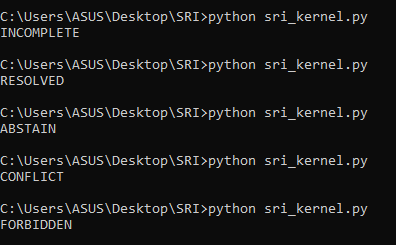
Five intelligence states — one 606-byte resolver.
Different structure -> different admissibility.
Zero AI.
This is not a simulation of intelligence.
This is intelligence resolved directly from structure.
This is not a smaller AI.
This is the layer underneath AI.
One kernel.
Five states.
Zero AI.
Zero inference.
Deterministic intelligence gating.
👁️ Observation
The system never:
• trains a model
• performs inference
• predicts an answer
• computes a probability
It determines whether intelligence is structurally admissible.
⚡ What Just Happened?
No model was trained.
No inference occurred.
No answer was predicted.
The system did not generate intelligence.
It determined whether intelligence was allowed to exist.
That is the shift.
📏 Structural Law (The Only Rule That Matters)
same structure -> same intelligence state

different intelligence state -> structure must differ
🛡️ Structural Guarantees
• same structure -> same intelligence state
• incomplete structure -> no intelligence
• conflicting structure -> no forced intelligence
• forbidden structure -> intelligence blocked
No forced inference.
No forced hallucination pathways.
Only structural intelligence.
📈 Why This Scales
The resolver does not grow.
Only the structure grows.
More complexity does not require a different system.
It requires more complete and consistent structure.
The rule remains the same.
🔬 What This Tiny Kernel Shows
Even in ~606 bytes:
• intelligence exists without artificial intelligence
• structure determines intelligence
• no training is required
• no inference is required
• intelligence is deterministic
Same resolver. Different structure. Different intelligence state.
Nothing else changed.
🌐 The Real Reason This Matters in 2026
Every week, we see another AI failure:
• hallucinated safety reports
• confident wrong answers in high-stakes domains
• systems that cannot say “I don’t know”
SRI gives every AI system a structural conscience —
a 606-byte voice that can say:
“Stop. This structure is incomplete / conflicting / forbidden.”
Before any model runs.
With zero extra compute.
This is not anti-AI.
This is AI that knows when to stay silent.
🔭 Applied Glimpse
The same structure applies beyond abstract examples:
• a robotics controller returns ABSTAIN when required environment state is missing — no forced action
• an autonomous system returns FORBIDDEN when structural safety conditions are violated — blocking unsafe action
• a policy system returns CONFLICT when contradictory decision rules coexist
• a decision engine returns RESOLVED when structure is complete and consistent
No model.
No learning loop.
Only structure determines whether intelligence is allowed.
🌌 Why This Is Bigger Than It Looks
This is a minimal proof that:
• intelligence does not require artificial intelligence
• intelligence does not require inference
• intelligence can be determined before AI begins
AI produces outputs.
This system determines whether outputs are even allowed to exist.
⭐ The Important Part
This is not a variation of AI.
This is a different layer of intelligence.
This is not a replacement for AI.
It is the first visible edge of a deeper shift:
Structural Resolution Intelligence (SRI)
— where structure alone determines whether intelligence is admissible
🧠 What SRI Is
SRI is a framework where:
intelligence_visible iff structure_matureInstead of producing outputs, SRI determines:
RESOLVED • INCOMPLETE • ABSTAIN • CONFLICT • FORBIDDEN
🚀 What Comes Next
SRI can become the foundation beneath systems such as:
• AI reasoning systems
• robotics controllers
• autonomous agents
• safety gates
• policy engines
• structural decision systems
Each system may still compute.
SRI determines whether intelligence is admissible before computation is even relevant.
📘 SRI Core Specification (Upcoming)
Formal definition, state lattice guarantees, and cross-domain unification — coming next.
• structure as S = (E, C, F, R, P)
• intelligence admissibility as a deterministic resolution function
• state lattice: RESOLVED, INCOMPLETE, ABSTAIN, CONFLICT, FORBIDDEN
• order-independence and determinism guarantees
This establishes SRI as a formal intelligence system — not just an implementation.
🌐 Open Reference Implementation
This tiny kernel is an open standard reference implementation — free to use, study, implement, extend, and deploy.
The broader architecture follows its own licensing terms.
❓ FAQ — Structural Resolution Intelligence
1. Is this AI?
No.
AI produces outputs through models, training, and inference.
SRI does none of these.
SRI resolves whether intelligence is admissible from structure.
2. Is this replacing AI?
No.
Classical AI remains valid.
SRI operates at a different layer —
determining whether intelligence is admissible before outputs are used.
3. Why is ABSTAIN important?
Because forcing intelligence when structure is incomplete leads to unsafe systems.
SRI preserves correctness by refusing unjustified intelligence.
It enables a system to say: “I don’t know — and I won’t guess.”
4. Isn’t this just an expert system?
SRI shares one similarity with expert systems: precondition checking.
But the distinction is architectural.
Expert systems encode what intelligence should do through domain rules and knowledge.
SRI encodes only whether intelligence is structurally allowed to exist.
No domain knowledge.
No encoded facts.
No rule base.
SRI is a structure-first admissibility gate.
The similarity is real.
The layer is different.
5. Is this computation?
No.
Classical AI computes outputs using models and inference.
SRI does not compute answers or predictions.
It resolves admissibility — not outcomes.
Boundary clarification:
Artificial Intelligence -> output generation via training and inference
SRI -> intelligence admissibility from complete and consistent structure
Implementation still runs.
But intelligence is not produced by execution.
It is resolved from structure.
6. Where can this be used?
Anywhere intelligence matters:
• AI decision systems
• robotics
• autonomous control
• safety-critical infrastructure
• governance
• industrial systems
Anywhere a system must decide whether it should act — before it acts.
⚔️ The Paradigm Contrast
Old Paradigm                 | Structural Paradigm (SRI)
-----------------------------|--------------------------------
Trains models                | Reveals intelligence
Performs inference           | Resolves admissibility
Outputs predictions          | Emits intelligence states
Depends on data              | Depends on structure
Uses probability             | Uses deterministic structure
Builds artificial intelligence | Reveals structural intelligence
🧭 Final Line
Artificial Intelligence produces outputs.
SRI determines whether intelligence is admissible.
Intelligence existed before AI.
👁️ The Simplest Way to See It
AI tries to produce intelligence.
SRI checks if intelligence is even possible.
🏁 Final Statement
AI did not create intelligence.
Training did not create intelligence.
Inference did not create intelligence.
Intelligence was always in structure.
SRI reveals it.
Structure is fundamental.
Everything else is optional — and removable.
⚠️ Authorship & Disclaimer
Created by the authors of the Shunyaya Framework.
Deterministic structural demonstration only.
Not intended for production use in autonomous, industrial, medical, defense, or safety-critical systems without independent validation.
🔗 Explore further:
GitHub:
Featured structural intelligence admissibility reference implementation:
SRI — Structural Resolution Intelligence
(deterministic intelligence admissibility where structure determines whether intelligent action is permitted before AI execution, inference, or prediction begins)
Medium:
SLANG — Deterministic Resolution Without Workflow Dependency
(across domains, minimal structural kernels demonstrate that removing workflows, pipelines, sequencing, or verification workflows does not break correctness. Reduce the dependency for correctness. Preserve the structure. Deterministic outcomes remain.)
ORL — Resolution Without Order
(independent systems converge to the same final truth without relying on timestamps, ordering, or coordination)
STRUMER — Structural Media Resolution
(deterministic media visibility where video, diagrams, audio, and images become structurally visible without editing timelines, drawing workflows, waveform sequencing, or manual visual construction)
STILE — Message Delivery Without Communication
(deterministic delivery where messages become delivered only when structure aligns, without communication, acknowledgements, or retries)
Structural Resolution & Admissibility Systems
(a series of deterministic structural systems that resolve whether correctness is admissible before computation begins. Across domains, outcomes become structurally visible from completeness and consistency — not from process, measurement, simulation, inference, or forced visibility.)
Join the structural revolution.
Explore the Shunyaya structural ecosystem across 75+ deterministic systems and executable proofs:
❔ A Final Question
If this idea challenges your understanding of intelligence:
Can two systems with the same structure
resolve to different intelligence states
without changing the structure itself?
If yes — where does the structure fail?
If no — what does that imply about intelligence?
Try the kernel.
Change one line.
See what happens.


Comments
Post a Comment