🧠 The Structural Engine That Resolves Exact Values and Explicit Mathematical States
Structural Value Resolution Engine (SVARE v10.0.6)
SVARE resolves supported mathematical expressions through canonical structure, exact semantic identity, and explicit resolution states.
A value becomes visible only when the submitted expression is complete, consistent, supported, within the published domain and resource policies, and resolves uniquely.
Different calculators may show different results.
Enter:
1.0000000000000001 - 1.0000000000000000Some floating-point systems may display:
0
Other systems may display:
1e-16
SVARE v10.0.6 converts each finite decimal literal directly into an exact rational structure.
It resolves the expression as:
0.0000000000000001
with the exact mathematical form:
1/10000000000000000
This is not a claim that SVARE performs no computation or that other systems are incorrect. Different systems may use different numeric representations and display policies.
SVARE’s distinction is that it separates:
surface expression -> canonical structure -> exact semantic value -> decimal display
The exact semantic identity is established before decimal presentation. Display precision does not replace or redefine that identity.
The Core Principle
At the structural foundation:
value_visible iff structure_uniquely_resolves
Where:
structure_uniquely_resolves = complete AND consistent
In SVARE v10.0.6, operational resolution also depends on the submitted expression being within the published grammar, supported real-number domain, and deterministic resource limits.
The SVARE Invariant
- Same supported input structure, under the same versioned rules and policies, produces the same semantic result or explicit resolution state.
- Incomplete structure produces no forced value.
- Invalid, unsupported, or conflicting structure produces no arbitrary value.
- Display precision changes presentation and the display receipt, not the exact semantic identity.
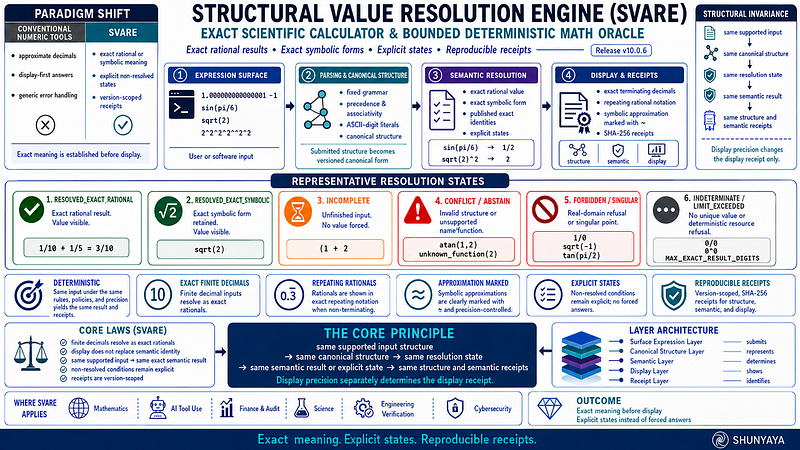
Same supported structure, under the same versioned rules and resource policy, resolves to the same semantic result or explicit state.
Structure governs resolution. Display governs presentation.
One-Line Resolution Model
resolution_outcome = resolve(canonical_structure, versioned_rules, resource_policy)SVARE performs computation to resolve supported expressions.
Canonical structure, versioned semantic rules, and the resource policy determine the exact result or explicit state.
The display layer presents that outcome without redefining its mathematical identity.
Why This Matters Now
Many numerical systems prioritize producing a displayable answer. The representation, approximation policy, error handling, and evaluation rules may remain hidden from the user or calling software.
This becomes increasingly important when mathematical outputs move through AI systems, automated workflows, scientific tools, financial models, and engineering software. A number alone may not reveal:
- whether the result is exact or approximate;
- which structure was resolved;
- whether the input was incomplete or unsupported;
- whether a singularity or domain restriction was encountered;
- which versioned rules produced the outcome.
SVARE makes these distinctions explicit.
Instead of returning only a displayed number, it resolves a supported expression through:
surface expression -> canonical structure -> exact semantic result or explicit state -> display and receipts
SVARE does not remove computation, replace arithmetic, or redefine mathematical truth.
For supported expressions, it applies conventional mathematical rules through a bounded and published resolution model. Its contribution is architectural: exact meaning is separated from decimal presentation, non-resolved conditions remain visible, and reproducible receipts identify the structure, semantics, and display.
Within the broader Shunyaya direction, SVARE explores how hidden assumptions can be reduced while established mathematical truth is preserved.
The shift is not from computation to non-computation.
The shift is from answer-only output to explicit, inspectable, and reproducible resolution.
Try It Live — Exact and Scientific Resolution
Do not just read about SVARE. Test it directly.
→ Live HTML Demo (v10.0.6)
Open the live demo in a modern browser. No installation or local server is required. The standalone HTML file can also be downloaded and run locally without a network connection.
You can explore:
- exact rational arithmetic;
- bounded exact symbolic scientific resolution;
- clearly marked symbolic approximations;
- canonical structure and semantic inspection;
- explicit resolved and non-resolved states;
- selectable decimal-display precision;
- structure, semantic, and display SHA-256 receipts;
- copyable values, exact forms, and receipts;
- downloadable JSON resolution records;
- the built-in release self-test.
The browser application provides the interactive SVARE interface.
The Python application, shared conformance vectors, validation records, verification instructions, and frozen release hashes are available in the SVARE GitHub repository.
Six Reference Demonstrations
The demonstrations below use the SVARE v10.0.6 reference implementation.
SVARE v10.0.6 supports exact rational arithmetic, bounded exact symbolic scientific resolution, canonical structure inspection, explicit resolution states, deterministic SHA-256 receipts, selectable display precision, and shared conformance testing across the Python and HTML applications.
Each demonstration distinguishes among:
surface expression -> canonical structure -> exact semantic result or explicit state -> display and receipts
The governing structural principle remains:
value_visible iff structure_uniquely_resolves
where:
structure_uniquely_resolves = complete AND consistent
The result is also governed by the published grammar, semantic rules, domain policy, resource limits, and release version.
Test 1 — Exact Rational Resolution
Run:
python demo_extension_v10_0_6/SVARE_v10_0_6.py "5 + 2"
Key expected fields:
State : RESOLVED_EXACT_RATIONAL
Resolved value : 7
Exact mathematical form : 7
Meaning:
The supported expression resolves completely and consistently to the exact rational value 7.
The decimal display and exact mathematical form agree because no approximation is required.
Test 2 — Exact Finite-Decimal Residual
Run:
python demo_extension_v10_0_6/SVARE_v10_0_6.py "1.0000000000000001 - 1.0000000000000000"
Key expected fields:
State : RESOLVED_EXACT_RATIONAL
Resolved value : 0.0000000000000001
Exact mathematical form : 1/10000000000000000
Meaning:
SVARE converts the finite decimal literals directly into exact rational structures before subtraction.
The exact residual is therefore preserved as:
1/10000000000000000
The displayed decimal:
0.0000000000000001
is an exact terminating representation of that rational value, not a rounded symbolic approximation.
Test 3 — Exact Repeating Rational
Run:
python demo_extension_v10_0_6/SVARE_v10_0_6.py "2 / 3"
Key expected fields:
State : RESOLVED_EXACT_RATIONAL
Resolution class : EXACT_RATIONAL
Resolved value : 0.6...
Exact mathematical form : 2/3
Meaning:
SVARE preserves 2/3 as the authoritative exact rational value.
The decimal display uses ellipsis notation to indicate that the repeating expansion continues indefinitely.
It is not treated as a rounded symbolic approximation.
Display precision does not alter the exact semantic identity:
semantic_value = 2/3
Test 4 — Signed Exact Resolution
Run:
python demo_extension_v10_0_6/SVARE_v10_0_6.py "-.99*(+0.72)"
Key expected fields:
State : RESOLVED_EXACT_RATIONAL
Resolved value : -0.7128
Exact mathematical form : -891/1250
Resolution class : EXACT_RATIONAL
Meaning:
SVARE preserves unary signs within the canonical expression structure.
The negative and positive signs are resolved as part of the expression:
MUL(UNARY_MINUS(RAT(99/100)),UNARY_PLUS(RAT(18/25)))
The resulting value is resolved exactly as:
-891/1250
with the exact terminating decimal display:
-0.7128
Test 5 — Boundary: Division by Zero
Run:
python demo_extension_v10_0_6/SVARE_v10_0_6.py "5 / 0"
Key expected fields:
State : FORBIDDEN
Resolution class : REFUSED
Resolved value : undefined
Evaluated expression : 5 / 0
Canonical semantic value: FORBIDDEN
Meaning:
Division by zero is outside the supported real numeric domain.
SVARE does not force a numerical result. It returns an explicit FORBIDDEN state and preserves the evaluated expression, canonical structure, and deterministic receipts.
Test 6 — Boundary: Indeterminate Form
Run:
python demo_extension_v10_0_6/SVARE_v10_0_6.py "0 / 0"
Key expected fields:
State : INDETERMINATE
Resolution class : REFUSED
Resolved value : indeterminate
Evaluated expression : 0 / 0
Canonical semantic value: INDETERMINATE
Meaning:
The expression 0 / 0 does not have a unique mathematical value.
SVARE does not force a numerical result. It returns the explicit INDETERMINATE state while preserving the evaluated expression, canonical structure, and deterministic receipts.
Determinism Check
Run the same command multiple times:
python demo_extension_v10_0_6/SVARE_v10_0_6.py "5 + 2"
Expected under the same SVARE version, rules, and resource policy:
- the same resolution state;
- the same exact value;
- the same canonical structure;
- the same canonical semantic result;
- the same structure certificate;
- the same semantic certificate;
- the same display receipt when the display precision is unchanged.
Invariant:
same input expression + same release and policy versions + same display settings -> same resolution outcome and receipts
The structure and semantic certificates identify the exact resolution independently of presentation changes.
The Engine — Current Reference Model
SVARE v10.0.6 is an exact scientific calculator and a bounded deterministic math oracle for supported real-number expressions.
Supported:
- exact integer, finite-decimal, and rational arithmetic;
- addition, subtraction, multiplication, division, remainder, and exponentiation;
- chained, grouped, and nested expressions;
- unary positive and negative signs;
- constants including
pi,e, andtau; - exact square-root reduction where supported;
- bounded exact symbolic forms;
- symbolic cancellation and coefficient reduction;
- selected exact trigonometric identities;
- inverse trigonometric functions;
- logarithmic and exponential functions;
- integer and ordering functions such as
gcd,lcm,min, andmax; - explicit resolved, singular, forbidden, indeterminate, incomplete, conflict, abstention, resource-limit, and internal-error states;
- canonical structure and canonical semantic inspection;
- deterministic structure, semantic, and display SHA-256 receipts;
- selectable symbolic decimal-display precision;
- shared conformance vectors across the Python and HTML applications.
Examples:
1 + 2 + 3
(1 + 2) * 3
2 * (3 + 4 * (5 - 2))
(2 / 3) + (1 / 6)
sqrt(2)^2
sin(pi/6) + cos(pi)
sqrt(2) + ln(2)
pi - pi
SVARE is intentionally bounded.
It is not:
- a full computer algebra system;
- a general equation solver;
- a calculus engine;
- a complex-number engine;
- a theorem prover;
- a graphing system;
- a formally verified mathematical system.
Its current resolution model can be summarized as:
resolution_outcome = resolve(canonical_structure, versioned_rules, resource_policy)
The implementation performs parsing, normalization, exact arithmetic, symbolic rule application, and decimal presentation.
Structural completeness and consistency are necessary for resolution, while the published grammar, semantic rules, real-domain policy, and deterministic resource limits define what the current release supports.
Full current reference implementation, standalone HTML demo, conformance vectors, validation records, verification instructions, and frozen release hashes:
The complete SVARE v10.0.6 reference implementation is available in the repository.
Run from the repository root:
python demo_extension_v10_0_6/SVARE_v10_0_6.py
or:
python demo_extension_v10_0_6/SVARE_v10_0_6.py "1 + 2 + 3"
Interactive Mode
Run from the repository root:
python demo_extension_v10_0_6/SVARE_v10_0_6.py
Then enter expressions directly at the prompt.
Try:
5 + 2
2 / 3
1.0000000000000001 - 1.0000000000000000
-.99*(+0.72)
sqrt(2) + ln(2)
sin(pi/6) + cos(pi)
Type exit or quit to stop.
What You Will Observe
SVARE returns more than a displayed number.
You will see:
- exact rational values where available;
- exact symbolic forms for supported expressions;
- clearly marked decimal approximations of symbolic results;
- explicit resolved and non-resolved states;
- canonical structure and canonical semantic records;
- separate structure, semantic, and display SHA-256 receipts;
- selectable display precision;
- visible distinctions among singular, forbidden, indeterminate, incomplete, conflict, abstention, resource-limit, and internal-error outcomes.
The exact semantic result remains authoritative.
Decimal presentation communicates that result without replacing its mathematical identity.
exact semantic identity -> controlled display
SVARE performs computation, but it makes the structure, outcome class, and presentation policy explicit and reproducible.
Resolution States SVARE Recognizes
State                       | Meaning                                                    | Output Visibility
----------------------------|----------------------------------------------------------- |------------------------------
RESOLVED_EXACT_RATIONAL     | Semantic result is an exact rational value                 | Exact value visible
RESOLVED_EXACT_SYMBOLIC     | Semantic result is retained in exact symbolic form         | Exact form and marked approximation visible
SINGULAR                    | Expression reaches a recognized singular point             | Explicit status; no numeric value
FORBIDDEN                   | Expression violates the real-domain or operation policy    | Explicit refusal; no numeric value
INDETERMINATE               | Expression has no unique value, such as 0/0 or 0^0         | Explicit status; no numeric value
INCOMPLETE                  | Submitted expression is unfinished                         | Explicit status; no numeric value
CONFLICT                    | Syntax, tokens, arguments, or function arity are invalid   | Explicit status; no numeric value
ABSTAIN                     | Name or function is outside the bounded registry           | Explicit abstention; not evaluated
LIMIT_EXCEEDED              | A deterministic resource boundary was reached              | Explicit refusal; no numeric value
INTERNAL_ERROR              | An unexpected implementation failure occurred              | Explicit failure; no numeric value
SVARE preserves these distinctions rather than collapsing every unresolved condition into a generic error.
The Structural Resolution Rule
value_visible = true only when the submitted expression is complete, consistent, supported, within the real-domain policy and resource limits, and resolves uniquely to a value.
Otherwise, SVARE returns an explicit resolution state rather than forcing a numerical output.
complete AND consistent is necessary for value visibility, but the expression must also satisfy the published grammar, semantic rules, domain policy, and resource policy.
What SVARE Is — and Is Not
SVARE is:
- an exact scientific calculator for supported expressions;
- a bounded deterministic math oracle for software;
- a structure-first mathematical expression resolver;
- an exact rational and bounded symbolic resolution engine;
- a versioned reference implementation with reproducible receipts and conformance tests.
SVARE demonstrates:
- exact finite-decimal and rational resolution;
- preservation of supported exact symbolic forms;
- explicit separation of canonical structure, semantic identity, and display;
- deterministic resolution under the same versioned rules and policies;
- explicit non-resolved states instead of forced numerical output;
- shared conformance behaviour across the Python and HTML applications.
Its resolution model is:
resolution_outcome = resolve(canonical_structure, versioned_rules, resource_policy)
SVARE does not claim:
- that computation is unnecessary;
- that structure alone proves mathematical correctness;
- to replace arithmetic or established mathematical systems;
- to support all mathematical expressions;
- to be a full computer algebra system;
- to solve general equations or calculus problems;
- to be a theorem prover or formally verified system;
- to be ready for safety-critical deployment without independent validation.
SVARE is a bounded public reference implementation.
Its central engineering invariant is:
same supported structure + same versioned rules + same resource policy -> same semantic result or explicit state
Display settings may change presentation and the display receipt.
They do not change the exact semantic identity.
FAQ — Four Core Questions
1. Is SVARE a calculator?
Yes.
At the interface, SVARE is an exact scientific calculator for supported expressions.
At the core, it is also a bounded deterministic math oracle that returns structured outcomes, exact forms, explicit states, and reproducible receipts.
2. Does SVARE replace arithmetic?
No.
SVARE uses established arithmetic and mathematical rules.
Its contribution is to separate:
surface expression -> canonical structure -> exact semantic result or explicit state -> display and receipts
3. Does SVARE resolve values without computation?
No.
SVARE performs parsing, normalization, exact arithmetic, symbolic rule application, and decimal presentation.
Its narrower claim is that the exact semantic identity is established before decimal display and is not defined by floating-point approximation alone.
4. What happens when an expression cannot be resolved?
SVARE does not force a numerical answer.
It returns an explicit state such as:
SINGULAR
FORBIDDEN
INDETERMINATE
INCOMPLETE
CONFLICT
ABSTAIN
LIMIT_EXCEEDED
or:
INTERNAL_ERROR
This allows users and software to distinguish among different non-resolved conditions.
More Questions?
For extended FAQs, deeper explanations, and additional edge cases, see the SVARE GitHub repository.
The Validation Challenge
Test SVARE at its boundaries.
Look for any case in which:
- the same supported expression, under the same SVARE version and settings, produces different semantic results;
- Python and HTML produce different outcomes for the same conformance case;
- an incomplete or conflicting expression produces a forced numerical value;
- a forbidden or indeterminate expression is presented as a valid exact result;
- an unknown name or function is evaluated instead of producing
ABSTAIN; - a published resource limit is exceeded without returning
LIMIT_EXCEEDED; - changing only display precision alters the canonical semantic identity;
- identical canonical semantic results produce inconsistent semantic certificates under the same release.
A reproducible mismatch may reveal an implementation defect, an undocumented limitation, or a case that should be added to the conformance suite.
Failure to find such a case does not constitute formal proof of correctness. It provides evidence that the tested release behaves consistently within its published scope.
Go Further
Additional edge cases, conformance vectors, validation records, verification instructions, and release artifacts are available in the SVARE GitHub repository.
Open Use Reference Implementation
SVARE v10.0.6 is available as an open use reference implementation together with a standalone interactive browser application.
Run locally from the repository root:
python demo_extension_v10_0_6/SVARE_v10_0_6.py "1 + 2 + 3"
Or explore the current live HTML application directly in a modern browser.
The implementation is intentionally bounded, versioned, and designed for inspectable and reproducible mathematical resolution.
The SVARE reference implementation, including the Python engine and standalone HTML application, is released under the repository’s SVARE Open Use License.
You may use, study, reproduce, implement, modify, and extend the reference implementation, subject to the terms stated in the repository’s LICENSE file.
Full repository:
Includes:
- Python reference implementation;
- standalone interactive HTML application;
- shared conformance vectors;
- cross-runtime validation records;
- verification instructions;
- frozen SHA-256 release hashes;
- architecture and technical documentation;
- archived earlier concept demonstrations.
Unless otherwise stated, the architecture descriptions and documentation are licensed separately under CC BY-NC 4.0.
The HTML application includes Decimal.js, which remains subject to its own MIT license and attribution.
Authorship and Disclaimer
Created by the authors of the Shunyaya Framework.
SVARE v10.0.6 is an open use reference implementation for exact and bounded deterministic mathematical resolution.
It is not presented as a production-ready system for financial, medical, industrial, defence, autonomous, or other safety-critical use.
Independent validation, peer review, security assessment, domain-specific testing, and appropriate governance are required before any critical real-world use.
Final Statement
SVARE does not remove computation.
It makes the path from expression to result explicit:
surface expression -> canonical structure -> exact semantic result or explicit state -> display and receipts
When a supported expression resolves completely and consistently, SVARE returns an exact rational value or an exact symbolic form.
When an expression produces SINGULAR, FORBIDDEN, INDETERMINATE, INCOMPLETE, CONFLICT, ABSTAIN, LIMIT_EXCEEDED, or INTERNAL_ERROR, SVARE preserves that distinction instead of forcing a numerical answer.
Its central engineering principle is:
same supported structure + same versioned rules + same resource policy -> same semantic result or explicit state
Display precision may change presentation.
It does not change the exact semantic identity.
That is Structural Value Resolution.
A Final Question
Try the live demo.
Run the six demonstrations.
Inspect the canonical structure, exact semantic form, explicit state, and deterministic receipts.
Then ask:
What becomes possible when a mathematical result carries not only a displayed number, but also its exact identity, resolution state, governing version, and reproducible evidence?
Structure first.
Exact meaning before presentation.
Explicit states instead of forced answers.
Reproducible resolution instead of answer-only output.
That is the shift.
That is SVARE.
OMP


Comments
Post a Comment