⚡ Money Without Network Dependency — Correctness from structure.
Modern financial systems are built around a deep assumption:
money needs networks.
More specifically, they often assume that financial correctness depends on:
- continuous connectivity
- synchronized communication
- ordered message exchange
- real-time coordination
- downstream settlement confirmation
STINT-Money explores a different possibility.
It asks whether bounded financial-state admissibility can be resolved from complete and consistent declared structure, without treating continuous connectivity, synchronization, ordering, or transport as the governing authority.
The answer demonstrated by the v1.0 reference model is:
Yes — inside a bounded deterministic structural model.
🧩 What Is STINT-Money?
STINT-Money is a deterministic structural settlement reference model.
It does not execute payments.
It does not transfer funds.
It does not replace banks, payment networks, regulation, identity systems, fraud controls, or legal settlement.
Instead, it demonstrates something narrower and more fundamental:
bounded financial-state admissibility can be resolved from structure.
Within the reference model:
admissible_state = resolve(declared_structure)
This means that a financial state becomes admissible only when the declared structure is complete and consistent under fixed rules.
⚡ The One-Line Insight
The compact slogan is:
correctness = structure
But the safer technical meaning is:
structural correctness within the declared model = complete and consistent declared structure admitted by fixed rules
Or more simply:
admissible outcome = resolve(declared structure)
This distinction matters.
STINT-Money does not claim universal financial correctness.
It does not claim legal settlement.
It does not claim production readiness.
It demonstrates a bounded structural principle:
inside the declared model, structure governs admissibility.
🧠 The Core Structural Rules
STINT-Money uses a small set of structural rules:
admissible_state = resolve(declared_structure)
resolved_state_visible iff structure_mature
structure_mature = structure_complete AND structure_consistent
dependency failure != truth failure
resolution_state != activation_state
READY != RELEASED
The architectural separation is:
structure -> admissibility
transport -> availability
activation -> operational release
This is the heart of the model.
The network may carry structure.
The network may affect when structure becomes available.
The network may affect reconciliation, notification, and downstream settlement.
But the network does not govern structural admissibility inside the reference model.
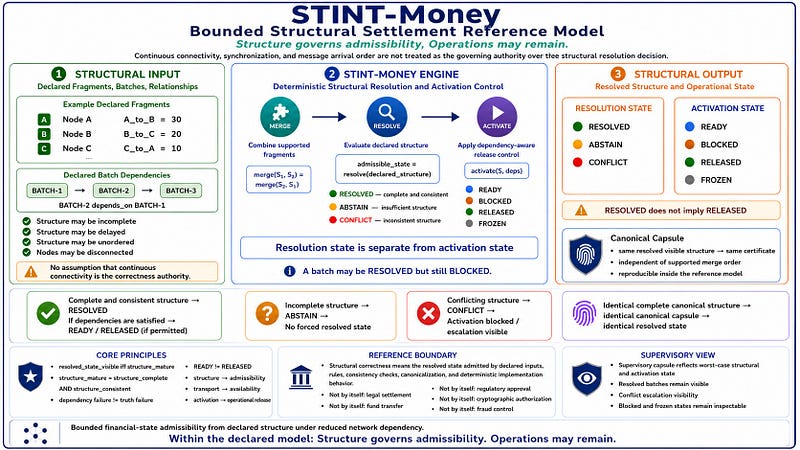
Figure: STINT-Money reference model. Structure governs admissibility; transport affects availability; activation controls operational release. Operations may remain.
🌍 Why This Matters
Traditional financial systems often depend on process order and communication state.
A message arrives.
A transaction executes.
A ledger updates.
A settlement process confirms.
A reconciliation process follows.
This works, but it also creates deep dependency on infrastructure:
- if the network fails, correctness may become hard to establish
- if messages arrive out of order, state may need repair
- if systems partition, reconciliation becomes fragile
- if activation happens too early, risk propagates
STINT-Money asks a structural question:
What if the system did not need to decide correctness from connectivity?
What if structural admissibility could be resolved only when structure itself becomes sufficient?
🔄 The Shift
The shift is from:
network guarantees correctness
to:
structure governs admissibility
This does not mean operations disappear.
It means operations are put in the right layer.
- Structure determines admissibility.
- Transport determines availability.
- Activation determines operational release.
- Settlement remains external and downstream.
The key line is:
Structure governs admissibility. Operations may remain.
🧱 The Structural Dependency Framework
Across Shunyaya structural systems, the deeper pattern is this:
a dependency that was assumed to govern correctness can sometimes be separated from the correctness decision.
Structural Dependency Framework

+---------------------+------------------------------------+----------------------------------------------+
| Domain              | Former Governing Dependency        | Structural Reframing                         |
+---------------------+------------------------------------+----------------------------------------------+
| Time                | clocks as final authority          | structural time and replay evidence          |
| Decision            | order as final authority           | declared rules and maturity                  |
| Meaning             | sequence as final authority        | structural relationships                     |
| Money               | connectivity as final authority    | complete and consistent declared structure   |
| Truth               | agreement as final authority       | reproducible structural resolution           |
| Computation         | execution as final authority       | deterministic structural evaluation          |
| Distributed systems | synchronization as final authority | supported merge and replay                   |
+---------------------+------------------------------------+----------------------------------------------+
The goal is not to deny that these dependencies exist.
The goal is to show that they may not need to be the governing authority over admissibility.
🧪 The 30-Second Verification
Run the reference demonstration:
python demo/stint_money_demo_v1.0.py
Expected structural behavior includes:
BATCH-1 -> RESOLVED + RELEASEDBATCH-2 -> RESOLVED + READY / RELEASED when permittedBATCH-3 -> RESOLVED + BLOCKEDBATCH-4 -> CONFLICT + BLOCKEDSupervisory state -> worst-case structural condition
Run it again.
The result should remain deterministic under the same reference implementation.
The verification principle is:
same complete canonical structure + same rules + same implementation version -> same resolved state
🔍 What the Demonstration Shows
STINT-Money v1.0 demonstrates:
- bounded financial-state admissibility from declared structure
- deterministic resolution under delayed availability
- independence from continuous connectivity as governing authority
- independence from synchronization as governing authority
- supported merge-order independence inside the reference model
- separation of structural truth and activation
- dependency-aware activation control
- safe handling of incomplete structure
- safe handling of conflicting structure
- tamper rejection through capsule validation
- supervisory worst-case visibility
This is not merely delayed synchronization.
This is not merely offline replay.
This is structural resolution.
🧾 The Structural Triad
Every declared financial structure resolves into one of three structural states:
RESOLVED -> complete and consistent structure
ABSTAIN -> insufficient structure
CONFLICT -> inconsistent structure
This triad is important because it prevents forced correctness.
If the structure is incomplete, STINT-Money does not pretend that the answer exists.
If the structure is conflicting, STINT-Money does not silently repair it.
If the structure is complete and consistent, the resolved state becomes visible.
That is the safety boundary:
resolved_state_visible iff structure_mature
🧠 The Absence Principle
One of the most important ideas in STINT-Money is that an incomplete outcome is not merely delayed.
It is structurally absent.
incomplete structure -> ABSTAIN
conflicting structure -> CONFLICT
This means the model does not guess.
It does not approximate.
It does not force a resolved state from partial structure.
Core principle:
partial structure cannot force RESOLVED
🔁 Truth vs Activation
STINT-Money separates structural resolution from operational activation.
Resolution:
resolve(S) -> resolution_state
Activation:
activate(S, dependencies) -> activation_state
A batch may be:
RESOLVED + BLOCKED
This means:
- the structure is valid inside the reference model
- operational activation is not allowed
This is a major safety improvement.
A valid structural state should not automatically become an executed or released operational state.
Core distinction:
resolution_state != activation_state
⚙️ Activation States
STINT-Money models activation explicitly:
READY -> eligible inside the reference model
RELEASED -> operationally applied inside the reference model
BLOCKED -> prevented by dependency, conflict, or unresolved condition
FROZEN -> intentionally withheld
This creates another key safety rule:
READY != RELEASED
A state can be ready without being released.
A state can be resolved without being activated.
A state can be preserved while being intentionally withheld.
🧩 Dependency-Aware Activation
Suppose:
BATCH-2 depends_on BATCH-1
If BATCH-2 is structurally valid, it may still be blocked because its dependency is not satisfied.
In that case:
dependency failure -> BLOCKED
not:
dependency failure -> truth failure
The core principle is:
dependency failure != truth failure
Dependencies govern activation.
They do not rewrite structural truth.
🔐 Structural Capsules and Certificates
STINT-Money uses structural capsules to preserve replayable evidence.
A capsule may include:
- visible state
- structural time
- certificate
- resolution state
- activation state
- policy action
A deterministic certificate is derived from structure and canonicalization.
The certificate is designed to be reproducible inside the reference model.
A compact invariant is:
same complete canonical structure + same rules + same implementation version -> same resolved state
A structural certificate is not a legal signature.
It is not regulatory approval.
It is not identity proof.
It is not cryptographic authorization by itself.
It is a deterministic structural artifact inside the reference model.
🛡️ Conflict Safety
If the declared structure conflicts with itself:
resolve(S) -> CONFLICT
This means no admitted resolved state is fabricated.
Conflict remains visible.
Activation is blocked.
Supervisory escalation becomes possible.
This is critical for safety because conflict should not be hidden behind execution.
🧊 Frozen State Preservation
A valid state may still be intentionally withheld:
activation_state = FROZEN
This allows the model to preserve resolved truth while preventing operational release.
That matters in supervised, regulated, or staged environments.
Core principle:
truth can be preserved while activation is withheld
🧭 Supervisory Composition
STINT-Money also supports supervisory rollup.
Multiple batches can be combined:
S_super = {B1, B2, B3, ...}
The supervisory view reflects worst-case structural and activation state.
For example:
any batch CONFLICT -> supervisory resolution reflects CONFLICT
any batch BLOCKED -> supervisory activation reflects BLOCKED
any batch FROZEN -> supervisory activation reflects FROZEN
This creates structural visibility across batches without erasing local truth.
⚖️ Comparison
+-----------------------------+--------------------------------------+----------------------------------+---------------------------------------------+
| Model                       | Connectivity as Governing Authority  | Ordering as Governing Authority  | Truth / Admissibility Source                 |
+-----------------------------+--------------------------------------+----------------------------------+---------------------------------------------+
| Traditional processing      | often yes                            | often yes                        | process and downstream confirmation          |
| Ledger-based systems        | often yes                            | often yes                        | consensus and ordered history                |
| Eventual systems            | often yes                            | sometimes                        | communication and reconciliation             |
| STINT-Money reference model | no                                   | no, for supported merge paths    | complete and consistent declared structure   |
+-----------------------------+--------------------------------------+----------------------------------+---------------------------------------------+
This comparison is not a claim that STINT-Money replaces these systems.
It shows where the governing authority moves.
📌 Pre-Settlement Structural Layer
STINT-Money can be used conceptually as a pre-settlement structural admissibility layer.
Before entering:
- banking systems
- payment networks
- settlement infrastructure
- downstream execution systems
it can determine:
- what is structurally resolved
- what is incomplete
- what is conflicting
- what is blocked
- what is ready
- what may be released
- what must remain withheld
This changes where the structural admissibility decision is made.
It does not remove the need for downstream settlement.
🌍 Implications
If this model scales under broader validation, it may support:
- pre-settlement validation layers
- offline-safe financial-state evaluation
- partition-resilient infrastructure
- deterministic recovery after disconnection
- capsule-based audit and validation
- dependency-aware activation layers
- supervisory structural monitoring
- distributed settlement research
These are research implications.
They are not production guarantees.
⚠️ What STINT-Money Does Not Claim
STINT-Money does not provide:
- legal settlement
- fund transfer
- regulatory approval
- cryptographic authorization
- fraud control
- identity proof
- production payment finality
- production security
- universal proof of real-world financial correctness
It provides:
a deterministic structural admissibility reference model.
🧭 Structural Lineage
STINT-Money extends the structural financial stack:
SLANG-Money -> correctness without execution as governing authority
ORL-Money -> correctness without ordering as governing authority
STINT-Money -> correctness without continuous connectivity as governing authority
This progression examines whether execution, ordering, and connectivity can be separated from the structural admissibility decision.
The result is not that operations disappear.
The result is:
Structure governs admissibility. Operations may remain.
📜 License
Reference implementation:
STINT-Money Open Use License
The reference implementation may be used, studied, copied, modified, extended, implemented, distributed, and deployed for commercial or non-commercial purposes, subject to the license terms.
Architecture descriptions, diagrams, and documentation:
CC BY-NC 4.0, unless otherwise stated.
📂 Repository
The full reference implementation, documentation, verification notes, and diagrams are available on GitHub:
Repository structure:
demo/ -> deterministic reference demonstration
docs/ -> proof sketch, architecture notes, quickstart, FAQ, diagrams
VERIFY/ -> reproducibility and hash validation
⭐ Final Statement
Continuous connectivity did not create admissibility.
Synchronization did not create admissibility.
Order did not create admissibility.
Inside the declared model:
Structure governs admissibility. Operations may remain.
STINT-Money v1.0 is a minimal reference implementation of that idea.
OMP


Comments
Post a Comment