🌟 Can Structural Progress Be Determined Without Physical Clocks or Synchronized Timestamps?
No physical clock input.
No synchronized timestamps.
Different supported event streams.
Premature attempts may arrive before their required structure exists.
Duplicates may appear.
Independent nodes may temporarily disagree.
Yet, within explicit rules, structural progression can still be resolved deterministically.
Structural Time (STIME) explores a bounded question:
Can a system represent accepted structural progress without using elapsed physical time or synchronized timestamps as the governing authority?
The STIME reference implementations demonstrate this within their declared models, supported inputs, frozen rules, and implementation versions.
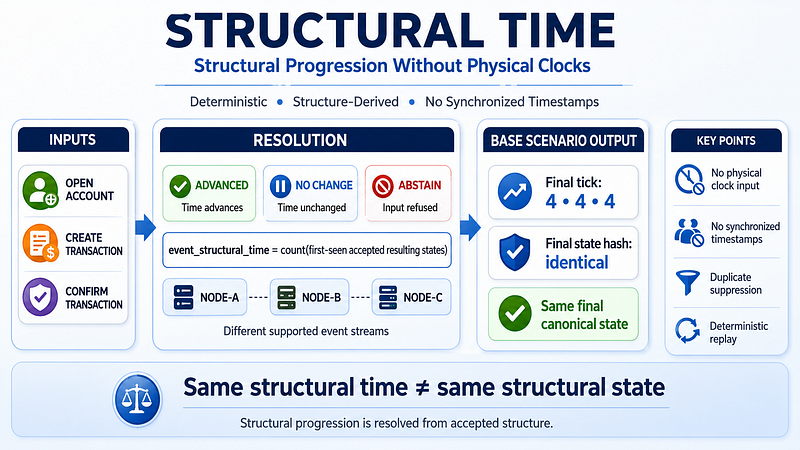
Structural Time resolves bounded progression from accepted structure. Equal structural time must remain separate from structural-state identity.
🧠 What Structural Time Is
Physical clocks measure physical or civil time.
Lamport clocks provide logical ordering compatible with causal precedence.
Vector clocks represent causal history and identify concurrency.
STIME serves a different purpose.
It resolves a bounded structural-progress value from:
- declared structural input
- explicit transition or acceptance rules
- deterministic normalization or canonicalization
- versioned implementation behaviour
The general idea is:
structural_time = resolve(declared_structural_input, frozen_rules)
The result is not a measurement of seconds, dates, duration, or latency.
It is a representation of accepted structural progression.
⚠️ What STIME Does Not Replace
STIME is not a replacement for:
- wall clocks
- physical timestamps
- calendars
- duration measurement
- deadlines
- scheduling systems
- causal ordering
- concurrency detection
- consensus protocols
- communication infrastructure
- authentication or authorization
STIME does not answer:
When did this occur in physical time?
It asks:
What structural progression has been accepted under the declared rules?
These questions are complementary, not interchangeable.
⚡ The Structural Shift
Many systems treat time or arrival sequence as a governing authority.
A state may appear valid because:
- it arrived first
- it carries an earlier timestamp
- it appears later in a log
- a synchronized service assigned it a position
STIME explores another possibility:
Arrival time and arrival order need not always determine structural progress.
Instead of asking only:
What arrived first?
the system can ask:
Is this transition structurally admissible now?
If the transition is valid and changes the declared state, progression may advance.
If it is already represented, progression does not advance.
If it is invalid, premature, unknown, or incompatible, the system abstains.
⚙️ Two Related Reference Models
The STIME repository contains two related models.
They share a structure-first discipline, but they do not use one identical counting rule.
1. Event-Based Structural Time
The event-based model processes declared events against a structural state.
Its core identity is:
event_structural_time = count(first-seen accepted resulting structural states)
A raw event is not automatically counted.
The event must first satisfy the active transition rules.
2. Normalized-Structure Structural Time
The normalized-structure model:
- removes duplicates
- sorts signals into canonical form
- checks declared conflict pairs
- derives accepted normalized structure
- calculates a structural-time value
Its core identity is:
normalized_structural_time = count(accepted normalized structure)
If the normalized input contains a declared conflict:
state = ABSTAIN
normalized_structural_time = 0
The two models should therefore be understood separately.
⚖️ The Three Resolution States
ADVANCED
An accepted transition changes the declared structural state.
accepted state-changing transition -> ADVANCED
In the event-based reference, the local tick advances when the resulting accepted state has not already been counted by that node.
NO_CHANGE
The supplied input is already represented or produces no new accepted structure.
duplicate or already represented input -> NO_CHANGE
The structural state and structural-time value remain unchanged.
ABSTAIN
The supplied input does not satisfy the active rules.
invalid or premature input -> ABSTAIN
The model does not manufacture progression from insufficient or incompatible structure.
🔬 The Event-Based Reference Scenario
The reference demonstration creates three independent nodes:
- Node-A
- Node-B
- Node-C
Each begins with:
- no accounts
- no pending transactions
- no confirmed transactions
- structural-time tick
0
The target structure contains:
- account A
- account B
- one transaction from A to B
- confirmation of that transaction
However, the nodes do not receive identical operational streams.
Some streams contain:
- different supported arrival orders
- premature attempts
- later retries
No shared physical clock is used.
No synchronized timestamp is used.
No central structural-time counter is used.
🧭 Node-A
Node-A processes the direct valid sequence:
- open account A
- open account B
- create transaction
- confirm transaction
All four transitions are accepted.
Final structural-time tick:
4
🧭 Node-B
Node-B opens the accounts in a different order.
It then attempts to confirm the transaction before the transaction exists.
The early confirmation returns:
ABSTAIN
After the transaction is validly created, confirmation is attempted again and accepted.
Final structural-time tick:
4
🧭 Node-C
Node-C attempts to create the transaction before the required accounts exist.
The early transaction attempt returns:
ABSTAIN
The node then opens both accounts, retries the transaction, and confirms it.
Final structural-time tick:
4
✅ Base-Scenario Result
The supplied base scenario finishes with:
tick_A = tick_B = tick_C = 4
The nodes also reach the same final canonical structural state.
Their shortened state hashes match as compact evidence that the canonical states match in the supplied demonstration. Direct canonical-state comparison remains the stronger identity check.
The important conclusion is bounded:
Different supported event streams can reach equal structural-time values and the same final canonical state without using physical clock input or synchronized timestamps in the structural-time calculation.
This does not mean that every possible event permutation will converge.
Premature events may require retry.
Missing events may prevent convergence.
Different accepted claims may produce different final states.
⚠️ The Most Important Distinction
Equal structural-time values do not prove equal structural states.
same structural time != same structural state
Two nodes may each record four accepted structural changes while accepting different content.
For example:
- Node-A accepts a transaction amount of
100 - Node-B accepts a transaction amount of
200 - both nodes perform four accepted transitions
Their structural-time values may both equal 4.
Their final states are still different.
Therefore, a complete comparison may require both:
structural_time_A = structural_time_B
and:
canonical_state_A = canonical_state_B
The interactive conflict scenario demonstrates exactly this separation:
structural_time_equal = Yes
structural_state_equal = No
Structural time is a progress value.
It is not a globally unique state identifier.
🔁 The Normalized-Structure Reference
The second reference model works with structural signals rather than account transitions.
Suppose three nodes contribute:
fevercoughfatigue
After set merge, deduplication, and sorting, the normalized structure becomes:
["cough", "fatigue", "fever"]
The accepted normalized structure contains three elements.
Therefore:
normalized_structural_time = 3
If the same signals are distributed differently across nodes, normalization still produces the same canonical structure.
Under the same rules and implementation version:
same accepted normalized structure -> same normalized structural time
🛡 Visible Conflict Instead of Forced Agreement
Now consider:
["fatigue", "no_fatigue"]
These two signals form a declared conflict pair.
The model does not select one claim merely because it arrived first or last.
It returns:
state = ABSTAIN
accepted_structure = []
normalized_structural_time = 0
This is not proof that the model knows the real-world truth.
It means only that the declared structure is incompatible under the active rules.
STIME enforces declared structural discipline.
It does not independently prove:
- authenticity
- authorization
- legal validity
- factual truth
- absence of fraud
- correctness of the rules themselves
🔁 Deterministic Replay
Deterministic replay requires more than vaguely similar input.
For the event-based model, reproducibility depends on:
- the same ordered event stream
- the same initial canonical state
- the same initial tick
- the same previously counted-state history
- the same transition rules
- the same canonicalization
- the same implementation version
For the normalized-structure model, reproducibility depends on:
- the same normalized input structure
- the same conflict rules
- the same acceptance rules
- the same certificate construction
- the same implementation version
Under these conditions:
same relevant input + same initial state + same frozen rules + same implementation version -> same supported resolution
For normalized certificates:
same normalized input structure + same rules + same implementation version -> same certificate
Rule changes may change the result.
Implementation changes may change serialization or certificate output.
Versioning is therefore part of reproducible structural resolution.
🧮 Bounded Order Independence
STIME should not be described as universally order-free.
The normalized model uses set union, deduplication, and sorting.
For supported signal groups:
A union B = B union A
(A union B) union C = A union (B union C)
A union A = A
This supports permutation independence for that declared normalization model.
The event-based model is different.
Order may affect:
- whether an event is premature
- whether it is retried
- which intermediate states are accepted
- the number of counted states
- the final state
The supplied event streams demonstrate supported order tolerance, not universal order independence.
The accurate statement is:
Arrival order need not serve as the sole governing authority over structural progression when the relevant structure, retry behaviour, and acceptance rules support resolution.
🌐 Offline Processing and Communication
Local structural resolution can operate offline.
The supplied demonstrations do not need:
- a live clock service
- NTP synchronization
- GPS time
- a cloud database
- continuous internet access
However, STIME does not create agreement without information.
Cross-node convergence may still require:
- communication
- event transfer
- shared storage
- delayed synchronization
- retry of premature events
- reconciliation
- eventual availability of relevant structure
The distinction is important:
local resolution without synchronized clocks != global agreement without information
📊 Comparison with Other Time Models
Model            | Primary Purpose                              | Physical Time | Causal Ordering             | Concurrency Detection | Structural Acceptance
-----------------|----------------------------------------------|---------------|-----------------------------|-----------------------|----------------------
Physical clocks  | Measure physical or civil time               | Yes           | Not guaranteed              | No                    | External to clock
Lamport clocks   | Logical ordering compatible with causality   | No            | Happened-before compatible  | No                    | External to clock
Vector clocks    | Represent causal history                     | No            | Causal partial order        | Yes                   | External to clock
STIME            | Resolve bounded structural progression       | No            | Not provided                | No                    | Explicit
The systems are not direct substitutes.
Physical clocks measure time.
Lamport clocks order events.
Vector clocks represent causal history.
STIME resolves bounded structural progression from accepted structure.
🧱 Minimal Structural Pattern
A bounded integration may follow:
declared input -> normalize or transition -> validate -> resolve -> evidence
For the event-based model:
event + current state + frozen rules -> ADVANCED | NO_CHANGE | ABSTAIN
For the normalized model:
normalized structure + conflict rules -> accepted structure | ABSTAIN
STIME can therefore be explored as a component beside existing infrastructure rather than as a forced replacement for it.
🌍 Potential Research Directions
STIME may be explored in bounded roles such as:
- deterministic validation
- replay verification
- audit evidence
- offline processing
- distributed reconciliation
- financial-state experiments
- edge-system processing
- AI signal normalization
- workflow maturity tracking
- state-transition certification
These are research and implementation directions.
They are not claims of production suitability or superiority.
A real deployment would still require domain-specific analysis.
🚧 From Reference Implementation to Deployment Grade
A civilization-grade system cannot be established by a demonstration alone.
A serious deployment path would require:
- a normative specification
- formal state and transition definitions
- machine-readable rule schemas
- versioned canonical serialization
- formal invariant verification
- property-based and adversarial testing
- crash and recovery analysis
- persistent-state guarantees
- authentication and authorization
- provenance verification
- malicious-input resistance
- consensus integration where required
- interoperability standards
- domain-specific safety review
- independent implementation
- external replication
- security audit
- failure-mode analysis
- operational monitoring
- governance for rule evolution
The present repository is a bounded reference implementation and research foundation.
It does not claim that these deployment requirements have already been completed.
⚠️ What the Repository Demonstrates
Within the supplied rules, scenarios, and implementation version, STIME demonstrates:
- structural progression without physical clock input
- no synchronized timestamp requirement for the calculation
- deterministic transition evaluation
- explicit
ADVANCED,NO_CHANGE, andABSTAINstates - duplicate suppression
- refusal of invalid or premature input
- monotonic event-based ticks
- supported event-order tolerance
- deterministic normalization
- permutation independence in the declared set-based model
- deterministic normalized certificates
- visible conflict
- no forced state convergence
- separate verification of structural-time equality and structural-state identity
🚫 What the Repository Does Not Demonstrate
It does not establish:
- universal order independence
- universal distributed convergence
- consensus
- causal ordering
- concurrency detection
- physical-time replacement
- scheduling correctness
- latency guarantees
- crash-safe persistence
- network-protocol correctness
- malicious-input resistance
- arbitrary rule correctness
- real-world truth
- production certification
- safety-critical suitability
💡 The Deeper Insight
Traditional systems often ask:
What time did this occur?
STIME introduces an additional question:
Has the declared structure changed in a way that the active rules accept as structural progression?
The first question concerns physical or logical chronology.
The second concerns structural admissibility.
STIME does not make chronology unnecessary.
It demonstrates that chronology need not always be the sole authority over progress.
⭐ One-Line Summary
Structural Time (STIME) is a bounded structural-progression model that derives structural-time values from declared input and explicit acceptance rules without using physical clock input or synchronized timestamps, while keeping structural-time equality separate from structural-state identity.
🔗 GitHub Repository
The GitHub repository includes the event-based and normalized-structure Python references, an interactive browser demonstration, supporting documentation, verification guidance, and frozen-hash materials.
See the repository for the latest implementation, project scope, test instructions, verification resources, and license terms.
✍️ Authorship and Disclaimer
Created by the authors of the Shunyaya Framework.
STIME is a deterministic structural research demonstration.
It is not intended for safety-critical, financial, legal, medical, infrastructure, or production deployment without independent validation, domain-specific controls, security analysis, and appropriate professional review.
⚡ Final Reflection
The supplied nodes do not calculate structural time from seconds.
They do not consult synchronized timestamps.
They do not depend on a shared physical clock.
They resolve progression from accepted structural outcomes.
In the base scenario:
equal structural-time counts + equal final canonical states
In the conflict scenario:
equal structural-time counts + unequal final canonical states
That distinction is the heart of STIME.
Structural progress can be resolved without measuring elapsed time.
But structural-time equality must never be mistaken for independently verified truth, causal order, or final structural-state identity.


Comments
Post a Comment