⚡ What If Transaction Evidence Could Arrive in Any Order Without the Arrival Order Deciding the Result?
Deterministic Ledger Reconciliation from Partial Evidence
A transaction is not always observed all at once.
One system may first see a debit.
Another may first see a credit.
A third may temporarily see only part of the transaction.
Later, the evidence may be combined.
The usual operational questions are important:
What arrived first?
When did it arrive?
Which node received it?
What does the log say?
But Orderless Ledger (ORL) asks a narrower structural question:
Once the relevant evidence is present, does its arrival chronology still need to decide what that evidence means?
ORL explores a bounded answer:
Validate the evidence. Canonicalize it. Resolve the structure. Keep uncertainty explicit.
The core relation is:
same validated canonical evidence + same rules -> same structural resolution
For the complete bounded result, declared closure context also matters:
same validated canonical fragment set + same ruleset + same declared boundary context -> same bounded resolution bundle
The principle is simple:
Evidence may arrive in different orders. Arrival order does not have to become resolution authority.
💡 Different Evidence Can Produce Different Results
Imagine three systems observing the same broader activity.
One currently has:
debit(Alice, 500)
Another has:
debit(Alice, 500) + credit(Bob, 500)
A third may have conflicting declarations.
ORL does not say that these systems must immediately agree.
Their evidence is different.
The rule is narrower:
different evidence -> equal results not required
But once two systems hold the same validated canonical evidence and apply the same rules:
same evidence + same rules -> same structural resolution
That is the central idea.
The system does not ask which fragment arrived first.
It asks:
What valid canonical evidence is present now?
🧠 Five Questions That Should Not Be Collapsed Into One
ORL separates questions that are often treated as though they were the same:
is the input valid?
what canonical evidence is present?
what does that evidence resolve to?
what projection follows from the resolved subset?
has the evidence satisfied an explicitly declared boundary?
These become separate state lanes:
validation_state = ACCEPTED | REFUSED
resolution_state = RESOLVED | INCOMPLETE | ABSTAIN
closure_state = OPEN | SEALED
The distinctions matter:
validation != resolution
resolution != closure
closure != authorization
projection != settlement
A transaction may be structurally resolved without being authorized.
A resolved transaction may exist inside an evidence set that is still open.
A structural projection is not a financial settlement.
ORL keeps those boundaries explicit.
🛑 Invalid Input Does Not Become Incomplete Evidence
Before ORL resolves anything, supported fragments must pass validation.
The current policy is:
any invalid fragment -> REFUSE_WHOLE_BATCH
A malformed fragment is not silently ignored.
It is also not converted into:
INCOMPLETE
The distinction is important.
INCOMPLETE means:
valid supported evidence is missing something required for structural resolution
It does not mean:
the input was malformed but the system decided to continue anyway
The current fragment contract checks declared fields, supported values, exact amount syntax, identifier boundaries, Unicode normalization requirements, and other bounded rules before resolution begins.
🔐 The Same Evidence Needs the Same Identity
Two systems cannot meaningfully compare evidence if one system interprets the same input differently from another.
ORL therefore converts supported evidence into a deterministic canonical form.
The current implementation uses:
- Unicode NFC normalization
- UTF-8 encoding
- explicit length-framed canonical records
- SHA-256 content identities
Conceptually:
fragment_id = SHA256(canonical_fragment)
fragment_set_id = SHA256(canonical_unique_fragment_set)
This lets the implementation distinguish between:
the order in which fragments were presented
and:
the canonical evidence set actually being resolved
These identities provide deterministic content identity within the declared ORL profiles.
They do not prove who created the evidence, whether it is authentic, or whether anyone is authorized to act on it.
🔁 An Exact Duplicate Should Not Become a New Conflict
Suppose the same fragment is received twice because of retry, synchronization, copying, or repeated submission.
Under the current ORL policy:
same canonical declaration repeated under the same tx -> exact duplicate
The duplicate is absorbed.
The implemented relation includes:
D(E union E) = D(E)
So repeating the same canonical fragment does not create a false multiplicity conflict.
But ORL does not assume that two genuinely separate real-world transfers are duplicates.
Under the current schema:
distinct real-world transfer -> distinct tx identifier
The distinction is structural, not guessed from external intention.
🧭 Three Explicit Resolution States
After validation, canonicalization, and exact duplicate absorption, ORL classifies supported transaction structure into three states.
✅ RESOLVED
The required supported structure is present and compatible.
For the current model:
compatible debit + compatible credit -> RESOLVED
⚠️ INCOMPLETE
Required supported structure is missing.
For example:
missing debit OR missing credit -> INCOMPLETE
ORL does not invent the missing fragment.
🛑 ABSTAIN
The current supported evidence contains a declared conflict or unsupported resolution shape.
Examples include:
amount mismatch -> ABSTAIN
unit mismatch -> ABSTAIN
multiple distinct debits -> ABSTAIN
multiple distinct credits -> ABSTAIN
unsupported self-transfer -> ABSTAIN
ORL does not silently select one incompatible alternative.
The goal is not to force every transaction into a successful state.
The goal is to make the current structural condition explicit.
📊 Only RESOLVED Structure Affects the Projection
The current rule is:
RESOLVED -> projection contribution
INCOMPLETE OR ABSTAIN -> no projection contribution
In the frozen reference scenario:
ORL100 -> RESOLVED
ORL200 -> RESOLVED
ORL300 -> INCOMPLETE
ORL400 -> ABSTAIN
ORL500 -> ABSTAIN
The state summary is:
R:2 I:1 A:2
The resulting structural projection is:
Alice = -500 UNIT
Bob = +200 UNIT
Dina = +300 UNIT
This is a deterministic structural projection over the current admitted evidence.
It is not payment execution.
It is not account posting.
It is not settlement.
It is not immutable financial finality.
📈 A Current RESOLVED State Is Not Permanent Truth
Evidence can change.
A transaction that is incomplete may later receive its missing counterpart:
INCOMPLETE -> RESOLVED
A transaction that currently appears compatible may later receive conflicting valid evidence:
RESOLVED -> ABSTAIN
Under the current append-only profile:
INCOMPLETE -> INCOMPLETE | RESOLVED | ABSTAIN
RESOLVED -> RESOLVED | ABSTAIN
ABSTAIN -> ABSTAIN
The important distinction is:
currently RESOLVED != permanently final
ORL therefore treats resolution as a result over the current validated evidence set.
It does not silently convert structural resolution into universal or immutable truth.
🔒 Resolution and Closure Are Different Questions
Suppose a transaction is structurally resolved.
That still does not answer:
Do we know that the exact evidence set we expected has been received?
ORL handles that through a separate bounded closure mechanism.
Without a declared boundary:
closure_state = OPEN
A declared boundary can specify the exact canonical fragment set expected.
Closure becomes:
SEALED
only when:
current canonical fragment IDs = declared expected fragment IDs
The meaning is deliberately narrow:
SEALED = declared exact boundary satisfied
not:
SEALED = proof that no other evidence exists anywhere
This allows ORL to represent bounded completion without claiming universal completeness.
🧾 Reproducible Receipts for Structural Results
Every transaction identifier that reaches structural classification can receive a deterministic receipt.
The receipt binds the current outcome to information such as:
- transaction evidence identity
- ruleset identity
- resolution state
- reason code
- resolved fields where applicable
- closure state
- boundary identity where applicable
A receipt can therefore answer:
What evidence and rules produced this structural result?
The current implementation also tests tamper rejection and different receipt identities when closure changes from open to sealed.
But a receipt does not establish:
receipt = authorization
or:
receipt = authenticity
or:
receipt = settlement
It is deterministic evidence of the declared structural computation.
🖼️ ORL Structural Overview Diagram
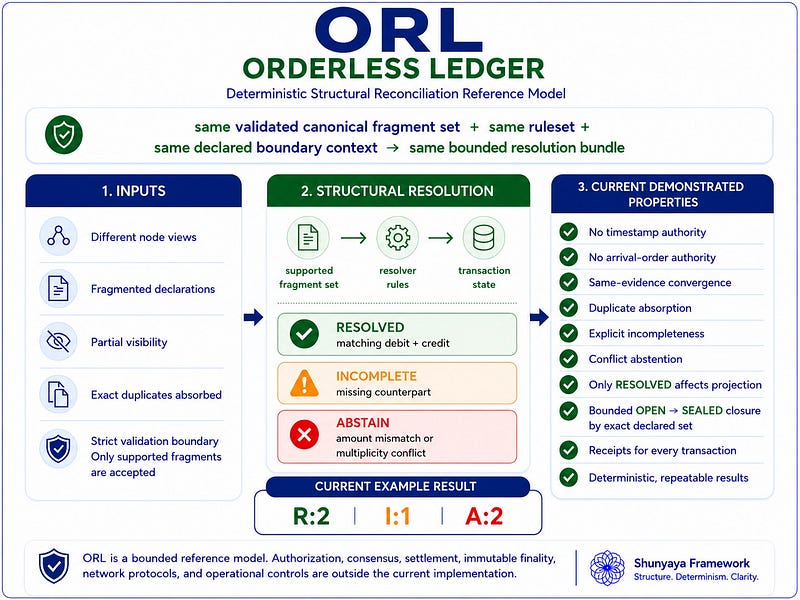
ORL separates input validation, canonical evidence identity, deterministic transaction resolution, resolved-only structural projection, bounded closure, and reproducible receipts. Timestamps and fragment arrival order are not inputs to the current structural classification rules.
🔀 What “Orderless” Actually Means
The name Orderless Ledger does not mean that all operational order disappears.
Systems may still need:
- ordered transport
- logs
- queues
- sequence numbers
- timestamps
- replay histories
- monitoring
- operational coordination
ORL’s claim is narrower.
For a validated supported fragment collection E, a permutation P(E), and the same ruleset:
R(P(E)) = R(E)
when the declared comparison context is unchanged.
The committed audit checks all:
5! = 120
permutations of the frozen five-fragment conformance vector.
All tested permutations reproduce the same bounded result.
This demonstrates an implemented invariant for the declared profile and corpus.
It is not a theorem that every ledger problem is order-independent.
The architectural point is:
operational sequence != structural resolution authority
🌐 Different Nodes Can Begin Differently
The ORL reference demonstration begins with three nodes holding different local evidence.
At that point:
different evidence may legitimately produce different results
The nodes are then given the same deduplicated canonical evidence.
With the same rules and no declared boundary:
same canonical evidence + same ruleset + same no-boundary context -> same open bundle
When the same exact boundary is declared and satisfied:
same canonical evidence + same ruleset + same satisfied boundary -> same sealed bundle
The demonstration does not prove that nodes magically converge while permanently holding different evidence.
The evidence must become the same before equality is expected.
The sharing mechanism is also only a demonstration harness.
It is not:
- consensus
- reliable broadcast
- Byzantine agreement
- leader election
- network finality
- settlement
⏱️ No Time as Resolution Authority
The current ORL resolver does not use:
- timestamps
- synchronized clocks
- wall-clock time
- GPS time
- NTP state
That does not mean real systems never need time.
Time may still be essential for:
- transport
- monitoring
- audit history
- legal records
- operations
- external policy
The narrower claim is:
clock metadata is not used by the current resolver to decide the structural classification.
🧭 No Coordinator State as Resolution Authority
ORL also does not accept:
coordinator says RESOLVED
as the authority that determines the transaction state.
The result is reconstructed from the current validated canonical evidence and the declared rules.
A coordinator could still distribute evidence.
A network could still synchronize data.
An application could still manage storage and transport.
Those mechanisms may help assemble the evidence.
They do not become the structural classification rule.
🧪 A Laboratory for Breaking the Assumptions
The browser reference implementation includes an interactive Structural Laboratory.
You can:
Shuffle Evidence
The presentation order changes while the canonical result remains stable when evidence, rules, and closure context are unchanged.
Add Exact Duplicate
The raw input count changes while the canonical unique evidence set remains the same.
Complete an Incomplete Transaction
INCOMPLETE -> RESOLVED
Add a Conflict to a Resolved Transaction
RESOLVED -> ABSTAIN
Add More Evidence After Conflict
ABSTAIN -> ABSTAIN
under the current append-only profile.
Inject Malformed Input
invalid fragment -> REFUSED
Declare the Current Exact Boundary
OPEN -> SEALED
These experiments make an important distinction visible:
some changes should preserve the result
while:
other changes should legitimately change the result
Determinism does not mean:
everything always stays the same
It means:
the same declared structure under the same rules produces the same declared result.
🔄 Two Reference Implementations, One Frozen Contract
ORL v2.0.0 includes:
- a Python reference kernel
- a standalone browser Structural Laboratory
Both implement the same declared structural profiles.
The browser audit checks six frozen identities against the Python reference outputs.
Current result:
CROSS_ENGINE_FROZEN 6/6 PASS
This demonstrates frozen cross-engine agreement between the two committed reference implementations.
It is not presented as independent third-party verification.
🧪 Current Reference Status
The current public release is ORL v2.0.0.
Published verification includes:
Python audit: 272/272 PASS
Browser audit: 286/286 PASS
Permutation invariant: 120/120 PASS
Exhaustive evidence-growth checks: 65/65 PASS
Interactive browser flows: 8/8 PASS
Frozen Python/browser identity checks: 6/6 PASS
The repository also includes a passing GitHub Actions verification workflow.
These results establish that the committed implementations satisfy the declared tests and frozen reference expectations.
They do not establish:
- universal ledger correctness
- production readiness
- financial legitimacy
- authorization
- settlement
- consensus
- third-party certification
⚖️ What ORL Does — and Does Not — Claim
ORL is a bounded structural-reconciliation reference implementation.
It demonstrates a model in which supported evidence can be:
validated
canonically identified
deduplicated
deterministically classified
projected when resolved
bound to reproducible receipts
and:
optionally evaluated against a declared exact closure boundary
ORL does not establish:
- source authenticity
- cryptographic signatures or authorization
- user identity
- account ownership
- available funds
- fraud prevention
- general double-spend prevention
- consensus
- Byzantine fault tolerance
- reliable broadcast
- payment execution
- settlement
- custody
- regulatory compliance
- universal evidence completeness
- immutable external finality
- universal order independence
The question ORL explores is much narrower:
Which bounded reconciliation decisions truly require arrival sequence as authority, and which can instead be reconstructed from validated canonical evidence?
🌱 A Core for Different Structural Domains
ORL is intentionally small.
Related ORL-family systems can define their own domain rules.
Examples include:
ORL-Money
Financial reconciliation with its own supported money semantics and initial-state requirements.
ORL-Chat
Bounded conversation-state resolution from supported message fragments and declared relationships.
ORL-AI
Bounded deterministic decision-state resolution from normalized supported signals, explicit conflict pairs, and decision rules.
The reusable principle is:
shared structural discipline != shared domain authority
A domain may reuse the structural approach without inheriting claims that belong to a different domain.
🌍 Why This Could Matter
Many systems receive information gradually.
Data may be:
- duplicated
- delayed
- reordered
- partially visible
- collected through different paths
Operational chronology is often valuable.
Sometimes it is essential.
But ORL asks whether chronology should also become the authority that determines every bounded structural result.
The alternative explored here is:
Let transport collect the evidence.
Let validation determine what may enter the resolver.
Let canonical structure determine what evidence is actually present.
Let explicit rules determine the current structural state.
Let closure remain a separate question.
And let authorization and execution remain outside the resolver.
🌐 Explore ORL
The ORL repository contains the Python reference kernel, standalone browser Structural Laboratory, architecture documentation, Quickstart, FAQ, test guide, verification material, frozen artifact identities, and the structural overview diagram.
🌌 The Larger Question
The usual question is:
What happened first?
ORL asks another:
What validated canonical evidence is present now, and what does the declared ruleset allow us to resolve from it?
Those are not the same question.
Sequence may still matter operationally.
Time may still matter externally.
Coordination may still be necessary to exchange evidence.
But none of those facts automatically prove that fragment arrival chronology must govern every bounded reconciliation result.
That is the research direction behind ORL:
collection != validation != resolution != closure != authorization != execution
Keep those questions separate.
Then ask which one genuinely needs order as authority.
✍️ Authorship & Disclaimer
Created by the authors of the Shunyaya Framework.
ORL is a bounded deterministic structural-reconciliation reference architecture and implementation.
It is not a banking, payment, accounting, custody, consensus, settlement, authentication, fraud-prevention, or production financial system.
High-risk, financial, regulated, or production use requires independent verification, domain-specific validation, appropriate authentication and authorization controls, operational safeguards, and compliance with applicable requirements.
⭐ The Idea in Simple Terms
ORL validates and organizes supported transaction evidence before resolving it into RESOLVED, INCOMPLETE, or ABSTAIN.
Within the declared model, fragment arrival order and clock metadata do not decide the structural result.
The same validated canonical evidence, evaluated under the same rules, produces the same structural resolution.
OMP


Comments
Post a Comment