⚡ What If Financial Fragments Arrived in Different Orders Without the Arrival Order Deciding the Result?
A financial transaction does not always appear to every system as one complete event.
One system may observe a debit.
Another may observe a credit.
The same financial claim may be observed more than once.
Some evidence may still be missing.
Some evidence may conflict.
And even when the transaction structure itself is complete, the supplied starting balance may raise a separate question.
Should the order in which all of that evidence happened to arrive decide the result?
ORL-Money explores a different approach.
It asks whether validated financial observations can be transformed into canonical money claims and resolved deterministically from the structure currently present — without silently making timestamps or arrival order the authority that decides the financial result.
The current governing relation is:
same validated balance basis + same canonical money claim set + same ruleset + same compatibility profile + same boundary declaration -> same bounded financial resolution
The idea is not that every system always sees the same evidence.
It is simpler:
When the validated financial structure becomes the same, and the governing rules and boundary context are the same, the bounded financial resolution becomes the same.
💡 The Central Idea
Most financial systems naturally involve sequence.
Transactions may be submitted at different times.
Messages may travel through different routes.
Logs may record different arrival histories.
Systems may synchronize at different speeds.
ORL-Money does not claim that ordering, timestamps, execution sequence, or settlement chronology are unnecessary in real financial systems.
It asks a narrower question:
Which parts of financial reconciliation actually need arrival order to be the authority over the result?
For the current bounded model, ORL-Money separates:
observation != financial claim
transaction resolution != declared balance compatibility
resolution != evidence-boundary closure
financial reconciliation != authorization
financial reconciliation != execution
financial reconciliation != settlement
That separation is the foundation of the architecture.
⚡ Try ORL-Money Live
Explore the interactive ORL-Money Structural Lab in your browser:
🧾 An Observation Is Not Automatically a New Financial Claim
Imagine that two systems both report the same underlying transfer.
Should that automatically count as two financial movements?
ORL-Money says no.
The current model separates the financial claim itself from the observation of that claim.
A canonical financial claim represents the supported money declaration.
An observation can additionally preserve information such as its source and observation reference.
This gives the relation:
observation multiplicity != financial multiplicity
Multiple observations may therefore refer to the same underlying canonical financial claim.
The observations remain visible as provenance.
But the financial resolver operates over the unique canonical claim set.
In the supplied two-node reference scenario:
10 unique observations
correspond to:
9 unique financial claims
because one additional observation refers to a claim that has already been observed.
This distinction helps prevent repeated evidence from silently becoming repeated money movement.
🧩 What Does a Financial Claim Contain?
The current supported money structure includes fields such as:
- transaction identifier
- debit or credit side
- account
- exact amount
- unit
A simplified example might describe:
M100 -> debit VillageA 500 UNIT
and another claim:
M100 -> credit VillageB 500 UNIT
The resolver groups canonical claims by transaction identifier and evaluates the structure currently available.
The current transaction states are:
RESOLVED
INCOMPLETE
ABSTAIN
🧭 Three Explicit Transaction States
RESOLVED
A transaction becomes RESOLVED when exactly one debit claim and one credit claim are present with matching amount and unit.
For example:
debit VillageA 500 UNIT + credit VillageB 500 UNIT -> RESOLVED
The current reason is:
MATCHED_DEBIT_CREDIT_PAIR
INCOMPLETE
A transaction remains INCOMPLETE when required structure is missing.
For example:
debit VillageA 500 UNIT only -> INCOMPLETE
The resolver does not invent the missing credit.
Possible reasons include:
MISSING_DEBIT_CLAIM
MISSING_CREDIT_CLAIM
ABSTAIN
A transaction becomes ABSTAIN when the supplied canonical structure conflicts under the current rules.
Examples include:
debit 500 + credit 700 -> ABSTAIN
or:
multiple incompatible debit or credit claims -> ABSTAIN
Possible reasons include:
MULTIPLE_DEBIT_AND_CREDIT_CLAIMS
MULTIPLE_DEBIT_CLAIMS
MULTIPLE_CREDIT_CLAIMS
UNIT_MISMATCH
AMOUNT_MISMATCH
The resolver does not silently choose whichever conflicting claim appeared first.
The principle is simple:
Missing structure remains incomplete. Conflicting structure remains explicit.
💰 Exact Money Without Binary Floating-Point Arithmetic
Financial arithmetic should not quietly change because of floating-point representation.
ORL-Money therefore represents supported transaction amounts as canonical decimal integer strings using:
amount_minor
Examples include:
"1"
"250"
"1000"
The Python reference implementation evaluates these values with exact integers.
The browser implementation uses BigInt.
Unsupported forms such as these are refused:
01
+1
-1
1.0
1e3
A transaction amount of:
0
is also refused under the current transaction grammar.
This keeps the declared reference money path outside binary floating-point arithmetic.
🧾 Every Result Carries a Structural Witness
ORL-Money does not stop at returning a state such as:
RESOLVED
or:
ABSTAIN
Each transaction result receives a deterministic receipt containing information such as:
- transaction identity
- participating claim identities
- transaction state
- deterministic reason code
- structural witness
- projection contributions when resolved
- deterministic receipt identity
A RESOLVED receipt can identify the matching debit and credit claims.
An INCOMPLETE receipt can identify what is present and what is missing.
An ABSTAIN receipt can identify the conflicting structure.
The result therefore carries a bounded explanation of why it exists.
📊 Only RESOLVED Transactions Affect the Structural Projection
Transaction classification and balance projection are separate stages.
Only:
RESOLVED
transactions contribute to the current projection.
For a resolved amount x:
debit contribution = -x
credit contribution = +x
For each account and unit:
final_amount_minor = initial_amount_minor + sum(resolved contribution deltas)
Transactions that remain:
INCOMPLETE
or:
ABSTAIN
produce no projection contribution.
This does not mean they were cancelled, reversed, legally rejected, or settled.
It means only that the current bounded structural projection does not apply them.
⚖️ A Transaction Can Be RESOLVED and Still Raise a Balance Conflict
This is one of the most important distinctions in the current ORL-Money architecture.
A transaction can be structurally complete while the supplied balance basis raises a separate compatibility issue.
The current compatibility rule is:
resolved_gross_outflow <= declared_initial_balance
Possible compatibility states are:
COMPATIBLE
CONFLICT
UNASSESSED
This means:
transaction resolution != declared balance compatibility
For example, two transactions may each contain complete matching debit and credit claims.
Both can therefore be structurally:
RESOLVED
But together, their resolved gross outflow may exceed the supplied declared starting balance.
The overall compatibility result can then be:
CONFLICT
ORL-Money does not respond by asking:
Which transaction arrived first?
It does not silently select an arrival-order winner.
The transaction structure remains resolved, while the balance incompatibility remains separately visible.
This compatibility check is also not a claim about actual available funds.
It is a bounded structural comparison against the supplied declared balance basis.
🔒 OPEN and SEALED Evidence Boundaries
ORL-Money also separates financial resolution from evidence-boundary closure.
The current boundary states are:
OPEN
SEALED
OPEN means the current evidence is being evaluated without declaring the current claim set sealed.
SEALED means the current observed claim set has been explicitly declared as the sealed claim set for that bounded evaluation.
But:
SEALED != settlement finality
SEALED != legal finality
SEALED != immutable global completeness
SEALED != proof that no evidence exists elsewhere
It is a structural boundary declaration — nothing more and nothing less.
🔀 What “Orderless” Means Here
ORL-Money does not claim that order is useless everywhere in finance.
Real financial systems may need ordering for:
- execution
- posting
- settlement
- history
- transport
- recovery
- auditing
- regulation
- legal records
The narrower question concerns resolution authority.
The current resolver examines the validated canonical financial structure supplied to it.
It does not classify a transaction by asking:
Which claim arrived first?
The underlying principle is:
arrival order != transaction-resolution authority
The current implementation tests more than simple list shuffling.
Its merge-algebra audit covers properties including:
- commutativity
- associativity
- idempotence
- permutation independence
- partition independence
- merge-tree independence
- origin neutrality for financial resolution
The current merge-algebra result is:
259/259 PASS
The bounded architectural idea is:
Equivalent canonical financial structure should not derive its resolution authority from the route by which observations happened to be combined.
⏱️ What “No Time Authority” Means
The current resolver does not use:
- timestamps
- GPS time
- NTP state
- wall-clock synchronization
as inputs to its transaction-resolution rules.
This does not mean that real financial systems no longer need time.
Time may remain essential for:
- monitoring
- operations
- contracts
- regulation
- settlement
- reconciliation windows
- investigation
- historical records
ORL-Money simply keeps those roles separate from the current bounded structural resolution.
time may remain operationally important
while:
time != current transaction-resolution authority
🌐 Different Systems Can Begin With Different Evidence
ORL-Money does not claim:
different evidence -> same result
Different evidence can legitimately produce different local results.
The stronger requirement appears only once the relevant bounded inputs become equal.
The governing relation is:
same validated balance basis + same canonical money claim set + same ruleset + same compatibility profile + same boundary declaration -> same bounded financial resolution
This is same-structure deterministic resolution.
It is not a claim that disagreement disappears while systems continue to hold materially different evidence.
🧪 Four Reference Scenarios
ORL-Money v2.1.0 includes four frozen reference scenarios.
1. Two-Node Reconciliation
Expected transaction states:
M100 -> RESOLVED
M200 -> INCOMPLETE
M300 -> INCOMPLETE
M400 -> ABSTAIN
M500 -> ABSTAIN
Summary:
R:1 I:2 A:2
Starting from:
VillageA|UNIT = 1000
VillageB|UNIT = 1000
the final structural projection is:
VillageA|UNIT = 500
VillageB|UNIT = 1500
Only M100 contributes to that projection.
2. Three-Node Reconstruction
The three-node scenario demonstrates different local evidence views becoming structurally equal after bounded evidence sharing.
Its final transaction states are:
M100 -> RESOLVED
M200 -> RESOLVED
M300 -> RESOLVED
M400 -> ABSTAIN
M500 -> ABSTAIN
The final projection is:
VillageA|UNIT = 650
VillageB|UNIT = 1300
VillageC|UNIT = 1050
The reconstruction progression is:
before_match = false
round_1_match = false
round_2_match = true
The scripted sharing is a demonstration mechanism.
It is not a consensus protocol, reliable-broadcast protocol, networking architecture, or settlement system.
3. Declared-Balance Conflict
The dedicated conflict scenario contains two structurally complete transactions:
T1 -> RESOLVED
T2 -> RESOLVED
But their combined resolved gross outflow exceeds the supplied declared starting balance.
The compatibility state becomes:
CONFLICT
The demonstrated deficit is:
40
No arrival-order winner is selected.
This scenario makes the distinction explicit:
transaction resolution != declared balance compatibility
4. Multi-Unit Isolation
The multi-unit scenario produces:
A|USD = 800
B|USD = 200
A|EUR = 450
C|EUR = 50
Unit-local conservation remains true for both:
USD = true
EUR = true
The demonstrated evidence boundary is:
SEALED
This shows that projections remain separated by account and unit rather than collapsing unlike units into one balance.
🖼️ ORL-Money Structural Overview
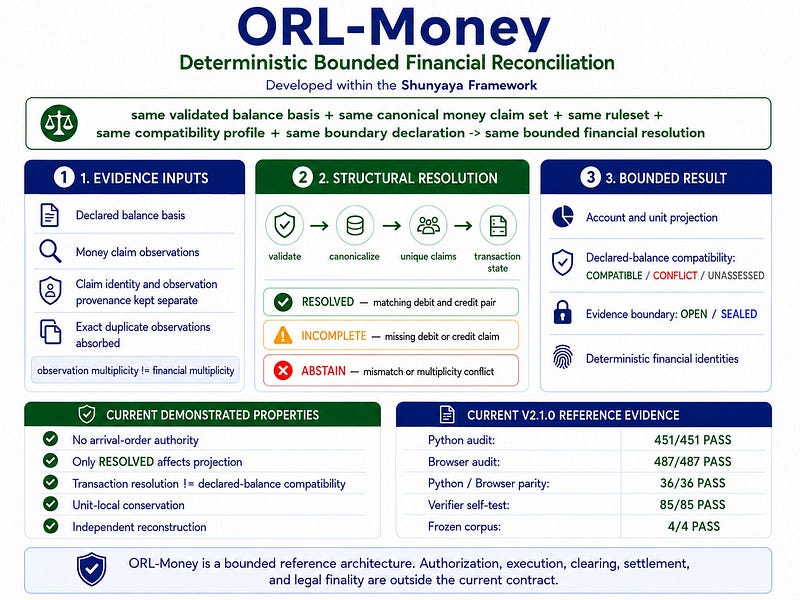
ORL-Money Structural Overview — validated financial observations become canonical money claims, deterministic transaction states, witness-carrying receipts, structural projections, declared-balance compatibility results, and bounded evidence-boundary states without making fragment arrival order the authority over the result.
🧮 Unit-Local Conservation
For each resolved matching pair with amount x:
debit contribution = -x
credit contribution = +x
Therefore:
(-x) + (+x) = 0
For each unit in the supplied scenarios, the current model checks:
initial_total_minor = final_total_minor
and:
net_delta_minor = 0
This is a useful structural property of the current resolved projections.
It is not a universal theorem proving money conservation, financial correctness, or economic validity.
🧬 Financial Structure and Provenance Get Different Identities
ORL-Money intentionally separates the resolved financial structure from the provenance of the observations that produced it.
Conceptually:
financial_resolution_id = H(financial structure)
The broader bundle identity additionally commits to observation provenance:
financial_bundle_id = H(financial_resolution_id + observation_set_id)
Therefore:
same canonical financial structure + different provenance -> same financial resolution identity may coexist with a different financial bundle identity
This distinction allows the financial result and the history of how that result was observed to remain separate.
🔍 Independent Reconstruction
ORL-Money v2.1.0 includes a separate Python verifier.
The verifier does not import the producer reference kernel.
Instead, it independently reconstructs the supplied financial bundle from the declared inputs and compares the reconstructed structure with the supplied result.
Its verification boundary includes:
- UTF-8 validation
- duplicate JSON key rejection
- bounded input size
- non-standard JSON constant refusal
- deterministic failure stages
- deterministic reason codes
- independent reconstruction
- optional exact canonical-byte checking
- complete frozen-corpus verification
This provides a separate reconstruction path.
But independent reconstruction still does not prove that the original observations are true, legitimate, authorized, or legally valid.
It verifies agreement with the declared bounded ORL-Money contract.
🧊 A Frozen Canonical Verification Corpus
The current release includes a frozen corpus containing all four reference scenarios:
- two-node reconciliation
- three-node reconstruction
- declared-balance conflict
- multi-unit isolation
The corpus is accompanied by a deterministic manifest recording important structural identities and bundle hashes.
The complete corpus passes verification:
4/4 PASS
It also passes strict canonical-byte verification.
This keeps two questions separate:
semantic reconstruction != exact canonical-byte identity
A bundle can be semantically reconstructed and compared independently.
Strict canonical verification separately checks whether the exact published canonical bytes are present.
✅ Current Verification Evidence
The current ORL-Money v2.1.0 reference release reports:
Python full audit: 451/451 PASS
Browser full audit: 487/487 PASS
Python / Browser parity: 36/36 PASS
Browser quick audit: 143/143 PASS
Independent verifier self-test: 85/85 PASS
Frozen corpus verification: 4/4 PASS
Strict canonical corpus verification: PASS
The repository’s automated verification workflow also checks the declared frozen artifact hashes, corpus JSON files, Python audit, independent verifier, frozen corpus, and browser implementation in headless Chromium.
These results establish agreement with the declared test and verification boundaries.
They do not establish universal financial correctness or production safety.
🧠 What ORL-Money Actually Demonstrates
Within the declared v2.1.0 reference contract, ORL-Money demonstrates several ideas together.
Deterministic Structural Resolution
The same validated financial structure under the same declared rules and context produces the same bounded resolution.
Observation and Claim Separation
Repeated observations do not automatically become repeated financial claims.
observation multiplicity != financial multiplicity
Explicit Incompleteness
Missing counterpart evidence is not guessed.
Explicit Abstention
Conflicting financial structure is not silently forced into a resolved state.
Witness-Carrying Results
Transaction states carry deterministic structural reasons.
Resolved-Only Projection
Only RESOLVED transactions affect the structural projection.
Separate Balance Compatibility
A structurally resolved transaction does not automatically imply compatibility with the supplied starting balance basis.
Explicit Evidence Boundaries
OPEN and SEALED remain separate from transaction resolution.
Merge and Arrival-Order Independence
The current bounded model tests that equivalent canonical structure does not derive its resolution authority from observation arrival order or merge path.
Independent Reconstruction
A separate verifier can reconstruct and compare the declared financial bundle without importing the producer implementation.
These are bounded reference-contract claims.
⚖️ What ORL-Money Does Not Claim
ORL-Money is not:
- a banking core
- a payment network
- a settlement system
- an authorization system
- an identity system
- an available-funds authority
- an account-ownership verifier
- a fraud-prevention system
- a consensus protocol
- a blockchain replacement claim
- a complete double-spend solution
- a production accounting platform
It does not by itself establish:
- source-data truth
- account ownership
- identity proof
- authorization
- actual available funds
- reservations or holds
- overdraft policy
- payment execution
- account posting
- clearing
- settlement
- legal finality
- fraud prevention
- complete double-spend prevention
- consensus
- Byzantine fault tolerance
- reliable broadcast
- regulatory compliance
- production security
- universal financial correctness
A structurally resolved result is not automatically an authorized or completed financial event.
🌱 How ORL-Money Relates to ORL
ORL-Money develops the broader Orderless Ledger direction for a bounded financial reconciliation domain.
The shared structural discipline includes ideas such as:
validate -> canonicalize -> identify -> resolve -> preserve incomplete structure -> abstain on conflict -> produce receipts
But the domain authority remains separate.
shared structural discipline != shared domain authority
ORL-Money defines its own financial schemas, compatibility rules, exact-money representation, identities, receipts, projections, verification boundary, and evidence-boundary semantics.
It does not simply inherit every assumption or claim from the ORL core.
🔬 Why This Direction May Matter
The interesting question is not:
Can all financial systems operate without clocks, ordered logs, networking, coordination, authorization, or settlement systems?
That would be far too broad.
The more useful question is:
Can some bounded reconciliation decisions be derived deterministically from validated financial structure rather than from the accidental order in which evidence happened to arrive?
That question may be relevant when exploring:
- delayed evidence synchronization
- disconnected systems
- multi-source reconciliation
- audit reconstruction
- discrepancy classification
- independently reproducible receipts
- deterministic node comparison
- pre-execution structural checks
Any real deployment would still require appropriate controls for identity, security, authorization, execution, accounting, networking, governance, compliance, and settlement.
🌐 Explore ORL-Money
The ORL-Money repository contains the current Python reference kernel, browser Structural Lab, independent verifier, frozen verification corpus, documentation, architecture material, checksum identities, and verification guidance.
ORL-Money:
https://github.com/OMPSHUNYAYA/ORL-Money
The repository remains the authoritative source for the current implementation and verification details.
🌌 The Larger Question
Financial systems often collapse many different questions into one apparent result:
What evidence is present?
Has the same claim been observed more than once?
Is the transaction structurally complete?
Does the supplied structure conflict?
What projection follows from resolved transactions?
Is that projection compatible with the declared starting balance?
Has the current evidence set been declared closed for this bounded evaluation?
Is anyone authorized to act?
Has money actually moved?
Has settlement completed?
ORL-Money keeps these questions separate.
observation != financial claim
resolution != balance compatibility
resolution != boundary closure
resolution != authorization
resolution != execution
resolution != settlement
That separation is central to understanding the project accurately.
✍️ Authorship & Disclaimer
ORL-Money is developed within the Shunyaya Framework.
It is a bounded reference architecture and implementation for deterministic financial reconciliation research.
It is not financial advice, a banking system, a payment system, or a production financial authority.
Real-world financial use would require appropriate independent evaluation and domain-specific controls beyond the current ORL-Money contract.
⭐ The Idea in Simple Terms
ORL-Money looks at the validated financial evidence currently available.
It separates repeated observations from unique financial claims.
It then classifies transaction structure as:
RESOLVED
INCOMPLETE
or:
ABSTAIN
Only resolved transactions contribute to the structural financial projection.
Declared-balance compatibility is checked separately.
Evidence boundaries remain separately OPEN or SEALED.
And when the validated balance basis, canonical claim set, governing rules, compatibility profile, and boundary declaration are the same, the bounded financial resolution is the same.
The arrival order of the evidence does not silently decide the result.
OMP


Comments
Post a Comment