🤖 What If AI Could Propose a Decision Without Automatically Deciding the Outcome?
Turning AI proposals into clear, reproducible decision states
🧠 ORL-AI
AI systems can suggest answers, recommend actions, compare options, and generate possible decisions.
But a useful proposal is not automatically an admitted decision.
A model may produce one recommendation. Another model may disagree. A review system may support part of the proposal. Required evidence may be missing. Several apparent sources may actually repeat the same underlying claim. A candidate may also be explicitly prohibited.
At that point, a more important question appears:
What should the system admit as the current bounded decision state?
Should the first proposal win?
Should the latest proposal replace everything that came before it?
Should the most repeated answer be treated as the strongest?
Should an AI-generated recommendation automatically become an instruction to act?
ORL-AI explores a different approach.
It evaluates AI-assisted proposals through declared evidence, boundaries, source-family controls, conflicts, prohibitions, and deterministic rules.
Its central separation is:
AI proposal != admitted decision
admitted decision != execution authority
When the admitted structure and governing rules are the same, the bounded result is the same:
same admitted canonical structure + same frozen profile + same ruleset + same text profile -> same bounded admission state
Timestamps and proposal-arrival order do not decide the outcome.
💡 The Central Idea
AI systems are often good at producing possibilities.
But producing a possibility and admitting a decision are different responsibilities.
An AI-assisted workflow may contain:
- one proposed candidate;
- several competing candidates;
- supporting observations;
- opposing observations;
- evidence references;
- repeated reports from the same source;
- declared source families;
- missing expected evidence;
- an open or sealed evidence boundary;
- active prohibitions.
ORL-AI turns this submitted structure into an explicit bounded state.
It does not ask:
Which proposal arrived first?
It asks:
What admitted evidence is present, which rules apply, and what state follows from that structure?
🗣️ A Simple Example
Imagine that an AI-assisted system is evaluating three possible actions:
- Candidate A
- Candidate B
- Candidate C
Several declared sources support Candidate A.
A model proposes it.
A separate review source supports it.
A rule-check source also supports it.
Each supporting observation points to declared evidence, and the expected evidence boundary is complete.
Under the current frozen profile, Candidate A may become:
RESOLVED
Now imagine that one required evidence item is missing.
The result may become:
INCOMPLETE
Imagine that another supported candidate also remains eligible.
The result may become:
ABSTAIN
Imagine that Candidate A is subject to an active prohibition.
The result becomes:
DENIED
Imagine that the submitted document contains unsupported fields, duplicate identifiers, caller-declared authority, or malformed references.
The input becomes:
REFUSED
ORL-AI does not silently force every situation into a positive decision.
🧭 Five Explicit Decision States
RESOLVED
Exactly one candidate satisfies the declared admission profile.
The required boundary is sealed, the necessary evidence is present, no blocking disagreement remains, and no active prohibition applies.
But:
RESOLVED != factually proven
RESOLVED != safe to execute
RESOLVED != legally authorized
A resolved result means that one candidate satisfies the declared structural contract.
INCOMPLETE
The submitted structure is valid, but something required for resolution is missing.
Examples include:
- an open evidence boundary;
- a missing observation;
- a missing evidence item;
- too few distinct supporting sources;
- insufficient source-family coverage;
- a missing required source class.
ORL-AI does not invent the missing evidence.
Missing structure remains visible as missing structure.
ABSTAIN
The admitted structure contains conflict or competition that prevents one candidate from being uniquely admitted.
Examples include:
- opposition to a supported candidate;
- competing partial support;
- multiple eligible candidates;
- one source supporting more than one candidate;
- the same source both supporting and opposing a candidate.
ORL-AI preserves the disagreement rather than selecting whichever proposal appeared first.
DENIED
A supported candidate is blocked by an active prohibition.
This is different from disagreement.
The candidate may have strong support and complete evidence, but the declared prohibition still prevents admission.
REFUSED
The submitted structure violates the supported intake contract.
Examples include:
- malformed JSON;
- duplicate JSON keys;
- floating-point values;
- unsupported fields;
- duplicate identifiers;
- undeclared references;
- caller-supplied authority;
- unsupported profiles;
- resource-limit violations.
A refusal means that the input was not admitted into the supported ORL-AI model.
🔀 Arrival Order Is Not Decision Authority
AI proposals still arrive in an order.
Systems still record timestamps.
Applications may still display a chronological history.
ORL-AI does not claim that time and sequence are unnecessary.
It makes a narrower distinction:
proposal arrival order != bounded decision authority
The resolver evaluates the admitted canonical structure rather than replaying proposals as a timeline and allowing the first or latest message to control the result.
Conceptually:
raw input -> strict intake -> canonical structure -> evidence admission -> boundary evaluation -> conflict and prohibition evaluation -> bounded state
Different systems may temporarily hold different evidence and therefore produce different local states.
ORL-AI does not claim:
different evidence -> same result
Its reproducibility claim begins when the admitted structure and governing profile are equal.
♻️ Repetition Is Not Independence
The same proposal may be repeated through several endpoints, agents, relays, or interfaces.
That repetition should not automatically create additional independent support.
ORL-AI therefore separates:
observation multiplicity != source authority
and:
declared source-family diversity != proven real-world independence
The current structure can distinguish declared source identifiers, source families, and source classes.
But it does not independently prove that the sources are genuinely separate, trustworthy, or free from common control.
Those questions remain the responsibility of surrounding systems.
🔒 Declared Evidence Boundaries
A decision can look complete while important expected evidence is still missing.
ORL-AI therefore evaluates an exact declared boundary.
A sealed boundary means that the expected observation and evidence identifiers match the submitted bounded set.
But:
sealed boundary != proof that no other evidence exists
sealed boundary != universal completeness
sealed boundary != legal finality
It means only that the declared evaluation boundary is complete for that bounded resolution.
🧾 A Result Should Carry Evidence
ORL-AI does not return only a label such as:
RESOLVED
It can also produce structured artifacts showing how the result was formed.
Private reconstruction bundle
The private bundle retains the admitted structural material needed to reconstruct and verify the result.
Public receipt
The public receipt exposes a reduced structural summary without directly publishing source identifiers, observation identifiers, or evidence identifiers.
Decision-Admission Capsule
A Decision-Admission Capsule provides a compact, privacy-reduced representation derived from a verified private bundle.
The architecture separates:
submitted structure
normalized projection
bounded witness
decision state
private bundle
public receipt
Decision-Admission Capsule
Every generated bundle, receipt, and capsule declares:
authority = NONE
A result can therefore be inspected and compared without pretending that it automatically authorizes action.
📦 Decision-Admission Capsules
A capsule carries the bounded structural result and its identity links without reproducing the full private input.
The basic relation is:
verified private bundle -> structural result + commitments + identity links -> capsule
Capsules can support bounded comparisons such as:
- identical results;
- equivalent resolutions;
- compatible outcomes;
- different states;
- different candidates;
- different structures;
- incomparable contexts;
- unsupported artifacts.
These are structural relations.
They are not universal claims about truth, legality, safety, chronology, or consensus.
🖼️ ORL-AI Structural Overview
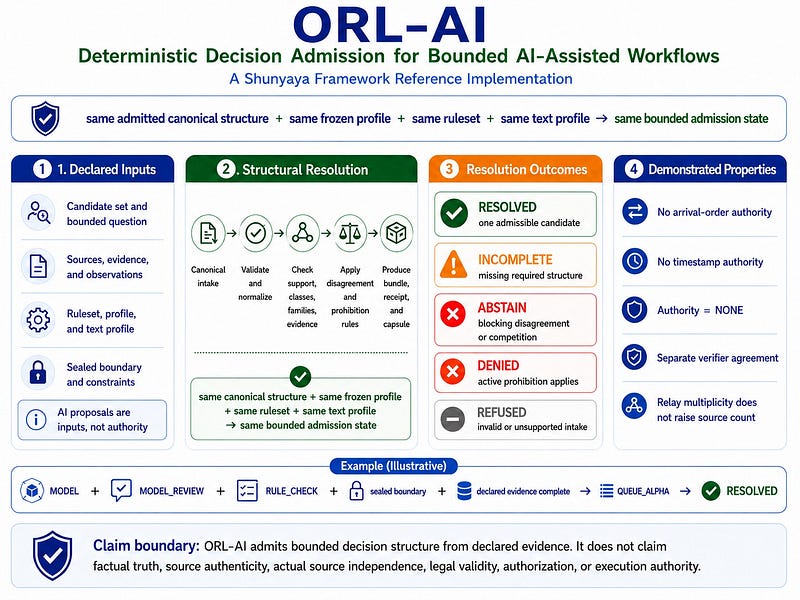
ORL-AI Structural Overview — bounded AI-assisted proposals pass through strict intake, canonical normalization, evidence and boundary checks, source-family controls, conflict and prohibition evaluation, and deterministic admission before becoming a private bundle, public receipt, or Decision-Admission Capsule.
🛡️ Strict Input Boundaries
Deterministic resolution begins before the decision rules are evaluated.
Two implementations may disagree if they admit different interpretations of the same input file.
ORL-AI therefore defines strict intake behavior across Python and JavaScript, including refusal of:
- duplicate JSON keys;
- floating-point and non-finite values;
- integers outside the supported exact range;
- malformed UTF-8;
- UTF-8 byte-order marks;
- trailing content;
- unpaired Unicode surrogates;
- unsupported fields;
- excessive resource use.
Text is preserved under a frozen exact Unicode scalar-sequence profile.
For example:
"café" != "cafe\u0301"
The two strings may appear similar, but their code-point sequences are different. ORL-AI does not silently normalize them into the same value.
🔍 More Than One Verification Path
ORL-AI v5.0.0 includes:
- a Python reference kernel;
- a separately implemented Python verifier;
- a separately implemented JavaScript resolver;
- a strict JavaScript JSON parser;
- a browser Structural Laboratory;
- frozen reference scenarios;
- cross-language parity vectors;
- seeded property testing;
- hostile-input fixtures;
- falsification fixtures;
- deterministic reproduction checks;
- state-precedence tests;
- Decision-Admission Capsule verification;
- automated GitHub Actions verification.
The independent Python verifier does not import the producer reference kernel.
The Python and JavaScript implementations are also checked against shared examples and edge cases.
This provides several ways to reconstruct and test the declared result.
✅ Current Verification Snapshot
The current v5.0.0 package reports:
26/26 PASS — Python reference-kernel tests
10/10 PASS — independent corpus reconstruction
19/19 PASS — strict JSON tests
11/11 PASS — raw-intake parity
10/10 PASS — JavaScript resolver cases
18/18 PASS — SHA-256 fallback checks
8/8 PASS — cross-language edge cases
10/10 PASS — deterministic regeneration cases
64/64 PASS — seeded property assertions
6/6 PASS — Decision-Admission Capsule tests
15/15 PASS — state-precedence scenarios
20/20 PASS — hostile-input checks
11/11 PASS — falsification checks
19/19 PASS — selected-file SHA-256 checks
The complete verification run ends with:
ORL-AI v5.0.0 functional verification: PASS
These are repository-bounded verification results.
They are not independent third-party certification, formal verification, security qualification, or proof of suitability for a real-world domain.
⚖️ What ORL-AI Does Not Claim
ORL-AI is not:
- a large language model;
- a model-training method;
- an unrestricted ranking engine;
- a truth detector;
- a source-authentication system;
- an evidence-authenticity system;
- a model-independence detector;
- a consensus protocol;
- an identity or permission system;
- an action executor;
- a safety guarantee.
It does not independently establish:
- factual truth;
- source authenticity;
- actual source independence;
- evidence authenticity;
- legal validity;
- authorization;
- execution authority;
- safety or suitability;
- completeness beyond the declared boundary.
The governing authority remains:
authority = NONE
🌱 Why This Direction May Matter
Many AI-assisted systems combine several different questions into one apparent answer:
What did the AI propose?
What evidence supports it?
Are the sources actually distinct?
Is anything missing?
Is there a competing proposal?
Is there opposition?
Is the candidate prohibited?
Has the declared evidence boundary been completed?
Is the result authorized for execution?
ORL-AI keeps these questions separate.
proposal != evidence
evidence != truth
repetition != independence
resolution != authorization
resolution != execution
That separation may be useful in areas such as:
- human and AI collaboration;
- multi-model review;
- structured recommendation systems;
- disconnected or delayed evidence exchange;
- auditable decision support;
- deterministic reconciliation between systems;
- privacy-reduced result sharing;
- portable decision receipts;
- bounded comparison of AI-assisted outcomes.
Any real deployment would still require appropriate controls for identity, authentication, evidence quality, domain validation, governance, permissions, security, and execution.
🌐 Explore ORL-AI
The ORL-AI repository contains the current reference implementations, browser Structural Laboratory, frozen corpora, public examples, verification tools, hostile-input fixtures, falsification cases, Decision-Admission Capsules, documentation, reports, and SHA-256 evidence.
🔗 Explore the ORL-AI GitHub repository
The repository remains the authoritative source for the current implementation, verification procedures, limitations, and license terms.
✍️ Authorship and Disclaimer
ORL-AI is developed within the Shunyaya Framework.
It is a bounded deterministic decision-admission reference architecture for AI-assisted workflows.
It is not a truth, identity, legal, safety, authorization, consensus, or execution authority.
The reference implementation and associated verification artifacts may be used, copied, modified, tested, studied, and redistributed without a license fee, subject to the repository license terms.
Documentation, architecture materials, specifications, diagrams, and explanatory content are governed by the separate terms stated in the repository LICENSE.
⭐ The Idea in Simple Terms
AI can propose.
ORL-AI checks whether the declared structure supports admitting that proposal.
The result becomes one of five explicit states:
RESOLVED
INCOMPLETE
ABSTAIN
DENIED
or:
REFUSED
It does not let timestamps, proposal order, repetition, or unrestricted model output silently decide the result.
And even when one candidate becomes RESOLVED:
admitted decision != execution authority
AI may propose. Declared structure decides what is admitted. Authority to act remains elsewhere.
OMP


Comments
Post a Comment